The word hibiscus refers to a beautiful flowering plant known for its large, colorful blooms. But what happens when you’re talking about more than one? Should you write hibiscuses or hibisci? If you’ve ever paused while writing this word, you’re not alone.
The plural of hibiscus is usually hibiscuses, although hibisci is also used in some contexts. I’ll help you understand both forms so you can choose the correct plural confidently in everyday writing.
In this guide, you’ll learn the plural forms of hibiscus, their meanings, pronunciation, and practical examples. Whether you’re writing about flowers, gardening, or simply improving your English vocabulary, you’ll find everything you need to use this word correctly.
Quick Answer: What Is the Plural of Hibiscus?
There are two widely recognized plural forms:
- Hibiscus: The same spelling as the singular.
- Hibiscuses: The regular English plural form.
For example:
- Singular: A red hibiscus grows near the window.
- Plural: Several hibiscuses grow near the window.
- Plural: Several hibiscus grow near the window.
Is Hibiscus Singular or Plural?
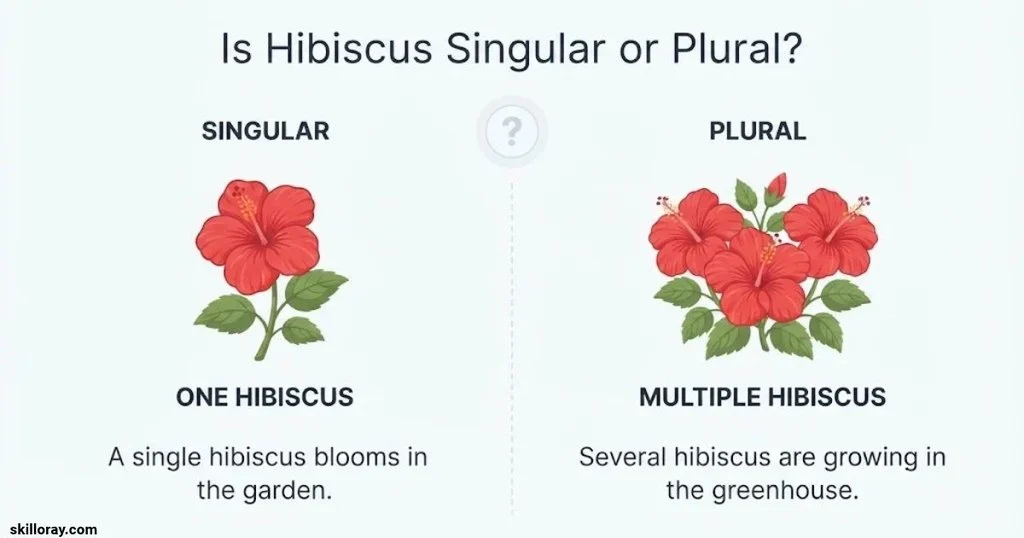
Hibiscus is a noun that can be singular or plural, depending on how you use it.
When you talk about one plant or flower, hibiscus is singular. When you refer to multiple plants or flowers, it can also be used as a plural without changing its spelling.
Singular examples:
- A beautiful hibiscus is growing beside the gate.
- This hibiscus has large pink flowers.
- My neighbor planted a hibiscus in her garden.
Plural examples:
- Hibiscus are popular garden plants in warm climates.
- The nursery has several types of hibiscus.
- We saw colorful hibiscus growing along the road.
You can usually identify the number from the rest of the sentence. Words such as a, one, and this often indicate a singular noun, while several, many, and these point to a plural meaning.
Hibiscus vs. Hibiscuses vs. Hibisci
These spellings can cause confusion, especially when you’re trying to choose the correct form for an article or school assignment.
| Form | Explanation |
| Hibiscus | Accepted singular and plural form |
| Hibiscuses | Regular English plural |
| Hibisci | Uncommon form; not listed as the standard plural in the major learner’s dictionary entries cited here |
Hibiscus
The word hibiscus can refer to one flower or plant. It can also describe multiple plants when the context makes the plural meaning clear.
Example: Hibiscus are common in tropical and subtropical gardens.
Hibiscuses
Hibiscuses follows a regular English plural pattern. It is useful when you want to make it obvious that you’re referring to more than one plant or flower.
Examples:
- The garden has red, white, and yellow hibiscuses.
- Several hibiscuses are blooming near the entrance.
- She bought two hibiscuses for her balcony.
Hibisci
You might come across hibisci in discussions about Latin-style plurals. However, Cambridge and Oxford list hibiscus and/or hibiscuses, not hibisci, as the plural forms.
For ordinary English writing, choose hibiscus or hibiscuses rather than hibisci.
Why Does Hibiscus Become Hibiscuses?
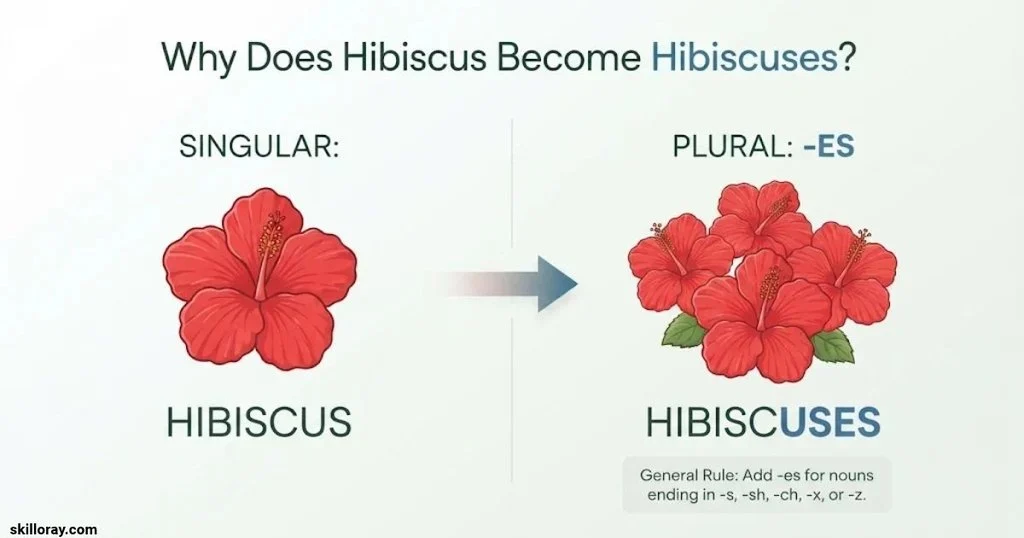
Many English nouns form their plurals by adding -s or -es. The spelling depends on the ending of the word.
For example:
- Bus → Buses
- Class → Classes
- Lens → Lenses
- Wish → Wishes
- Hibiscus → Hibiscuses
Adding -es creates the regular plural hibiscuses. However, English doesn’t always follow one simple rule for every noun. Some words have accepted unchanged or irregular plural forms, which is why hibiscus can also remain the same.
Examples of Hibiscus in Sentences
Here are some natural examples showing how to use both plural forms.
Using hibiscus as a singular noun:
- A red hibiscus opened in the morning sunlight.
- This hibiscus needs a little more water.
- I placed one hibiscus flower in a glass vase.
Using hibiscus as a plural noun:
- Hibiscus are popular in gardens across tropical regions.
- We noticed several hibiscus plants outside the hotel.
- The shop sells different varieties of hibiscus.
Using hibiscuses as a plural noun:
- The gardener planted three hibiscuses near the fence.
- Pink and orange hibiscuses brighten the front yard.
- These hibiscuses produce large flowers during the summer.
The important point is that both plural forms can be correct. Choose the one that makes your sentence clear and sounds natural.
Common Mistakes When Using Hibiscus
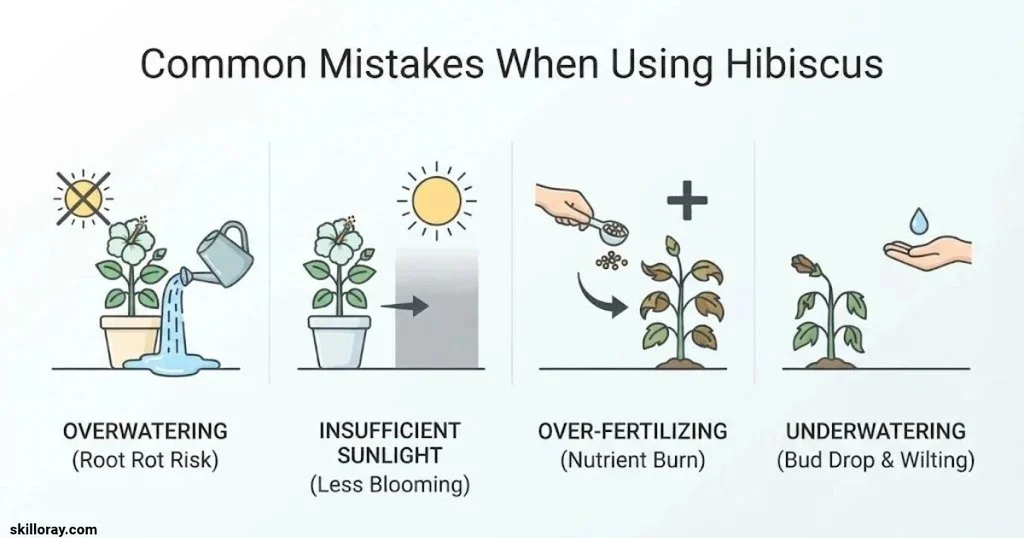
Even though the plural forms are straightforward, a few mistakes are worth avoiding.
1. Assuming hibiscus can only be singular
Incorrect assumption: Hibiscus always refers to one flower.
Correct explanation: Hibiscus can be singular or plural. For example, “Hibiscus are popular flowers” uses the word in a plural sense.
2. Treating hibiscuses as incorrect
Hibiscuses is a correct English plural. It is especially useful when you want to emphasize that you’re talking about several individual plants or flowers.
3. Using hibisci as the usual plural
Although hibisci may appear in some discussions of Latin-style plurals, it isn’t the form listed by the Cambridge and Oxford entries referenced above. Use hibiscus or hibiscuses for standard English writing.
4. Confusing the plant with the flower
The word hibiscus can refer to the plant or its flower. If you mean several individual blooms, you can also write hibiscus flowers.
For example:
- The plant has several hibiscus flowers.
- The garden contains several hibiscus plants.
Frequently Asked Questions
What is the plural of hibiscus?
The plural of hibiscus can be hibiscus or hibiscuses. Both are accepted English forms.
Can hibiscus be used as a plural?
Yes. Hibiscus can remain unchanged when referring to multiple plants or flowers. For example, “Hibiscus are popular in our area.”
Is hibiscuses grammatically correct?
Yes. Hibiscuses is a correct regular English plural. It follows the spelling pattern of adding -es to a noun ending in -s.
Is hibisci a correct plural?
Hibisci is sometimes mentioned as a Latin-style alternative, but it isn’t listed as the standard plural in the Cambridge and Oxford dictionary entries discussed above. For everyday writing, use hibiscus or hibiscuses.
Should I write hibiscus or hibiscuses?
Both are correct. Use hibiscus when the plural meaning is clear from the sentence. Choose hibiscuses when you want to make the plural especially clear.
Is hibiscus a flower or a plant?
It can refer to both. A hibiscus is a flowering plant or shrub, and the word can also refer to its individual flower.
What is the singular of hibiscuses?
The singular form is hibiscus. For example, one hibiscus grows in a pot, while several hibiscuses grow in the garden.
Final Thoughts
The plural of hibiscus can be hibiscus or hibiscuses. Both forms are correct, so you don’t have to change the word every time you refer to more than one plant or flower. If you want a clear and familiar plural in everyday writing, hibiscuses is a good choice. Remember: one hibiscus, several hibiscus, or several hibiscuses.

I am Olivia Brown, a professional English editor and grammar writer who believes that great writing begins with a strong foundation in grammar. I have spent years creating educational resources that help students and professionals improve their writing, avoid common errors, and communicate more effectively. I strive to provide clear explanations and practical examples that make grammar easy to understand and apply.
Books: English Grammar Essentials and Modern Writing Success
 James Walker
 Daniel Carter