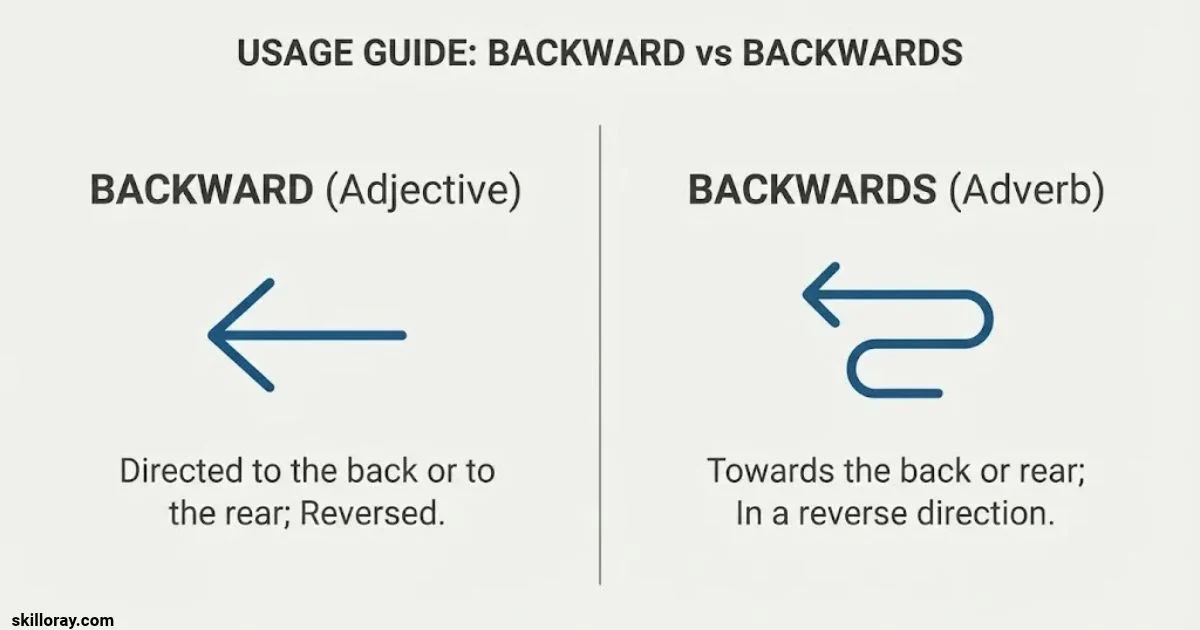
Backward or backwards? Both words look almost identical, so it’s easy to wonder whether one is correct and the other is a mistake. If you’ve ever paused while writing because you weren’t sure which form to use, you’re not alone.
The good news is that both backward and backwards are correct English words, but their usage can depend on the type of English you’re writing. I’ll help you understand the difference so you can choose the right word with confidence.
In this guide, you’ll learn what backward and backwards mean, how American and British English use them, and when to choose each form. I’ll also share clear examples and common mistakes to help you use both words naturally in everyday writing.
Backward vs. Backwards: Quick Difference
| Backward | Backwards |
| Preferred in American English | Common in British English |
| Used as an adverb | Used mainly as an adverb |
| Standard adjective form | Also appears in some established adjectival expressions |
| Example: He stepped backward. | Example: He stepped backwards. |
Both words can describe movement toward the back or in the opposite direction. The choice usually depends on your audience and the type of English you’re using.
Quick rule: If you’re writing for an American audience, choose backward in most situations. In British English, backwards is also a natural choice when describing movement.
What Does Backward Mean?
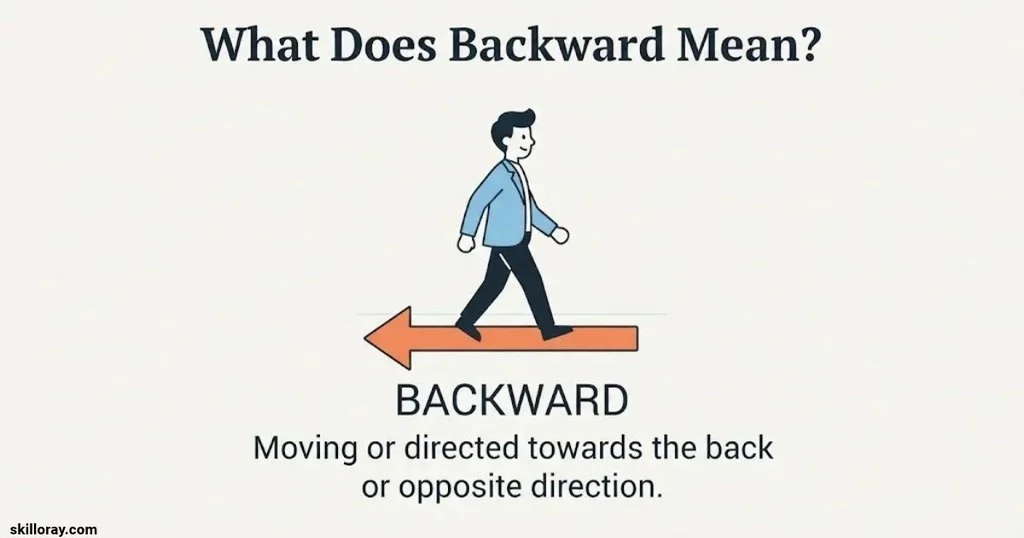
Backward is an adjective and adverb that describes movement toward the back, a reverse direction, or a lack of progress.
As an adverb, it tells readers how someone or something moves.
Examples:
- The child took two steps backward.
- The car rolled backward down the driveway.
- She leaned backward to avoid hitting her head.
- He looked backward before crossing the street.
- The machine began moving backward during the demonstration.
In each sentence, backward describes movement or direction.
Backward as an Adjective
When backward describes a noun, it works as an adjective. This is the usual form in standard English.
For example:
- A backward movement
- A backward glance
- A backward step
- A backward motion
- A backward-facing seat
Here are two examples in complete sentences:
- The athlete made a backward movement during the exercise.
- He took a backward step when the dog approached.
You may occasionally see backwards used adjectivally in established expressions, such as a backwards glance or backwards-compatible. However, backward is the safer choice for most ordinary adjective uses.
Backward as a Figurative Expression
The word can also describe a lack of progress or a move away from improvement.
For example:
- The company took a backward step after losing its biggest customer.
- The new policy was considered a backward move.
- Years of progress were lost when the project moved backward.
Be careful when describing people or communities as backward. This use can sound insulting or judgmental because it suggests that they are less developed or progressive than others.
What Does Backwards Mean?
Backwards is an adverb that describes movement toward the back or in the opposite direction. It has the same basic directional meaning as backward.
The spelling is particularly common in British English, although American readers also understand it.
Examples:
- The boy walked backwards across the room.
- She stepped backwards when the door suddenly opened.
- The dog moved backwards after hearing a loud noise.
- He read the instructions backwards by mistake.
- The truck slowly reversed backwards into the parking space.
The last sentence is understandable, but reversed backwards is unnecessarily repetitive. A more natural version is:
“The truck slowly reversed into the parking space.”
Backwards in Everyday Expressions
You may encounter backwards in several common expressions:
- Read backwards: Read from the end toward the beginning.
- Walk backwards: Move while facing the opposite direction.
- Look backwards: Look behind you or reflect on the past.
- Bend over backwards: Make an unusually great effort to help someone.
- Backwards and forwards: In both directions or with thorough familiarity, depending on context.
For example:
“She knows the song backwards and forwards.”
This means she knows the song extremely well.
Backward or Backwards in American and British English
The main spelling difference comes down to regional writing habits.
| Usage | American English | British English |
| Adverb | Backward is preferred | Both forms are common |
| Adjective | Backward | Backward is usual |
| Movement | He walked backward. | He walked backwards. |
| Direction | The car moved backward. | The car moved backwards. |
In American English, backward is generally the preferred spelling in both formal and everyday writing.
In British English, backwards is especially common when describing movement, although backward is also correct.
These are preferences, not strict rules that make the alternative spelling wrong. If you’re writing for a particular audience, choose the form that fits that variety of English and use it consistently.
Backward vs. Backwards: Examples in Sentences
The following examples show how both forms can appear naturally.
| Sentence with backward | Sentence with backwards |
| He stepped backward to avoid the puddle. | He stepped backwards to avoid the puddle. |
| The car rolled backward down the slope. | The car rolled backwards down the slope. |
| She leaned backward during the stretch. | She leaned backwards during the stretch. |
| The child walked backward across the garden. | The child walked backwards across the garden. |
| He glanced backward at the empty room. | He glanced backwards at the empty room. |
The meaning stays essentially the same. The difference is mainly the preferred form in the variety of English being used.
Common Mistakes with Backward and Backwards
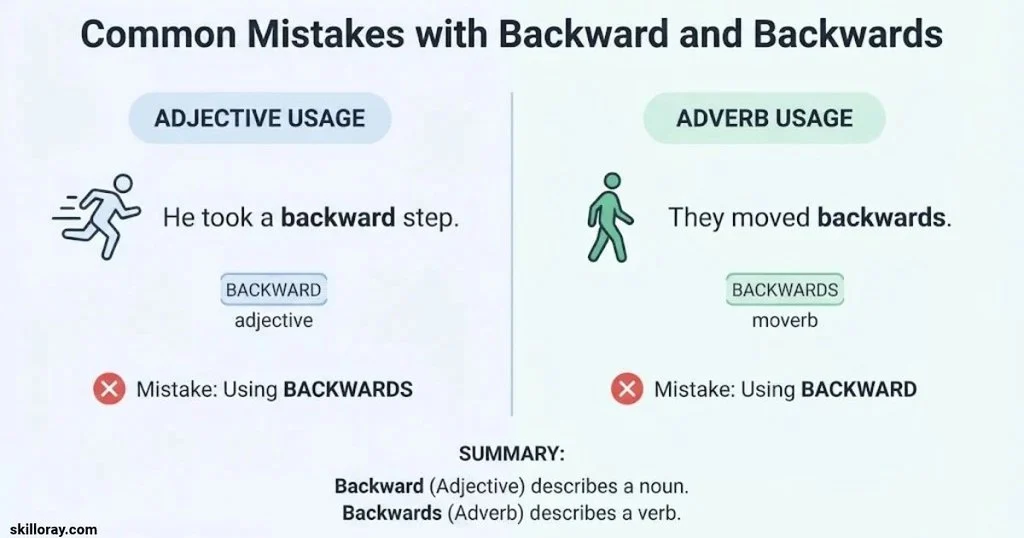
Even though both spellings are correct, certain uses can make a sentence awkward or grammatically incorrect.
Using backwards as the usual adjective
Less conventional: The athlete made a backwards movement.
Preferred: The athlete made a backward movement.
Backward is the usual adjective before a noun. Some established expressions use backwards, but it isn’t the standard choice in most ordinary adjective phrases.
Assuming backwards is always incorrect
Incorrect assumption: Backwards isn’t a real English word.
Correct understanding: Backwards is a standard English adverb, particularly common in British English.
Mixing spelling preferences unnecessarily
If you’re writing an American English article, using backward consistently is generally the better editorial choice. Switching between forms without a reason can make the writing feel inconsistent.
Using both words when one is enough
Awkward: The car reversed backwards into the driveway.
Better: The car reversed into the driveway.
The verb reverse already expresses movement in the opposite direction, so adding backwards is unnecessary.
Backward vs. Backwards vs. Forward vs. Forwards
You may also wonder whether backward and backwards follow the same pattern as forward and forwards.
They do.
| Word | Alternative | General preference |
| Backward | Backwards | Backward in American English; both in British English |
| Forward | Forwards | Forward in American English; both in British English |
Examples:
- The child moved forward.
- The child moved forwards.
- The car rolled backward.
- The car rolled backwards.
The same regional pattern applies to both pairs. American English generally prefers the shorter forms, while British English commonly accepts both.
Frequently Asked Questions
Is it backward or backwards?
Both spellings are correct. Backward is generally preferred in American English, while backwards is especially common in British English. Both can describe movement toward the back or in reverse.
Is backward or backwards correct in American English?
Backward is the usual American English preference. You may still encounter backwards in American writing, but backward is generally the safer choice.
Is backward or backwards British English?
Both forms are used in British English. Backwards is common as an adverb, while backward is also correct and is the usual adjective form.
Is backwards grammatically correct?
Yes. Backwards is a standard English adverb. For example, “The child walked backwards toward the door” is grammatically correct.
Should I write a backward step or a backwards step?
A backward step is the usual choice because backward is the standard adjective before a noun. The phrase backwards step is less conventional.
What is the difference between backward and forward?
Backward describes movement toward the back or in reverse, while forward describes movement toward the front or ahead. Both can also describe progress or a lack of progress.
What does bend over backwards mean?
To bend over backwards means to make an unusually great effort to help someone or satisfy a request.
Example: “The customer service team bent over backwards to solve the problem.”
Final Thoughts
Both backward and backwards are correct, so you don’t need to worry about choosing between a right and wrong spelling.
For American English, backward is the usual choice. In British English, backwards is common when describing movement. When the word comes before a noun, use backward in most cases.
The simplest approach is to follow your audience’s preferred English variety and keep your writing consistent.

I am James Walker, an English language specialist with extensive experience in grammar, editing, and academic writing. I enjoy helping students, bloggers, and professionals strengthen their writing by explaining grammar concepts in a clear and engaging way. My focus is on providing accurate, practical, and easy-to-follow guidance that helps learners communicate more effectively in everyday and professional situations.
Books: Perfect English Grammar Handbook and Advanced Writing Techniques
 Daniel Carter
 Olivia Brown