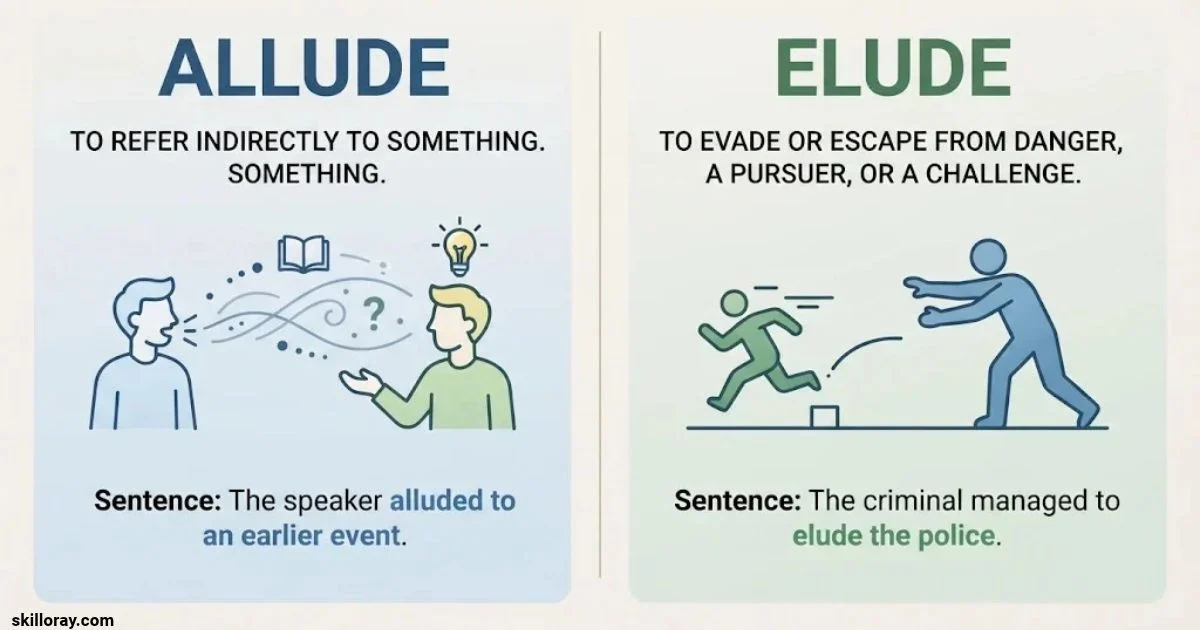
The words allude and elude may look and sound similar, but they have completely different meanings. It’s easy to mix them up when writing or speaking, especially because both words appear in everyday English. I know how confusing these small spelling differences can be when you’re trying to choose the right word.
Allude means to refer to something indirectly, while elude means to escape or avoid something. One small letter changes the meaning completely, so knowing the difference can make your writing clearer and more accurate.
In this guide, you’ll learn what allude and elude mean, how to use each word correctly, and how they differ through simple examples. I’ll also share practical tips to help you remember the difference and avoid common mistakes in the future.
Allude vs. Elude: What’s the Difference?
| Word | Meaning | Example |
| Allude | To refer to something indirectly | The manager alluded to upcoming changes. |
| Elude | To escape, avoid, or remain difficult to grasp | The answer eluded the student. |
Allude is about hinting at something without discussing it directly. Elude describes avoiding something or being difficult to catch, find, remember, or understand.
Here’s another way to see the difference:
- She alluded to a disagreement during the meeting. (She hinted that a disagreement had happened.)
- She tried to elude the reporter’s questions. (She tried to avoid answering them.)
The two words aren’t interchangeable. Using the wrong one can change the entire meaning of a sentence.
What Does Allude Mean?
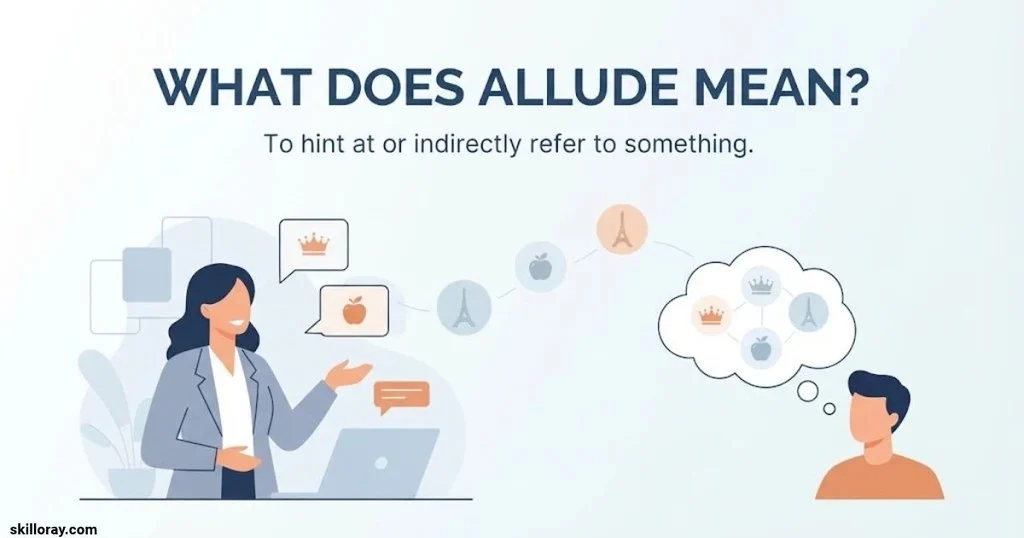
Allude is a verb that means to refer to something indirectly. Instead of naming a person, event, idea, or experience openly, you give a hint that allows others to recognize what you’re talking about.
For example, imagine a manager tells the team, “There may be some exciting changes in the department next month.” The manager hasn’t explained what will happen but may be alluding to an upcoming promotion or restructuring.
Writers use allusions in a similar way. They might refer to a famous story, historical event, or cultural figure without explaining the connection.
Allude Examples in Sentences
- The teacher alluded to an upcoming examination but didn’t reveal the date.
- During the interview, the actor alluded to a difficult experience from his childhood.
- The author alludes to Greek mythology in several chapters of the novel.
- My friend alluded to a surprise but refused to give me any details.
- The president alluded to possible changes in the country’s education system.
In each sentence, someone hints at a subject rather than discussing it directly.
Allude vs. a Direct Reference
An indirect reference isn’t the same as a direct mention.
Consider these two sentences:
- Direct reference: The speaker mentioned Shakespeare’s Hamlet by name.
- Indirect reference: The speaker alluded to the famous tragedy of a Danish prince.
The first sentence identifies the work directly. The second hints at it without naming the title.
This distinction is especially useful when reading literature, analyzing speeches, or writing essays.
What Does Elude Mean?
Elude is a verb that means to escape, avoid, or stay out of someone’s reach. It can describe a person avoiding capture or something that remains difficult to understand, remember, or achieve.
The word has both literal and figurative uses.
Literal meaning: Someone escapes from a person, place, or situation.
Figurative meaning: An idea, answer, memory, or opportunity remains difficult to grasp.
For example, if you know someone’s face but can’t remember their name, you could say, “Their name keeps eluding me.”
Elude Examples in Sentences
- The suspect managed to elude the police for several days.
- The answer continued to elude the students.
- I recognized her face, but her name completely eluded me.
- The company tried to elude public scrutiny after the incident.
- Despite hours of research, the solution still eluded the scientists.
Notice that elude doesn’t always involve physically running away. It can also describe something you can’t quite remember, understand, or achieve.
Common Expressions with Elude
Some combinations make the meaning of elude easier to recognize:
- Elude capture: Avoid being caught.
- Elude the police: Escape or avoid law enforcement.
- Elude a question: Avoid giving a direct answer.
- Elude understanding: Remain difficult to understand.
- Elude someone’s memory: Be difficult to remember.
For example, “The details of the conversation eluded me” means you couldn’t remember those details clearly.
Allude vs. Elude in Everyday Sentences
The best way to understand these words is to compare how they work in similar situations.
| Situation | Allude | Elude |
| Workplace | The director alluded to a possible promotion. | The manager tried to elude difficult questions. |
| Education | The teacher alluded to an important chapter. | The answer eluded the entire class. |
| Literature | The poem alludes to an ancient legend. | The poem’s deeper meaning eluded me. |
| Conversation | She alluded to their disagreement. | His name kept eluding me. |
| News | The official alluded to a new policy. | The suspect managed to elude investigators. |
Think about the action in each sentence. If someone is hinting at a subject, allude is the right choice. If someone or something is escaping or remaining out of reach, use elude.
Allude vs. Elude: Common Mistakes and Corrections
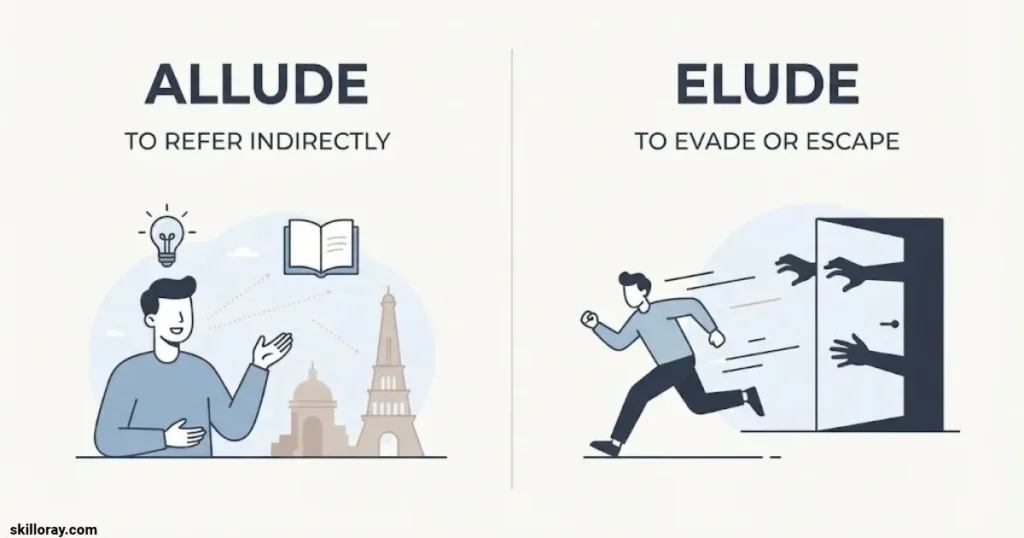
Because these words look alike, it’s easy to use one when you mean the other. Here are some mistakes to watch for.
Mistake 1: Using elude instead of allude
Incorrect: The author eluded to a famous historical event.
Correct: The author alluded to a famous historical event.
The author is making an indirect reference, not escaping from the event.
Mistake 2: Using allude instead of elude
Incorrect: The suspect managed to allude the police.
Correct: The suspect managed to elude the police.
The suspect is avoiding capture, so elude is the correct verb.
Mistake 3: Forgetting “to” after allude
Incorrect: She alluded the problem during the interview.
Correct: She alluded to the problem during the interview.
When you identify the subject being indirectly referenced, the usual construction is allude to something.
Mistake 4: Confusing elude with allude when discussing memory
Incorrect: The name alluded me during the conversation.
Correct: The name eluded me during the conversation.
The name was difficult to remember, so eluded is the appropriate choice.
Allude vs. Elude vs. Refer: What’s the Difference?
The word refer is closely related to allude, but the two aren’t identical. Refer can describe a direct or indirect mention, while allude specifically emphasizes an indirect reference.
Elude has a different meaning altogether.
| Word | Meaning | Example |
| Allude | Hint at something indirectly | She alluded to the disagreement. |
| Refer | Mention or point to something | She referred to the disagreement. |
| Elude | Escape, avoid, or remain difficult to grasp | The truth eluded the investigators. |
For example, if you say, “The teacher referred to the final chapter,” you mean the teacher mentioned it. If you say, “The teacher alluded to the final chapter,” you suggest the teacher hinted at it without discussing it directly.
How to Remember the Difference Between Allude and Elude
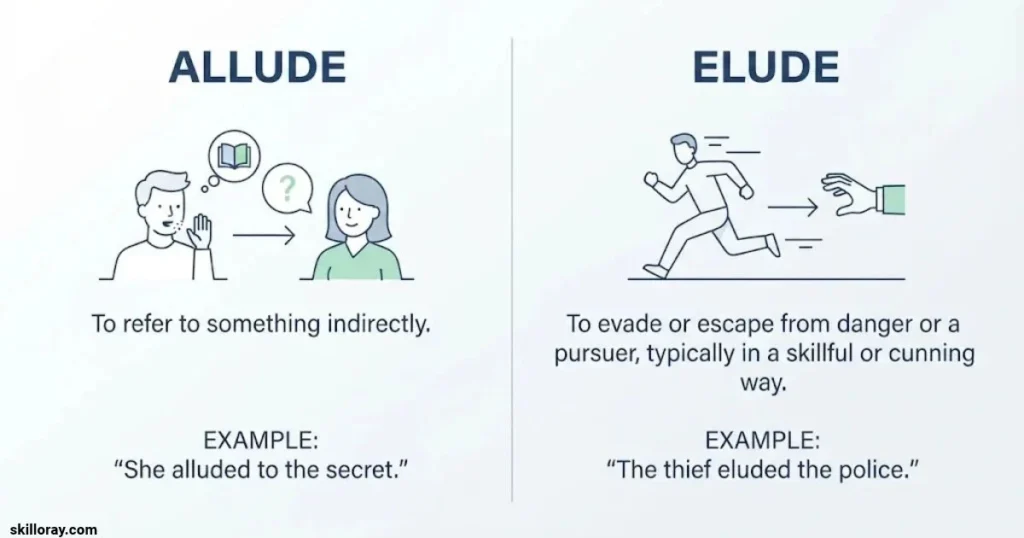
You don’t need to memorize complicated grammar rules to keep these words straight. Just connect each one with its main meaning.
- Allude = Hint: Someone indirectly mentions a subject.
- Elude = Escape: Someone or something stays out of reach.
Try these quick examples:
- The speaker alluded to a secret project but shared no details.
- The secret project continued to elude the reporters who were trying to uncover it.
A useful question to ask yourself is: Is someone making a hint, or is something being avoided or escaping? Your answer will usually tell you which word to use.
Frequently Asked Questions
What is the main difference between allude and elude?
Allude means to refer to something indirectly, while elude means to escape, avoid, or remain difficult to understand or remember.
Is it allude to or elude to?
The usual expression is allude to when someone hints at a subject. For example, “He alluded to his earlier comments.” Elude generally takes a direct object, as in “The answer eluded him.”
Can someone elude a question?
Yes. To elude a question means to avoid answering it directly. For example, “The politician eluded the reporter’s question during the interview.”
Can you allude to a person?
Yes. You can allude to someone without mentioning their name. For example, “She alluded to her former business partner during the discussion.”
What is another word for allude?
Depending on the context, alternatives include hint, imply, suggest, and refer to. These words have slightly different meanings, so choose one that fits the sentence.
What is another word for elude?
Common alternatives include escape, evade, avoid, and dodge. When discussing memory or understanding, elude can also mean to remain beyond someone’s grasp.
Final Thoughts
The difference between allude and elude is easier to remember when you focus on the action.
Use allude when someone hints at something without saying it directly. Use elude when someone escapes, avoids something, or can’t quite grasp an idea or memory.
If you’re writing about an indirect reference, choose allude. If you’re describing something that stays out of reach, choose elude.

I am Daniel Carter, a grammar enthusiast and language educator with over 10 years of experience helping students and professionals improve their English writing and communication skills. I enjoy simplifying complex grammar rules into easy-to-understand lessons that anyone can follow. My goal is to help learners write with confidence, avoid common mistakes, and develop strong communication skills for academic and professional success. I regularly create practical grammar guides, writing tips, and language resources that make learning both enjoyable and effective.
Books: Mastering English Grammar and The Complete Guide to Better Writing
 James Walker
 Olivia Brown