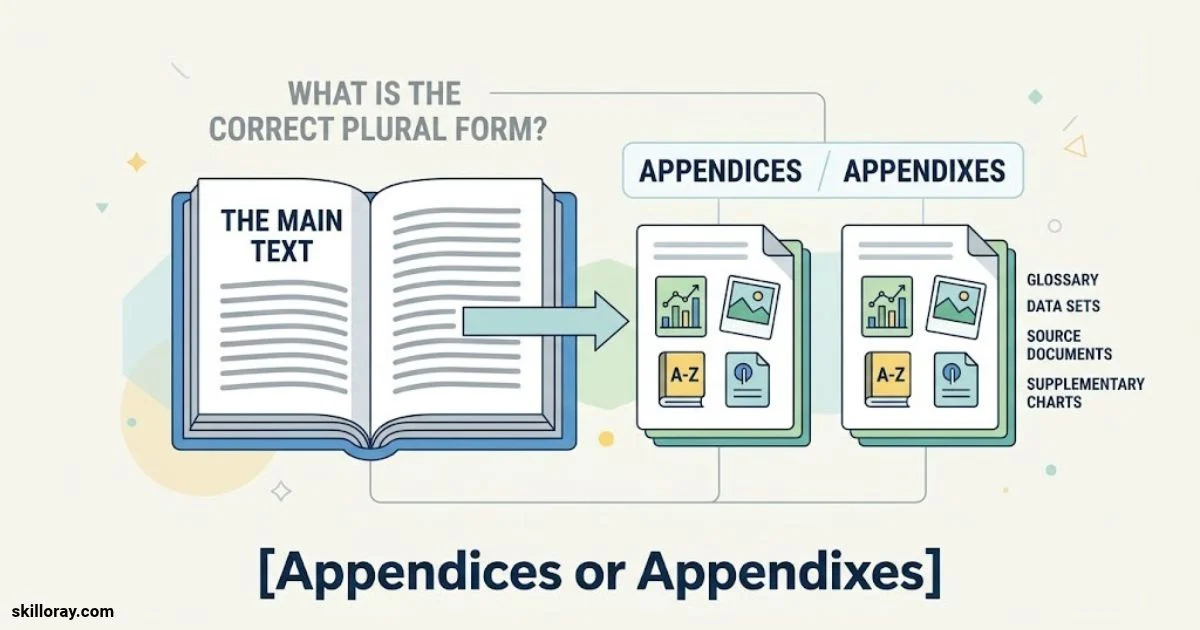
Have you ever stopped while writing and wondered whether to use appendices or appendixes? You’re not alone. Both spellings look unusual, and choosing the right one can be confusing, especially when you’re writing an academic paper, report, or formal document.
Here’s the interesting part: both appendices and appendixes are correct plural forms of appendix. However, their usage can depend on context, writing style, and personal preference. I want to help you understand the difference so you can choose the right word without second-guessing yourself.
In this guide, you’ll learn what appendices and appendixes mean, how to use them in sentences, and whether one spelling is better than the other. I’ll also share practical examples to help you feel confident using both forms in your everyday and academic writing.
What Is the Difference Between Appendices and Appendixes?
The difference comes down to how the plural is formed. Appendices follows a traditional Latin-derived pattern, while appendixes uses the regular English ending -es.
| Word | Form | Explanation |
| Appendix | Singular | One appendix |
| Appendices | Plural | Traditional Latin-derived form |
| Appendixes | Plural | Regular English form |
Both plural forms are accepted in standard English.
For example:
- Singular: The research paper includes an appendix.
- Plural: The research paper includes three appendices.
- Plural: The research paper includes three appendixes.
The last two sentences communicate exactly the same information. The spelling preference may change depending on the publication, but the grammar remains correct.
Why Does Appendix Have Two Plural Forms?
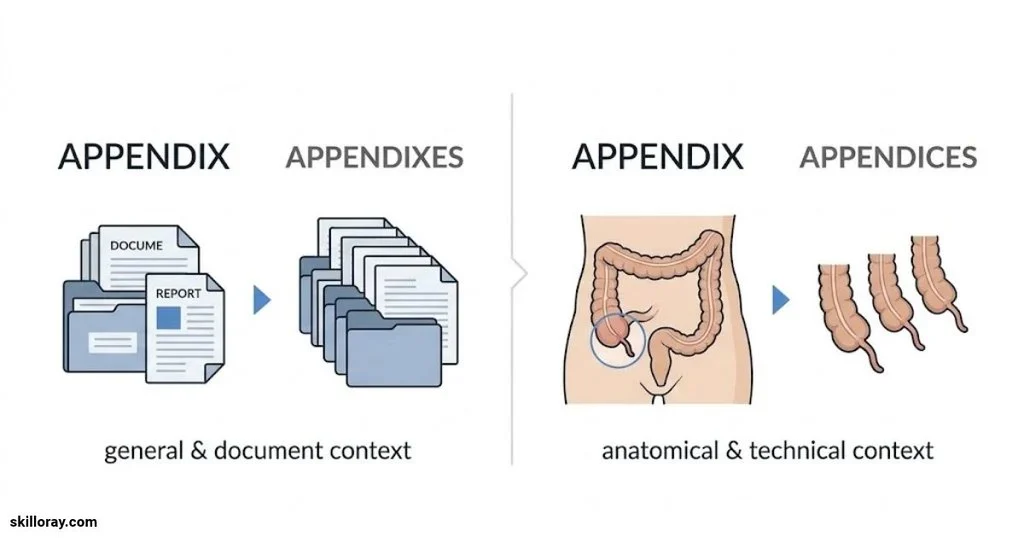
The word appendix comes from Latin. Its traditional plural is appendices, following a pattern in which words ending in -ix change to -ices.
English has borrowed many words from Latin. Some retain their original plural forms, while others gradually develop regular English endings.
That’s why appendix has two accepted plurals:
- Appendices: The traditional plural form.
- Appendixes: The regular English plural form, created by adding -es.
You can find similar variations in other words:
| Singular | Traditional Plural | Regular Plural |
| Appendix | Appendices | Appendixes |
| Index | Indices | Indexes |
| Matrix | Matrices | Matrixes |
The preferred form can depend on the subject. For instance, indices is common in mathematics, while indexes is widely used for book references and databases.
What Does Appendix Mean?
The word appendix has two common meanings. It can refer to an additional section in a document or a small organ in the human body.
Understanding the context helps you know which meaning a writer intends.
1. Appendix in books and documents
In publishing and academic writing, an appendix is extra material placed at the end of a document. It provides supporting information without interrupting the main discussion.
A research paper might include an appendix containing:
- Survey questions used during research
- Interview transcripts
- Detailed calculations
- Additional charts and tables
- Technical explanations
- Supporting documents
For example, a student writing about customer satisfaction might explain the research findings in the main paper and place the complete questionnaire in an appendix.
When a document contains several such sections, the writer can refer to them as appendices or appendixes.
2. Appendix in human anatomy
In anatomy, the appendix is a small, narrow pouch attached to the large intestine. It is located in the lower-right area of the abdomen.
The word also has two accepted plural forms in this context.
For example:
- The doctor examined the patient’s appendix.
- The medical report discussed inflammation affecting the appendix.
When discussing more than one, both appendices and appendixes are possible plural forms.
When Should You Use Appendices or Appendixes?
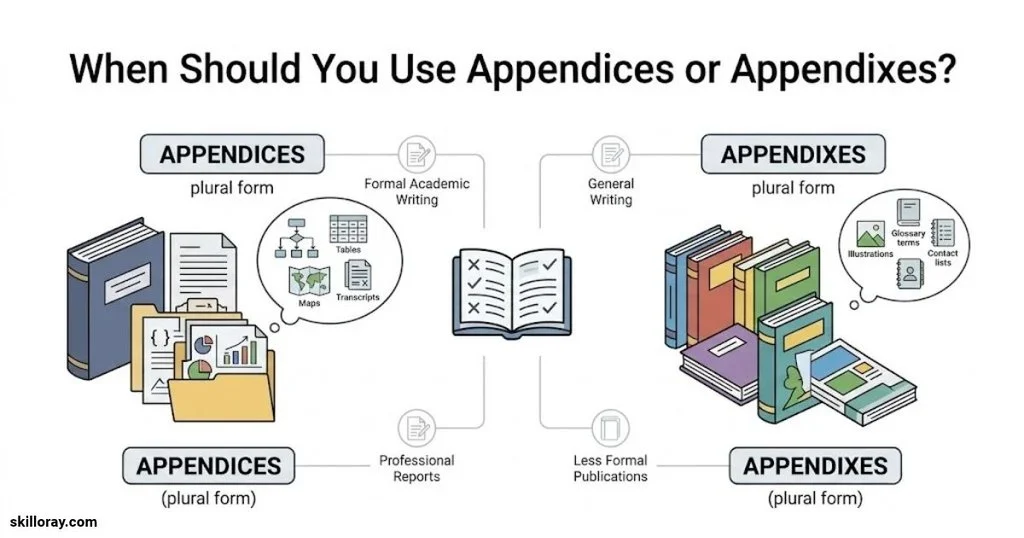
Both spellings are correct, but appendices is a familiar choice in academic and formal writing. Appendixes is a valid alternative in general English.
Here’s how to choose between them.
Use appendices in academic and formal writing
If you’re preparing a thesis, dissertation, research paper, or technical report, appendices is a practical choice.
For example:
- The dissertation includes two appendices containing interview transcripts.
- Please review the appendices before submitting your final research paper.
- The author placed the statistical calculations in the appendices.
Many academic writers prefer this traditional form. However, your university or publisher may have its own spelling requirements.
Use appendixes in general writing
Appendixes is also correct. You can use it in books, manuals, reports, and other general writing when it fits your chosen style.
For example:
- The instruction manual includes two appendixes with additional diagrams.
- Readers can find the extra illustrations in the appendixes.
- The report’s appendixes provide more information about the project.
You don’t need to treat appendixes as an incorrect or informal spelling. It’s an accepted plural form.
How Do You Number Appendices in a Document?
When a report or research paper contains multiple appendices, clear labels help readers find supporting information.
Many academic documents use letters to identify individual appendices. For example:
| Label | Content |
| Appendix A | Research questionnaire |
| Appendix B | Interview questions |
| Appendix C | Additional data tables |
| Appendix D | Supporting calculations |
You can refer to these sections directly in the main text.
For example:
- See Appendix A for the complete questionnaire.
- The interview responses appear in Appendix B.
- Additional statistical results are provided in Appendix C.
If your document has only one supporting section, label it Appendix. When there are several, use the plural appendices or appendixes when referring to them collectively.
Formatting rules vary between universities and publishers. Some require letters, while others use numbers or different heading styles. Always check the relevant guidelines before submitting your work.
Appendices vs. Appendixes: Examples in Sentences
The following examples show how both plural forms work in different situations.
| With Appendices | With Appendixes |
| The thesis contains four appendices. | The thesis contains four appendixes. |
| The research appendices include additional survey data. | The research appendixes include additional survey data. |
| All supporting charts appear in the appendices. | All supporting charts appear in the appendixes. |
| The book’s appendices contain extra illustrations. | The book’s appendixes contain extra illustrations. |
| The medical report discusses the patient’s condition in its appendices. | The medical report discusses the patient’s condition in its appendixes. |
Both columns are grammatically correct. Choose the form that matches your preferred spelling style and use it consistently.
Common Mistakes to Avoid
Even experienced writers sometimes hesitate over unusual plural forms. These are a few mistakes worth avoiding.
1. Assuming appendixes is incorrect
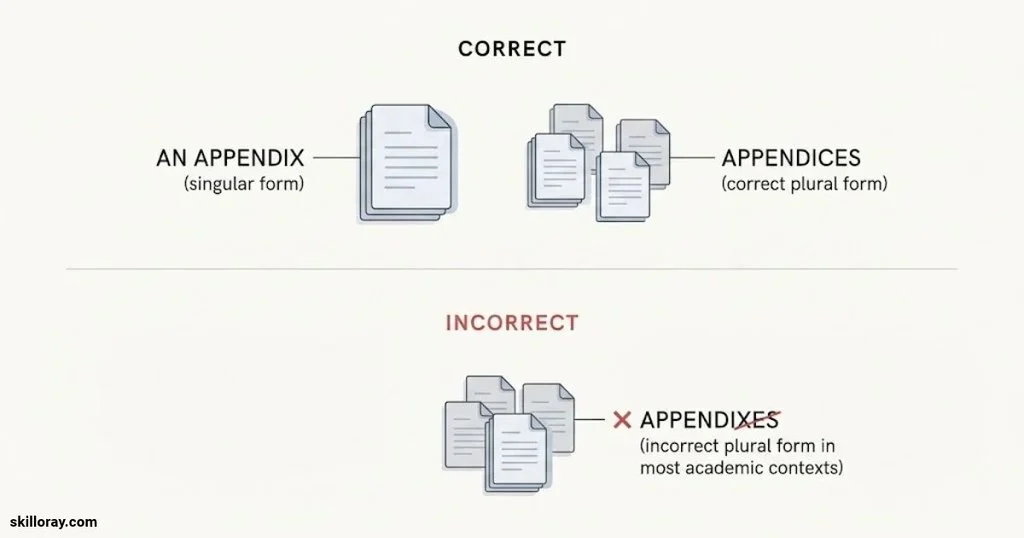
Appendixes is an accepted plural form. It isn’t automatically a spelling mistake just because appendices is more familiar in academic writing.
2. Using appendix for multiple sections
The singular form refers to one section or organ. When referring to more than one, use appendices or appendixes.
- Incorrect: The report includes three appendix.
- Correct: The report includes three appendices.
- Also correct: The report includes three appendixes.
3. Switching between plural forms
Avoid alternating between appendices and appendixes without a reason. Pick one form and keep it consistent throughout the document.
4. Ignoring your style guide
A university, journal, or publisher may specify which plural form to use. Follow its instructions rather than relying only on personal preference.
Frequently Asked Questions
1. Is appendices or appendixes correct?
Both are correct plural forms of appendix. Appendices is the traditional Latin-derived form, while appendixes follows regular English pluralization.
2. What is the plural of appendix?
The plural of appendix can be appendices or appendixes. Both forms are accepted in standard English.
3. Is appendices more formal than appendixes?
Appendices is more traditional and commonly preferred in academic and technical writing. However, appendixes is also accepted in formal contexts when the relevant style guide allows it.
4. Should I use appendices in a research paper?
Appendices is generally a safe choice for a research paper, thesis, or dissertation. Still, check your institution’s formatting guidelines before submitting your work.
5. Can I use appendixes in academic writing?
Yes. Appendixes is an accepted plural form. Some universities and publishers prefer appendices, so follow their specific requirements.
6. What is the singular form of appendices?
The singular form is appendix. Use appendix for one additional section or organ and appendices for more than one.
7. Are appendices and appendixes pronounced differently?
Yes. They have slightly different pronunciations:
- Appendices: /əˈpendɪsiːz/
- Appendixes: /əˈpendɪksɪz/
The first is commonly pronounced uh-PEN-duh-seez, while the second sounds like uh-PEN-dik-siz.
8. What is the difference between an appendix and an attachment?
An appendix is supporting material included within a book, report, or other document. An attachment is usually a separate file or document added to an email, letter, or other communication.
For example, a research paper might contain an appendix with extra tables, while an email might include the complete report as an attachment.
Final Thoughts
Both appendices and appendixes are correct. The traditional form is especially common in academic writing, while the regular English form is also widely accepted.
If you’re preparing a thesis, dissertation, or research report, appendices is a sensible choice unless your style guide specifies otherwise. For general writing, either form works. The key is to use one consistently.

I am Daniel Carter, a grammar enthusiast and language educator with over 10 years of experience helping students and professionals improve their English writing and communication skills. I enjoy simplifying complex grammar rules into easy-to-understand lessons that anyone can follow. My goal is to help learners write with confidence, avoid common mistakes, and develop strong communication skills for academic and professional success. I regularly create practical grammar guides, writing tips, and language resources that make learning both enjoyable and effective.
Books: Mastering English Grammar and The Complete Guide to Better Writing
 Olivia Brown
 James Walker