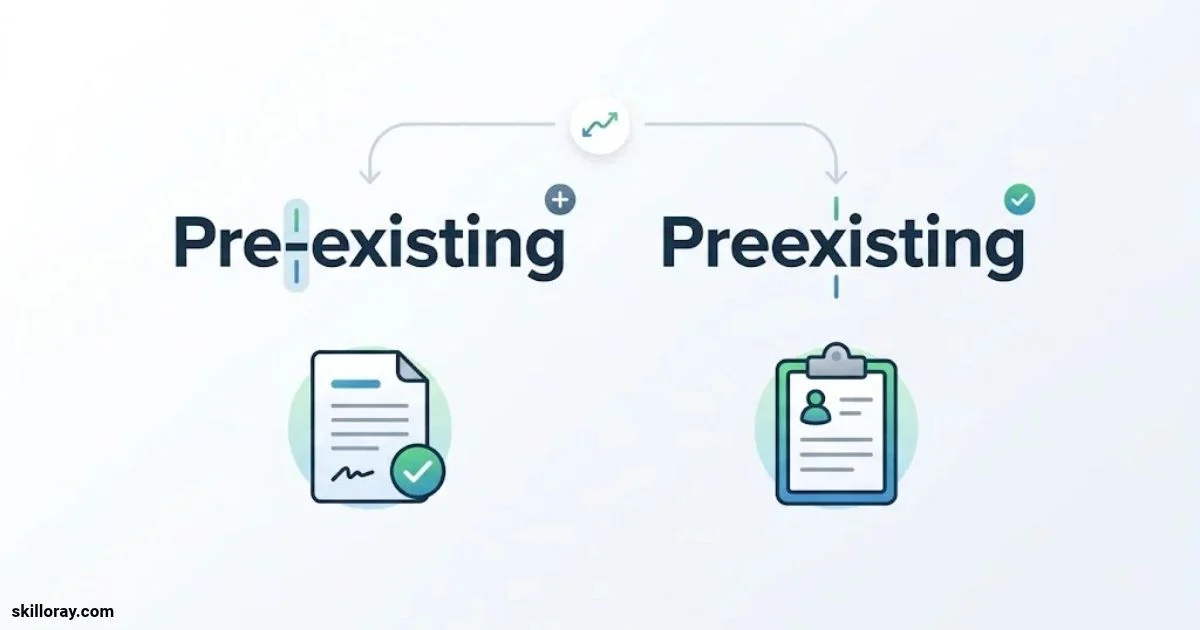
Have you ever wondered whether to write pre-existing or preexisting? Both spellings appear in everyday writing, professional documents, and published content. The difference is easy to miss, especially when you’re unsure whether the word needs a hyphen. Choosing the right form can make your writing clearer and more consistent.
Both pre-existing and preexisting mean something that already existed before a particular event, situation, or point in time. For example, you might describe a pre-existing condition, a preexisting agreement, or a problem that was present before a new change occurred. Although both forms are acceptable, their usage can vary depending on the writing style and publication guidelines.
In this guide, you’ll learn whether pre-existing or preexisting is the preferred spelling in American English. We’ll explain the difference, provide practical examples, and show you when to use the hyphen. By the end, you’ll know how to choose the right version and use it confidently in your writing.
What Is the Difference Between Pre-Existing and Preexisting?
The difference between pre-existing and preexisting is simply the hyphen.
Both words describe something that was already present or existed before something else happened. The hyphen doesn’t change their meaning or pronunciation.
| Spelling | Meaning | Example |
| Pre-existing | Existing before something else | The building had pre-existing structural damage. |
| Preexisting | Existing before something else | The company reviewed its preexisting agreements. |
Both forms are understandable and accepted in English. However, individual dictionaries, publishers, and organizations may prefer one spelling over the other.
For example, Cambridge Dictionary lists pre-existing and identifies preexisting as an alternative spelling. The Chicago Manual of Style uses the closed form preexisting.
The safest approach is to follow the reference guide used by your school, workplace, or publisher.
What Does Preexisting Mean?
Preexisting means that something was already in existence before a particular event, date, or change.
The word combines two parts:
- Pre-: A prefix meaning before or earlier.
- Existing: Being present, real, or in existence.
Together, they describe something that existed beforehand.
For example, imagine a company introduces a new payment system. Some employees already have agreements under the old system. Those agreements are preexisting because they were in place before the new system began.
Here are a few more examples:
- The investigation uncovered preexisting problems in the department.
- We reviewed all pre-existing contracts before approving the merger.
- The software update doesn’t affect preexisting user accounts.
- The doctor asked about any pre-existing medical conditions.
- The new rules apply to future purchases, not preexisting orders.
In each sentence, the word points to something that was already there.
When Should You Use Pre-Existing or Preexisting?
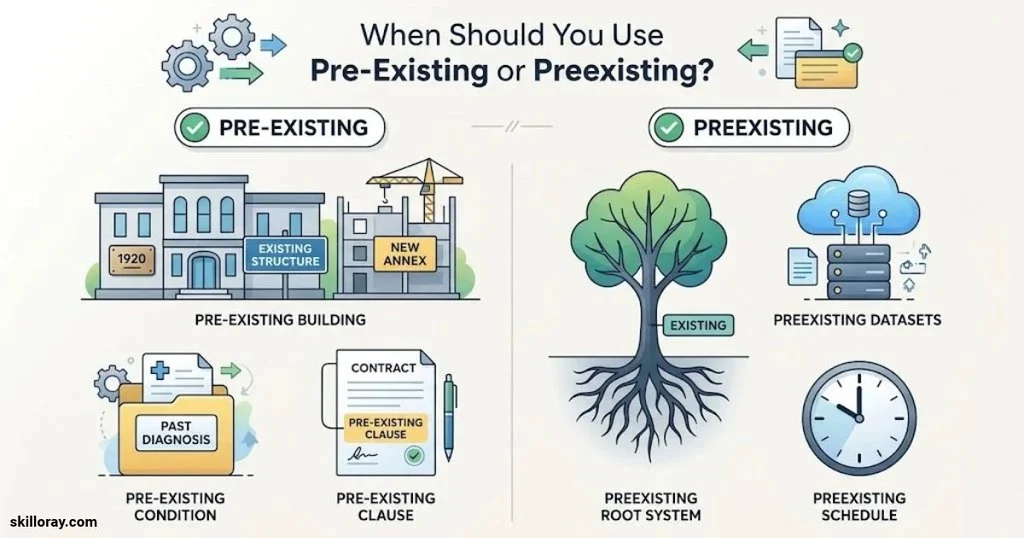
You can use either spelling when it matches your chosen dictionary or style guide. The important thing is to avoid switching between the two forms without a reason.
Use Pre-Existing When Your Style Guide Prefers the Hyphen
The hyphenated form appears in established dictionary entries and is common in formal writing.
You may see it in:
- Academic papers
- Medical documents
- Professional reports
- Legal discussions
- General publications
Examples:
- The research team identified several pre-existing limitations.
- The patient reported a pre-existing heart condition.
- The agreement included clauses covering pre-existing obligations.
The hyphen makes the two parts visually distinct, but it doesn’t give the word a different meaning.
Use Preexisting When Your Style Guide Prefers the Closed Form
The one-word form is also accepted. Some editorial references, including the Chicago Manual of Style, prefer preexisting.
You’ll find it in contexts such as:
- Business communication
- General American English writing
- Reports and research documents
- Digital publications
Examples:
- The company investigated preexisting customer complaints.
- The update works with preexisting software installations.
- The team identified preexisting issues during testing.
If your organization uses this spelling, there’s no need to add a hyphen simply because another publication does.
Should You Choose One Form and Stick With It?
Yes. Consistency makes your writing look more professional.
If you use preexisting in an article, don’t switch to pre-existing in another section unless you’re quoting a source or following a specific title’s original spelling.
The same principle applies to reports, essays, websites, and business documents.
Is Pre Existing One Word or Two?
In standard edited English, write the term as either pre-existing or preexisting, not pre existing.
The prefix pre- combines with existing to create one adjective. Depending on the spelling convention you follow, the two parts appear joined or separated by a hyphen.
Compare these forms:
| Form | Recommendation |
| Pre-existing | Accepted hyphenated spelling |
| Preexisting | Accepted closed spelling |
| Pre existing | Generally avoid in standard edited writing |
For example:
- Correct: The company reviewed its preexisting policies.
- Correct: The company reviewed its pre-existing policies.
- Avoid: The company reviewed its pre existing policies.
Remember that not every word beginning with pre- follows exactly the same hyphenation pattern. Check a dictionary when you’re unsure about another word.
Pre-Existing or Preexisting in Example Sentences
Seeing both spellings in context makes their usage easier to understand. The following examples show how the word works in everyday and professional writing.
| Example with pre-existing | Example with preexisting |
| The report identified pre-existing errors in the data. | The report identified preexisting errors in the data. |
| We checked for pre-existing damage before moving in. | We checked for preexisting damage before moving in. |
| The new system must support pre-existing accounts. | The new system must support preexisting accounts. |
| She disclosed her pre-existing medical condition. | She disclosed her preexisting medical condition. |
| The company honored its pre-existing agreements. | The company honored its preexisting agreements. |
Both columns communicate the same ideas. The difference is editorial preference, not meaning.
Examples in Everyday Writing
You don’t need a complicated sentence to use this word correctly.
- The landlord documented all pre-existing damage before the tenant moved in.
- Our team found preexisting problems during the first inspection.
- The new software must work with pre-existing files.
- The school reviewed its preexisting safety procedures.
- The contractor repaired damage that existed before the renovation.
These examples show that the word can describe conditions, problems, agreements, files, and other things that were already present.
Common Mistakes to Avoid
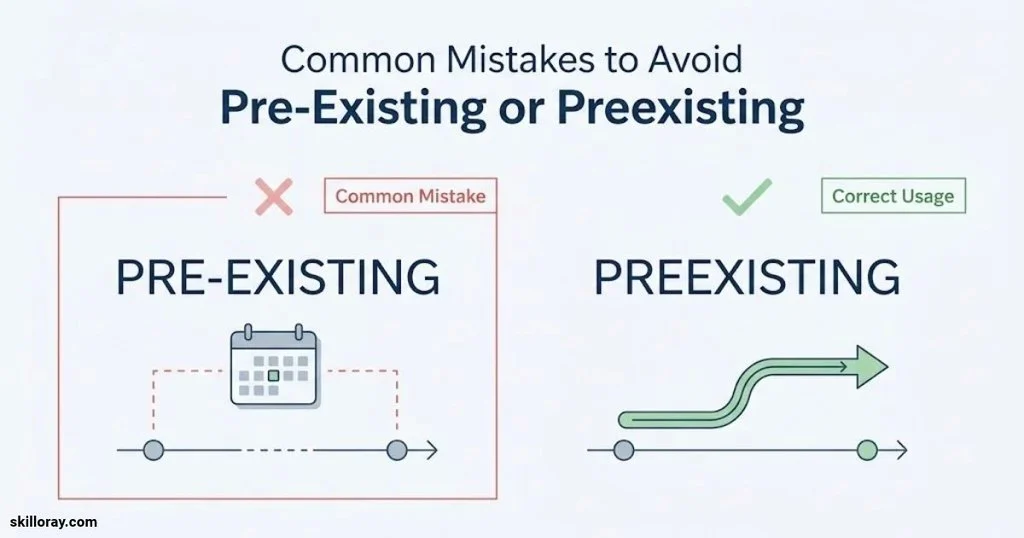
Although the spelling difference is simple, a few mistakes can make your writing less clear.
1. Writing Pre Existing as Two Separate Words
The form pre existing is generally not the standard choice in edited English.
Use preexisting or pre-existing instead.
2. Assuming the Hyphen Changes the Meaning
Some writers think the hyphenated form has a different definition. It doesn’t.
Both spellings describe something that existed before another event or situation.
3. Switching Between Both Spellings
Using both forms in the same article can make your writing inconsistent.
Choose your preferred spelling before publishing and apply it throughout the document.
4. Assuming Every Pre- Word Needs a Hyphen
The prefix pre- doesn’t always require a hyphen. For example, preview and preschool are written as single words.
Other words may retain a hyphen depending on their spelling, meaning, or editorial convention. Check a reliable dictionary instead of applying one rule to every word.
5. Confusing Preexisting With Existing
These words are related, but they don’t communicate exactly the same information.
- Existing: Something is currently present or in existence.
- Preexisting: Something existed before a particular time or event.
For example:
- The company has an existing customer database.
- The company transferred its preexisting customer database to a new system.
The second sentence emphasizes that the database was already there before the transfer.
Frequently Asked Questions
Is Preexisting One Word or Two?
Preexisting is written as one word. The hyphenated form pre-existing is also accepted. Avoid writing it as two separate words in standard edited English.
Is Pre-Existing Grammatically Correct?
Yes. Pre-existing is an established spelling used in dictionaries and formal writing. It has the same meaning as preexisting.
Does Preexisting Mean the Same as Pre-Existing?
Yes. Both forms mean that something existed before a particular event, time, or situation. The only difference is the hyphen.
Which Spelling Should I Use in American English?
Both forms appear in American English. Some American editorial references prefer preexisting, while dictionaries such as Cambridge list pre-existing with preexisting as an alternative. Follow your publication’s preferred dictionary or style guide.
Is Pre-Existing Hyphenated?
Yes. The hyphenated spelling is pre-existing. The alternative spelling, preexisting, doesn’t contain a hyphen.
What Is the Opposite of Preexisting?
There isn’t one exact opposite in every context. Depending on the sentence, you might use newly created, subsequent, or developed later.
For example, a preexisting agreement was in place before a change, while a newly created agreement came afterward.
Can I Use Preexisting in Formal Writing?
Yes. Preexisting is acceptable in formal writing. However, check your institution’s or publisher’s style guide before choosing between the closed and hyphenated forms.
Conclusion
Both pre-existing and preexisting are correct spellings. They share the same meaning and pronunciation, so the hyphen doesn’t change what the word communicates.
Choose the form recommended by your dictionary, workplace, or style guide. If no preference exists, either spelling works. Just use it consistently throughout your writing.

I am James Walker, an English language specialist with extensive experience in grammar, editing, and academic writing. I enjoy helping students, bloggers, and professionals strengthen their writing by explaining grammar concepts in a clear and engaging way. My focus is on providing accurate, practical, and easy-to-follow guidance that helps learners communicate more effectively in everyday and professional situations.
Books: Perfect English Grammar Handbook and Advanced Writing Techniques
 Daniel Carter
 Olivia Brown