Have you ever paused while writing the word traveler and wondered whether it needs one L or two? You’re not alone! Both traveler and traveller look correct, and you might see them used in different books, websites, and everyday conversations.
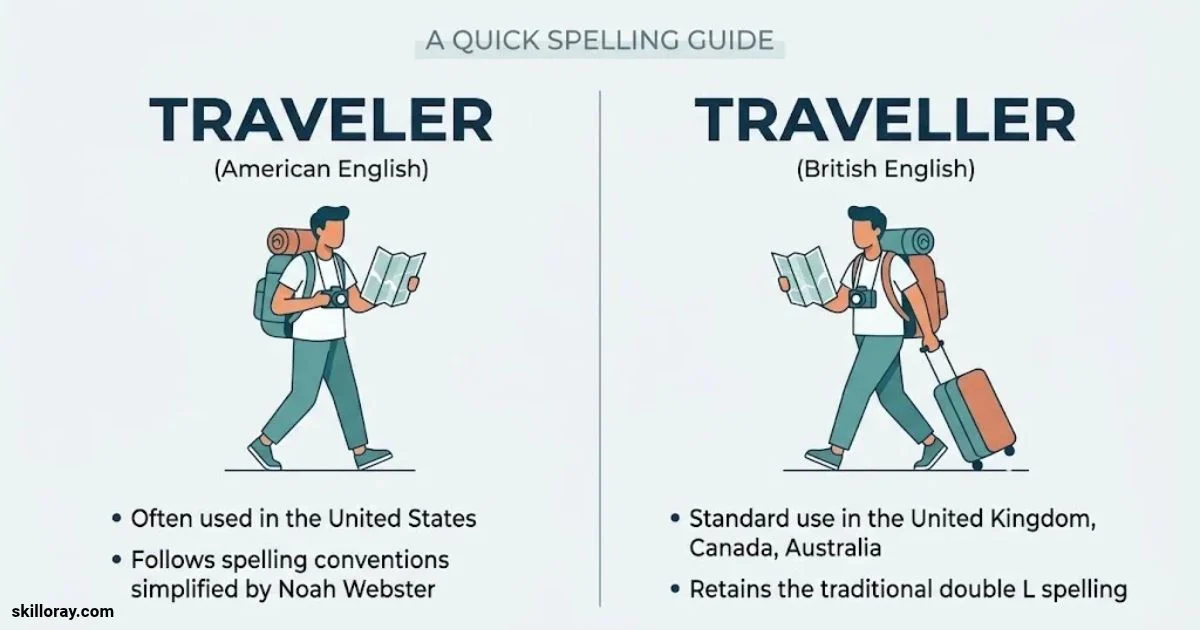
The good news is that neither spelling is wrong. Traveler is the standard spelling in American English, while traveller is preferred in British English and several other varieties. I’ll help you understand why both versions exist and when you should use each one.
In this guide, you’ll discover the difference between traveler and traveller, learn which spelling fits your audience, and explore simple examples to avoid confusion. Whether you’re writing an email, a blog post, or an academic assignment, you’ll know exactly which version to choose.
What Is the Difference Between Traveler and Traveller?
The only difference between traveler and traveller is their spelling. One has a single L, and the other has two.
| Traveler | Traveller |
| American English | British English |
| One L | Two Ls |
| Common in the United States | Common in the United Kingdom |
| Preferred in most US publications | Preferred in many British publications |
For example:
- American: Every traveler should check their passport before departure.
- British: Every traveller should check their passport before departure.
Both sentences are correct. The spelling changes, but the meaning stays exactly the same.
Why Does American English Use Traveler With One L?

The difference comes from regional English spelling conventions. American English often uses a single L in words formed from travel, while British English usually doubles it when certain suffixes are added.
This is why the two varieties have different forms:
| American English | British English |
| Traveler | Traveller |
| Traveling | Travelling |
| Traveled | Travelled |
The base word travel has one L in both varieties. The difference appears when endings such as -er, -ing, and -ed are added.
You may notice a similar pattern in other words:
| American English | British English |
| Canceled | Cancelled |
| Labeled | Labelled |
| Modeled | Modelled |
| Signaling | Signalling |
These examples follow a common regional pattern, although English spelling has exceptions.
When Should You Use Traveler or Traveller?
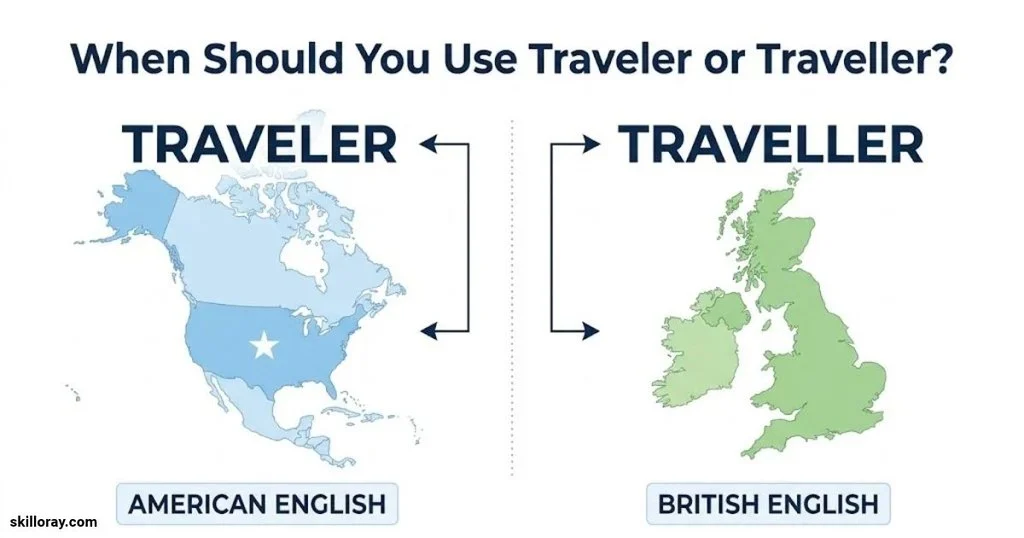
Your audience should guide your spelling choice. Neither version is more correct than the other.
Use traveler for American English.
Choose traveler when writing for readers in the United States. You’ll commonly see this spelling in American newspapers, travel websites, books, and business publications.
Examples:
- The traveler missed his connecting flight because of a delay.
- Our website shares practical advice for first-time travelers.
- Every international traveler should understand the local entry requirements.
- She became a frequent traveler after starting her consulting business.
Use traveller for British English.
Choose traveller when following British spelling conventions. This version is common in the UK and is also widely used in Australia and New Zealand.
Examples:
- The traveller asked the hotel receptionist for directions.
- Every traveller should check the weather before starting a journey.
- The railway station provides assistance for disabled travellers.
- She met several fellow travellers during her trip through Scotland.
If you’re writing for an international audience, select one spelling style and use it throughout your content.
Traveler, Traveling, and Traveled: What’s the Difference?
The same regional spelling difference appears in other forms of the word travel. Knowing these forms can help you avoid inconsistent spelling.
| Word Form | American English | British English |
| Noun | Traveler | Traveller |
| Present participle | Traveling | Travelling |
| Past tense | Traveled | Travelled |
| Past participle | Traveled | Travelled |
Here is how these forms work in everyday sentences:
Traveler or traveller: Describes a person who takes a journey.
- The traveler booked a room near the airport.
- The traveller booked a room near the airport.
Traveling or travelling: Describes the action of going from one place to another.
- We are traveling to Chicago next month.
- We are travelling to Chicago next month.
Traveled or travelled: Describes a journey that has already happened.
- He traveled across Europe last summer.
- He travelled across Europe last summer.
The spelling depends on your English variety, not the tense or meaning of the sentence.
Traveler vs. Traveller: More Examples in Sentences
These examples show how both spellings work in different situations.
| American English | British English |
| The traveler checked in two hours before the flight. | The traveller checked in two hours before the flight. |
| The hotel welcomes international travelers. | The hotel welcomes international travellers. |
| A solo traveler needs to plan carefully. | A solo traveller needs to plan carefully. |
| The traveler lost his luggage at the airport. | The traveller lost his luggage at the airport. |
| Many travelers prefer direct flights. | Many travellers prefer direct flights. |
| The experienced traveler packed light. | The experienced traveller packed light. |
Notice that the sentence structure doesn’t change. You only need to adjust the spelling to match your chosen English style.
Is Traveler or Traveller More Common?
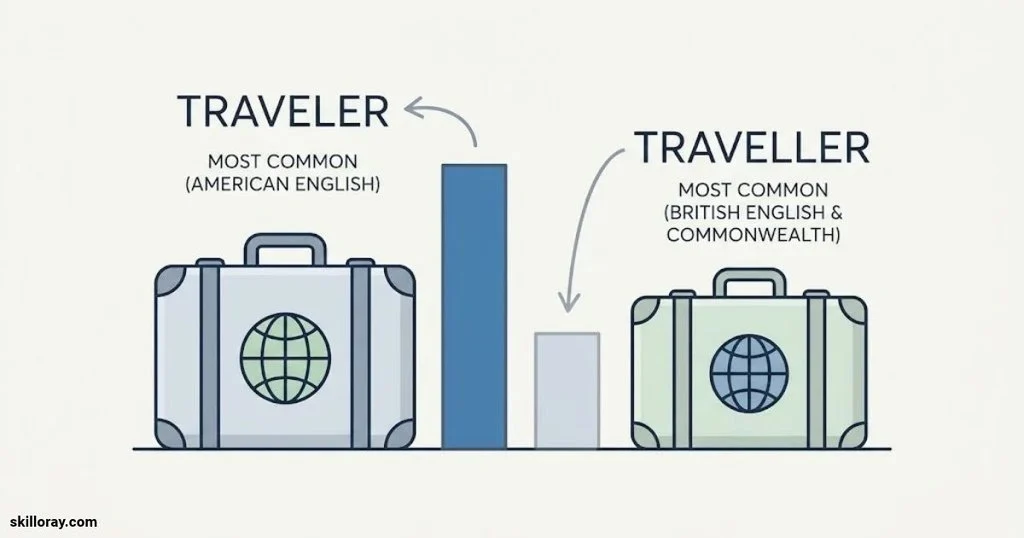
Neither spelling is universally preferred. Their popularity depends on the region and the audience.
Traveler is the standard spelling in the United States. Traveller is the usual choice in British English and other regions that follow British spelling conventions.
For example, an American tourism website would normally write about international travelers. A British travel magazine would generally use international travellers.
When publishing online, consider where your readers live. A website targeting American readers should follow American spelling consistently. The same applies to content written for British or Australian audiences.
Common Mistakes to Avoid
Even though both spellings are correct, writers sometimes make avoidable mistakes.
1. Mixing spelling styles
Using traveler in one paragraph and traveller in another makes your writing inconsistent. Choose one version based on your target audience.
2. Treating one spelling as incorrect
Neither spelling is wrong. The difference reflects American and British English conventions.
3. Forgetting related word forms
If you use American English, write traveling and traveled. If you follow British English, use travelling and travelled.
4. Changing spelling without considering your audience
A British spelling isn’t automatically suitable for an American publication. Follow the spelling conventions your readers expect.
Frequently Asked Questions
1. Is traveler or traveller correct?
Both are correct. Traveler is the standard American English spelling, while traveller is the standard British English spelling.
2. Is traveler American or British?
Traveler is American English. It uses one L and is the preferred spelling in the United States.
3. Is traveller British or American?
Traveller is British English. It uses two Ls and is commonly preferred in the United Kingdom, Australia, and New Zealand.
4. Why does traveller have two Ls?
British English generally doubles the L when adding certain suffixes to travel. That’s why British writers use traveller, travelling, and travelled.
5. Is traveling or travelling correct?
Both are correct. Americans write traveling, while British writers generally use travelling.
6. Is traveled or travelled correct?
Both spellings are accepted. Traveled is the American version, while travelled is the British version.
7. Does traveler or traveller have a different pronunciation?
No. Both spellings have the same pronunciation: /ˈtræv.əl.ər/. The difference is written, not spoken.
8. Which spelling should I use for an international audience?
Choose the spelling that matches your main audience. If you don’t have a specific regional audience, select one English variety and apply it consistently.
Final Thoughts
The choice between traveler and traveller comes down to regional spelling. American English uses one L, while British English uses two.
Remember the simple rule: write traveler for American readers and traveller for British readers. Apply the same pattern to traveling/travelling and traveled/travelled. Consistency is what matters most.

I am Olivia Brown, a professional English editor and grammar writer who believes that great writing begins with a strong foundation in grammar. I have spent years creating educational resources that help students and professionals improve their writing, avoid common errors, and communicate more effectively. I strive to provide clear explanations and practical examples that make grammar easy to understand and apply.
Books: English Grammar Essentials and Modern Writing Success
 Daniel Carter
 James Walker