Have you ever paused while writing and wondered whether to use led or lead? You’re not alone. These two words look almost identical, but their meanings, pronunciations, and uses can be quite different. Choosing the wrong one can easily change the meaning of your sentence.
The difference between led and lead is easier to understand than you might think. Once you learn a simple rule, you’ll know exactly which spelling to use and avoid this common writing mistake.
In this guide, I’ll explain what led and lead mean, how they differ, and when to use each one. You’ll also find simple examples, pronunciation tips, and practical tricks to help you remember the correct spelling whenever you write.
Led or Lead: What’s the Difference?
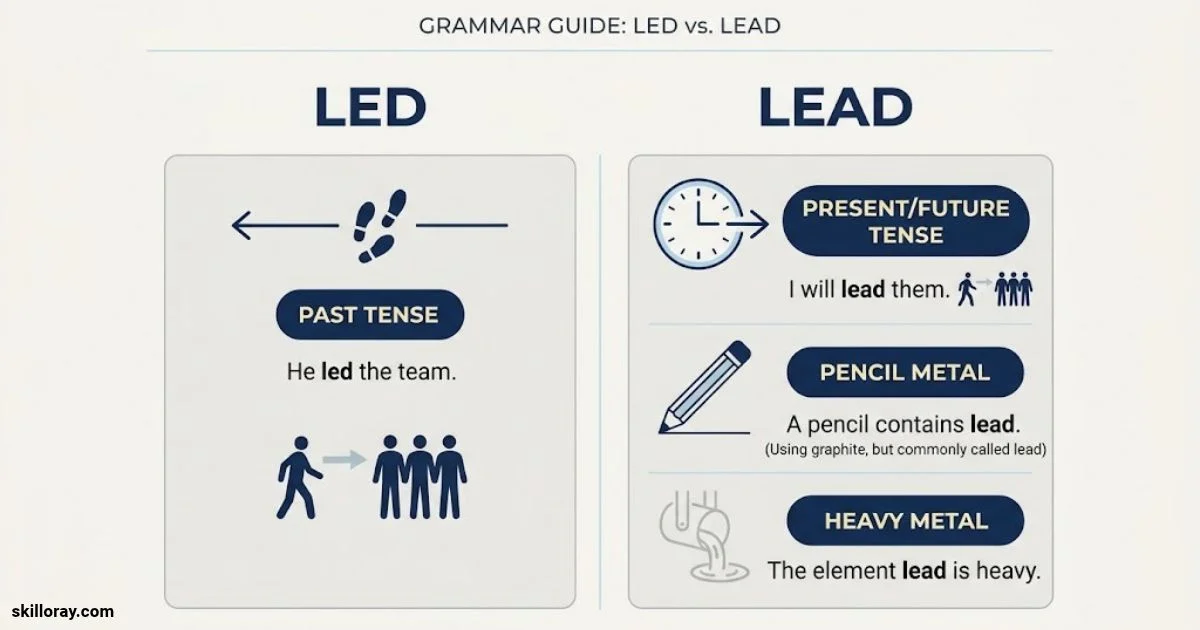
Lead (pronounced leed) is the base form of a verb that means to guide, manage, or direct. It can describe something happening now or an action planned for the future.
Led (pronounced led) is the simple past tense and past participle of lead. Use it when describing guidance or leadership that happened earlier.
There’s also a second meaning of lead. As a noun, it refers to a heavy metal with the chemical symbol Pb. In this case, it’s pronounced led, just like the past-tense verb.
Here’s a quick comparison:
| Word | Pronunciation | Meaning | Example |
| Lead (verb) | Leed | To guide or direct | I lead the team. |
| Led (verb) | Led | Guided or directed | I led the team. |
| Lead (noun) | Led | A type of metal | The paint contains lead. |
Quick rule: Today I lead; yesterday I led. If you’re talking about the metal, the spelling is lead, but the pronunciation is led.
What Does Lead Mean?

The verb lead means to guide people, manage a group, take responsibility, or show someone the way. It can also describe something that causes or results in another thing.
You’ll often see it in conversations about work, education, sports, and everyday responsibilities.
Consider these examples:
- Maya leads the morning shift at our store.
- Our teacher will lead the discussion tomorrow.
- I lead a small team of content writers.
- Good communication can lead to better relationships.
- Follow this road, and it will lead you to the station.
Notice that lead changes to leads when the subject is a third-person singular noun or pronoun in the simple present tense.
For example:
- I lead the project.
- She leads the project.
- They lead the project.
Lead as a Noun
Apart from its use as a verb, lead can also be a noun. One common meaning refers to the chemical element lead (Pb), a heavy metal used in certain industrial applications.
When used this way, it’s pronounced led, not leed.
Examples:
- Some older buildings may contain lead paint.
- The pipes were replaced because they contained lead.
- Children should be protected from exposure to lead.
Context makes the meaning clear. If someone says they lead a team, they’re talking about leadership. If they mention lead pipes, they’re referring to the metal.
What Does Led Mean?

Led is the simple past tense of lead. It describes an action that has already happened.
When someone guided a group, managed a project, or showed others the way in the past, led is the correct choice.
Here are some examples:
- Sarah led the meeting yesterday.
- Our coach led the team to victory.
- My brother led the school debate team last year.
- The manager led the company through a difficult period.
- I led my first client presentation last Friday.
Each example describes something that happened before the present moment.
Led as a Past Participle
Led also works as the past participle of lead. You’ll usually find it after helping verbs such as has, have, and had.
For example:
- She has led several successful projects.
- They have led the organization for years.
- He had led the department before becoming its director.
This is why the sentence “She has lead the team” is incorrect when you mean that she guided the team. The correct version is “She has led the team.”
Lead vs. Led: Verb Forms and Grammar Rules
Understanding the different forms of lead makes the spelling much easier to remember.
| Verb Form | Correct Word | Example |
| Base form | Lead | I want to lead the group. |
| Simple present | Lead / Leads | She leads the group. |
| Simple past | Led | She led the group. |
| Past participle | Led | She has led the group. |
| Present participle | Leading | She is leading the group. |
There are a few simple grammar rules worth remembering.
1. Use Lead for Present Actions
Choose lead when describing someone’s current responsibility or a regular activity.
Examples:
- I lead the morning training sessions.
- Our director leads the company.
- They lead the discussion every Friday.
2. Use Led for Completed Past Actions
If the action happened yesterday, last month, or several years ago, use led.
Examples:
- I led the training session yesterday.
- Our director led the company for ten years.
- They led the discussion last Friday.
3. Use Lead After Modal Verbs
Modal verbs such as will, can, should, and must take the base form of the main verb.
That means you should write lead, not led, after them.
Examples:
- She will lead the next meeting.
- You can lead the project.
- We should lead by example.
- He must lead the team responsibly.
4. Use Led After Has, Have, and Had
When using the present perfect or past perfect tense, choose led.
Examples:
- She has led this department for three years.
- I have led several successful campaigns.
- They had led the project before I joined.
These rules also help you avoid one of the most common mistakes in English writing: using lead as the past participle.
Lead or Led: Examples in Everyday Sentences
Sometimes, the easiest way to understand a grammar rule is to see how people use it in real situations.
The following examples show how the correct word changes with the context.
| Situation | Correct Sentence |
| At work | I lead a team of six employees. |
| At school | Our teacher led the discussion yesterday. |
| In sports | The captain will lead the players onto the field. |
| In business | She has led several successful campaigns. |
| In everyday life | My brother led me to the right classroom. |
| In the future | Who will lead the next meeting? |
You can also understand the difference through a short conversation:
Alex: Who leads your department now?
James: Sarah leads it. She took over last month.
Alex: Who led it before her?
James: Michael led the department for five years.
Both speakers use the correct form because they’re talking about different periods.
Common Mistakes When Using Led and Lead
These words are easy to mix up, especially when writing quickly. A small change in spelling can make a sentence grammatically incorrect.
Here are some mistakes to watch for.
| Incorrect | Correct | Why? |
| She lead the team yesterday. | She led the team yesterday. | The action happened in the past. |
| He has lead the project. | He has led the project. | Use the past participle after has. |
| They will led the meeting. | They will lead the meeting. | Use the base form after will. |
| I led the team every day. | I lead the team every day. | The sentence describes a current routine. |
| Our coach lead us to victory last year. | Our coach led us to victory last year. | The event happened in the past. |
| She is lead the discussion. | She is leading the discussion. | Use the -ing form after is for a continuous action. |
One mistake deserves extra attention: writing leaded instead of led.
When lead means guiding or directing someone, its past tense is always led. You don’t add -ed to form leaded.
Is It Lead, Led, or Leaded?
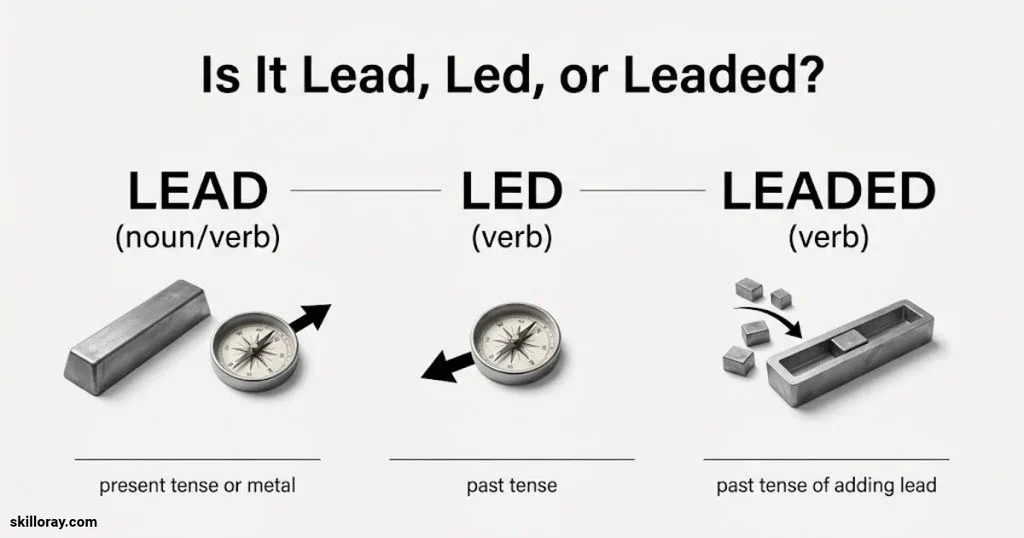
These three spellings can confuse English learners, but they don’t mean the same thing.
- Lead: The base form of the verb meaning to guide or direct. It can also refer to a type of metal.
- Led: The past tense and past participle of the verb lead.
- Leaded: A word used when describing something containing lead metal or having lead added to it.
For example:
- I lead the marketing team.
- I led the marketing team last year.
- The building had old leaded windows.
In the final example, leaded describes windows containing or made with lead. It doesn’t mean someone guided the windows.
So, if you’re describing past leadership, always choose led.
How to Remember the Difference Between Led and Lead
You don’t need to memorize complicated grammar definitions to get this right. A simple time-based trick can help.
Think about today and yesterday.
- Today, I lead the team.
- Yesterday, I led the team.
You can also use a question to check your sentence: Has the action already happened?
If the answer is yes, led is usually the right choice when talking about past guidance or leadership.
Another helpful trick is to remember the verb pattern:
Lead → Led → Led
The first form is the base verb. The second is the simple past, and the third is the past participle.
This pattern is worth remembering because lead is an irregular verb. It doesn’t form its past tense by simply adding -ed.
Frequently Asked Questions About Led and Lead
1. Is it led or lead?
Both spellings are correct, but they have different grammatical uses. Lead is the base form of the verb meaning to guide or direct. Led is its past tense and past participle.
Example: “I lead the team today, but I led it last year.”
2. Is led the past tense of lead?
Yes. Led is the simple past tense of lead when the verb means to guide, manage, or direct someone.
Example: “She led the team during the competition.”
3. Is it lead by example or led by example?
Both expressions are correct, depending on the tense.
- Present: Good managers lead by example.
- Past: She led by example throughout her career.
4. Is it has led or has lead?
The correct expression is has led. Use the past participle led after has.
Example: “Our manager has led the department for five years.”
5. Is lead pronounced the same as led?
No, not when lead is used as a verb meaning to guide someone.
- Lead (verb): Pronounced “leed.”
- Led (past tense): Pronounced “led.”
- Lead (metal): Pronounced “led.”
The metal and past-tense verb sound alike, but their meanings are different.
6. Is it team lead or team led?
Team lead is correct when referring to a person responsible for guiding a team.
Example: “Ask the team lead if you need help.”
Team led can also be correct in a sentence where the team performs an action.
Example: “The team led the competition from the beginning.”
7. Can lead be used in the past tense?
Not when it’s used as a verb meaning to guide or direct. Its past-tense form is led.
For example, write “He led the project last year,” not “He lead the project last year.”
8. What is the difference between lead and leading?
Lead is the base form of the verb, while leading is its present participle.
Examples:
- I want to lead the team.
- I am leading the team.
Both are correct, but their grammatical structures are different.
9. Is leaded ever correct?
Yes. Leaded is used in contexts involving lead metal, such as leaded glass or leaded fuel. However, it isn’t the past tense of the verb meaning to guide. For that meaning, use led.
Final Thoughts
The difference between led and lead becomes much easier once you understand how verb tenses work. Use lead when someone guides or directs others in the present or future. Choose led when describing something that happened in the past or using the past participle.
Don’t forget the second meaning of lead, either. When it refers to the metal, it’s pronounced the same way as led.Keep one simple sentence in mind: Today I lead; yesterday I led. It’s a quick way to remember the correct spelling whenever you’re writing.

I am James Walker, an English language specialist with extensive experience in grammar, editing, and academic writing. I enjoy helping students, bloggers, and professionals strengthen their writing by explaining grammar concepts in a clear and engaging way. My focus is on providing accurate, practical, and easy-to-follow guidance that helps learners communicate more effectively in everyday and professional situations.
Books: Perfect English Grammar Handbook and Advanced Writing Techniques
 Daniel Carter
 Olivia Brown