Have you ever wondered whether to write hustle or hussle? These two spellings look almost identical, and it’s easy to see why people mix them up. Whether you’re writing a social media caption, a business post, or a regular sentence, choosing the right spelling matters.
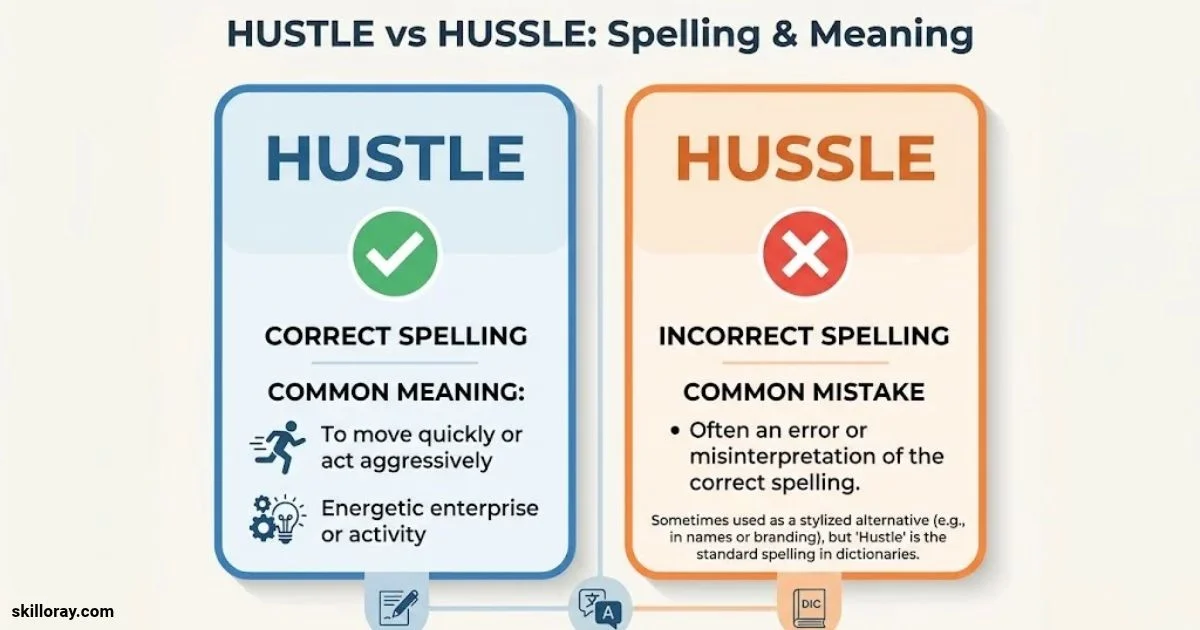
The correct standard English spelling is “hustle,” while “hussle” is generally considered a misspelling.
If you’ve been using both versions interchangeably, I’ll help you understand the difference and avoid this common spelling mistake.
In this guide, you’ll learn what hustle means, why hussle is incorrect in standard English, and how to use the correct word in everyday writing. I’ll also share practical examples to make the difference easy to remember.
Hustle or Hussle: What’s the Difference?
The main difference is that hustle is the standard English spelling, while hussle is not an accepted alternative spelling in ordinary writing.
Although people sometimes type hussle because of the way the word sounds, dictionaries recognize hustle as the correct form.
| Word | Standard Spelling? | Meaning |
| Hustle | Yes | To work energetically, move quickly, or obtain something through dishonest means |
| Hussle | No | Usually a misspelling of hustle |
For example:
- Correct: I need to hustle to finish my assignment.
- Incorrect: I need to hussle to finish my assignment.
The spelling doesn’t change based on the meaning. Whether you’re talking about business, sports, travel, or everyday activities, the correct word is hustle.
What Does Hustle Mean?
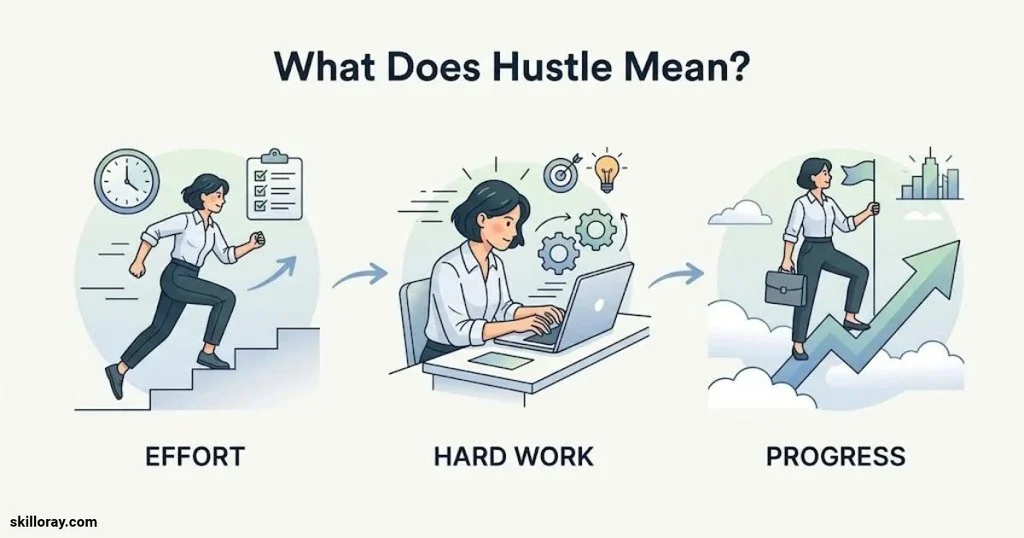
Hustle can function as both a noun and a verb. Its meaning depends on the situation.
Most commonly, it refers to energetic work, determination, or quick movement. However, it can also describe pressuring someone to act quickly or deceiving someone to make money.
Let’s look at its different uses.
Hustle as a Verb
As a verb, hustle can mean to work hard, move quickly, or push someone to move or act faster.
Here are some examples:
- Maya hustles every evening to grow her small clothing business.
- We need to hustle if we want to catch the last bus.
- The coach told the players to hustle during practice.
- My parents hustled us out of the house before school.
- He spent the weekend hustling to finish the renovation.
The word can describe positive effort, physical movement, or urging someone to move faster.
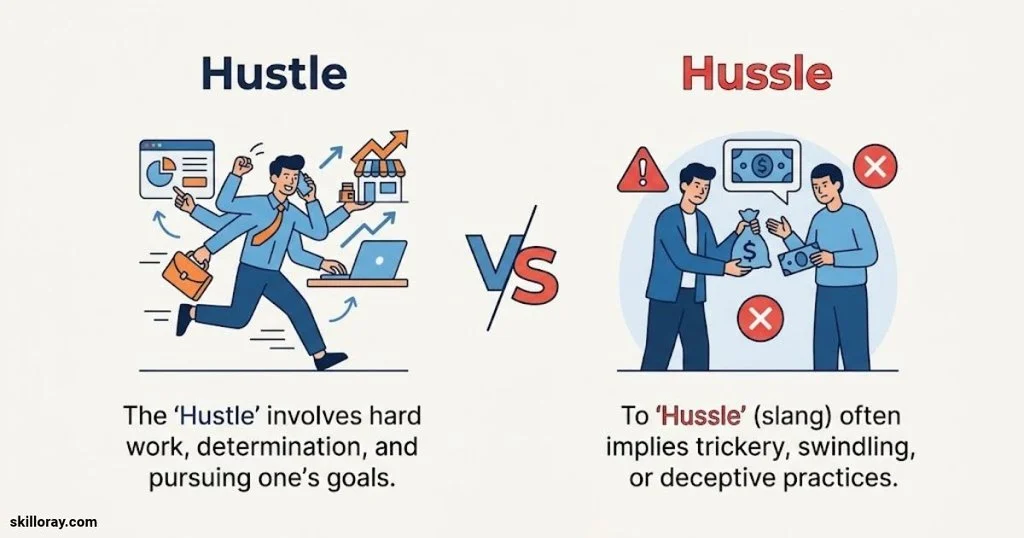
It can also have a negative meaning when someone uses dishonest methods to obtain money or an advantage.
For example:
“The salesperson tried to hustle tourists into buying overpriced souvenirs.”
Here, hustle suggests dishonest or aggressive behavior rather than ordinary hard work.
Hustle as a Noun
As a noun, hustle refers to energetic effort, determination, or an activity involving quick and persistent work.
Examples:
- Her hustle helped her build a business from home.
- Success requires more than talent; it also takes hustle.
- I respect his hustle because he never gives up easily.
- The players showed plenty of hustle during the final quarter.
The noun can also describe a dishonest scheme or activity.
For example:
“The online seller admitted that the entire deal was a hustle.”
In this sentence, the word refers to a dishonest way of making money.
How Do You Pronounce Hustle?
The word hustle is pronounced HUS-uhl.
Its International Phonetic Alphabet (IPA) pronunciation is /ˈhʌs.əl/.
The first syllable sounds like “huh,” while the second has a soft, unstressed sound.
Here is a simple breakdown:
| Feature | Details |
| Correct spelling | Hustle |
| Pronunciation | HUS-uhl |
| IPA | /ˈhʌs.əl/ |
| Number of syllables | Two |
| Middle consonant | One S |
The confusion with hussle often comes from spelling the word according to how it sounds. However, the pronunciation doesn’t change the standard spelling.
Remember that hustle has only one S between the U and T.
Hustle vs. Hussle: Examples in Sentences
Seeing the word in different situations makes its correct usage easier to understand.
Here are examples from everyday life.
| Situation | Example Sentence |
| Business | I hustle every day to grow my online store. |
| Education | She had to hustle to finish her assignment before class. |
| Travel | We hustled through the airport to catch our flight. |
| Sports | The coach praised the team’s hustle during the game. |
| Work | He hustles between two jobs to support his family. |
| Shopping | The vendor tried to hustle customers with misleading offers. |
| Personal goals | Her daily hustle helped her save enough money for college. |
Notice how the meaning changes with the context. Sometimes hustle describes hard work. In other situations, it refers to quick movement or dishonest behavior.
Common Spelling Mistakes
Here are a few incorrect sentences and their corrected versions.
| Incorrect | Correct |
| I need to hussle today. | I need to hustle today. |
| Her hussle is inspiring. | Her hustle is inspiring. |
| He hussles every morning. | He hustles every morning. |
| My side hussle earns extra money. | My side hustle earns extra money. |
| They hussled to reach the station. | They hustled to reach the station. |
The extra S is the main spelling mistake. It doesn’t belong in any standard grammatical form of hustle.
Is Hussle Ever a Correct Word?
Although hussle isn’t the standard spelling of the ordinary English word, you may encounter it in other contexts.
For example, the late American rapper <Entity value=”Nipsey Hussle” category=”musical_artist” disambig=”American rapper and entrepreneur”/> used Hussle as his professional name.
You might also see the spelling in:
- Business and clothing brand names.
- Social media usernames.
- Artistic identities.
- Creative slogans and logos.
These uses don’t make hussle an accepted alternative spelling in standard English.
Think of it this way: a person or business can choose a creative name, but that doesn’t change the spelling rules of the language.
If you’re describing hard work, determination, or quick movement, write hustle.
Hustle, Grind, and Hard Work: What’s the Difference?
These three expressions are closely related, but they don’t mean exactly the same thing.
Understanding the differences can help you choose the right word when writing about work, business, or personal goals.
| Word | Meaning | Example |
| Hustle | Energetic effort, initiative, or quick action | She hustles to grow her business. |
| Grind | Persistent effort, often involving repetitive or difficult work | He continues to grind toward his career goals. |
| Hard work | Consistent effort and dedication toward a task | Her hard work helped her earn a promotion. |
For example, someone might work hard at their regular job, grind through difficult training, and hustle to build a side business.
The words overlap, but each emphasizes a slightly different aspect of effort.
Common Expressions That Use Hustle
You may have heard hustle in everyday conversations, business discussions, or motivational messages.
Here are some popular expressions and what they mean.
| Expression | Meaning | Example |
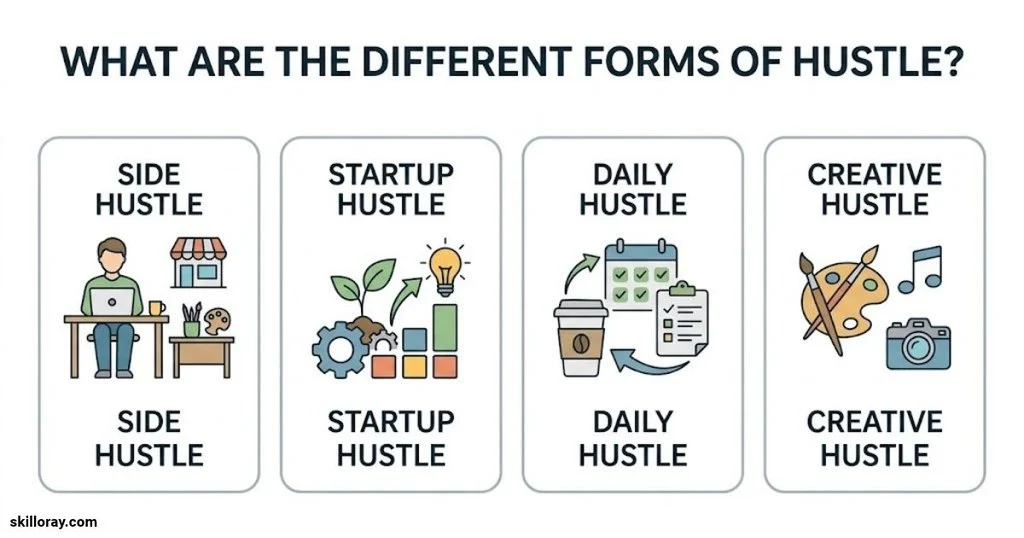
| Side hustle | An additional income-generating activity | Photography is my side hustle. |
| Hustle and bustle | Busy activity and movement | She enjoys the hustle and bustle of city life. |
| Daily hustle | Everyday work and responsibilities | His daily hustle starts before sunrise. |
| Hustle hard | Work with energy and determination | They hustle hard to reach their goals. |
| Hustle culture | A mindset that places heavy emphasis on constant work and productivity | Hustle culture can make people feel guilty about resting. |
One expression worth knowing is side hustle. It describes work you do outside your main job to earn additional income.
For example, a full-time office employee who designs websites for clients during weekends has a side hustle.
What Are the Different Forms of Hustle?
Hustle is a regular English verb, so its past tense and other forms follow a predictable spelling pattern.
| Verb Form | Word | Example |
| Base form | Hustle | I hustle every day. |
| Third-person singular | Hustles | She hustles after work. |
| Simple past | Hustled | He hustled to finish the project. |
| Past participle | Hustled | They have hustled for years. |
| Present participle | Hustling | She is hustling to meet the deadline. |
Notice that the word keeps its original spelling pattern. You don’t double the S when adding grammatical endings.
For example, write hustled, not hussled.
Frequently Asked Questions (FAQs)
1. Is it hustle or hussle?
Hustle is the correct standard English spelling. Hussle is generally a misspelling, although it may appear in personal names, brands, and creative usernames.
2. What does hustle mean?
Hustle can mean working energetically, moving quickly, or making an effort to achieve something. It can also describe a dishonest scheme or an attempt to obtain money through deception.
3. How do you spell hustle correctly?
The correct spelling is H-U-S-T-L-E. It contains one S between the U and T.
4. Is hussle a real word?
Hussle isn’t recognized as a standard alternative spelling of hustle. However, it can be used as a proper name, brand name, or creative spelling.
5. What is the past tense of hustle?
The past tense of hustle is hustled.
Example: “She hustled all week to complete the project.”
6. What is a side hustle?
A side hustle is an additional job or income-generating activity that someone does alongside their main job.
For example, selling handmade products online while working full-time is a side hustle.
7. Is hustle a noun or a verb?
Hustle can be both a noun and a verb.
- Noun: Her hustle helped her build a successful business.
- Verb: She hustles every day to improve her business.
8. Is hustle the same as hard work?
Not exactly. Hard work refers to consistent effort and dedication. Hustle often suggests energetic action, initiative, and determination. The meanings overlap, but they’re not identical.
9. What is the pronunciation of hustle?
Hustle is pronounced HUS-uhl, with the IPA pronunciation /ˈhʌs.əl/. It has two syllables, with the stress on the first.
Final Thoughts
When deciding between hustle or hussle, remember that hustle is the standard English spelling. It can describe energetic work, quick movement, determination, or even a dishonest scheme.
You might see Hussle in a person’s name or a brand, but that doesn’t make it a standard alternative spelling. If you’re writing about a business, a side job, or rushing to catch a train, the spelling stays the same.

I am Daniel Carter, a grammar enthusiast and language educator with over 10 years of experience helping students and professionals improve their English writing and communication skills. I enjoy simplifying complex grammar rules into easy-to-understand lessons that anyone can follow. My goal is to help learners write with confidence, avoid common mistakes, and develop strong communication skills for academic and professional success. I regularly create practical grammar guides, writing tips, and language resources that make learning both enjoyable and effective.
Books: Mastering English Grammar and The Complete Guide to Better Writing
 Olivia Brown
 James Walker