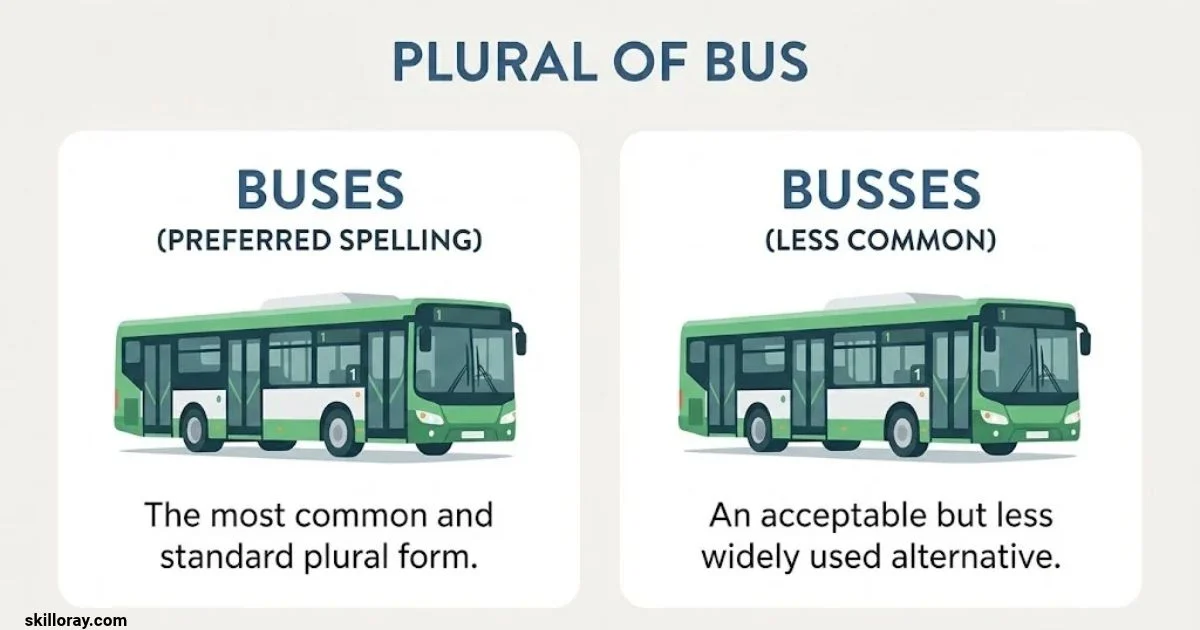
Have you ever wondered whether the correct spelling is buses or busses? Both words look familiar, but only one is generally accepted in modern English when referring to more than one bus. This spelling confusion often happens because English words ending in -s don’t always follow the same pluralization rules.
The correct plural form of bus is buses. You should use it when talking about two or more vehicles that carry passengers. Although busses may look like a reasonable choice, it’s not the standard spelling for the plural of bus. However, busses does exist as a separate word with a different meaning, which makes the distinction worth understanding.
In this guide, you’ll learn the difference between buses and busses, discover why buses is the preferred spelling, and explore simple examples to help you remember the correct form. We’ll also look at common spelling mistakes and explain when each word is appropriate so you can write with greater confidence.
What Is the Difference Between Buses and Busses?
The main difference is how commonly each spelling is used. Both can refer to more than one bus, but buses is the usual choice in everyday writing.
| Word | Meaning | Example |
| Buses | Standard plural of bus | Three buses arrived at the station. |
| Busses | Alternative American English plural of bus | The busses carried passengers across town. |
| Busses | Plural of buss, meaning a kiss | The old poem described their affectionate busses. |
For most readers, buses will look more familiar. It’s the spelling you’ll generally want in school assignments, business writing, articles, and everyday communication.
What Does Buses Mean?
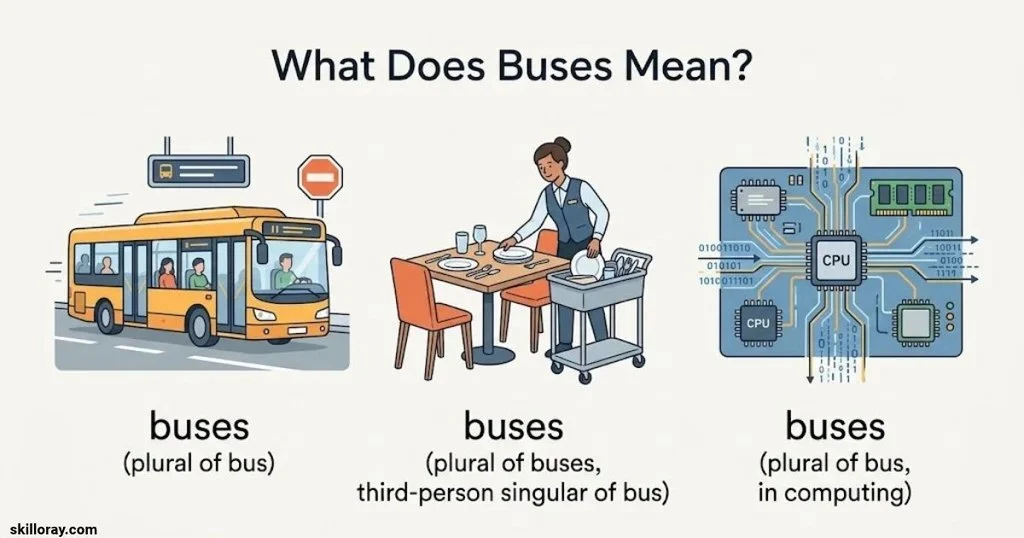
Buses is the plural form of bus, a vehicle designed to carry multiple passengers. Buses usually operate along planned routes or provide transportation for a particular group.
To form the standard plural, add -es to bus:
Bus → Buses
For example:
- Several buses were waiting outside the train station.
- The school arranged two buses for the students.
- City buses run less frequently on Sundays.
- The company recently added electric buses to its fleet.
- Tour buses stopped near the entrance to the museum.
The word works in many transportation contexts, including school buses, shuttle buses, tour buses, and public transit.
Why Is the Plural of Bus Buses?
Many English nouns ending in s, ss, sh, ch, or x form their plural by adding -es. This creates a plural ending that’s easier to pronounce.
Here are some familiar examples:
| Singular | Plural |
| Bus | Buses |
| Class | Classes |
| Glass | Glasses |
| Dish | Dishes |
| Watch | Watches |
| Box | Boxes |
The same pattern explains the standard spelling buses. Although busses is also recorded as a variant, you don’t need the extra s for the usual plural form.
Is Busses a Correct Word?

Yes. Busses is a real word with more than one recognized use.
First, it can be an alternative plural spelling of bus in American English. Some dictionaries record it, although buses remains the more common form.
Second, busses is the plural of buss, an old-fashioned noun meaning a kiss.
For example:
- The old poem described several affectionate busses.
- She remembered the playful busses exchanged before the journey.
The second meaning is uncommon in modern conversation. You’re much more likely to encounter busses when someone uses it as an alternative spelling for multiple buses.
Busses as an Alternative Plural of Bus
You might see busses in books, newspapers, or other American English publications. It isn’t automatically a spelling mistake.
However, that doesn’t mean it’s the best choice for every situation. If you want the spelling most readers recognize, use buses.
For example:
- Preferred: The buses arrived before the passengers.
- Also recognized: The busses arrived before the passengers.
Both sentences refer to multiple vehicles. The first uses the standard, more familiar spelling.
Buses or Busses: Which One Should You Use?
For most everyday writing, choose buses. It’s the standard plural spelling and is widely used in both American and British English.
You can use busses when following a source or publication that prefers the alternative form. If you’re writing for a school, employer, or website, follow its editorial guidelines.
Here are some examples:
| Writing situation | Recommended spelling |
| School assignments | Buses |
| Business documents | Buses |
| Public transportation articles | Buses |
| Travel guides | Buses |
| General American English | Buses |
| A publication using the alternative form | Busses, if its style guide prefers it |
The goal isn’t to treat the alternative as incorrect. It’s to choose the spelling that makes your writing clear and consistent.
Buses in Example Sentences
A few everyday examples can make the spelling easier to remember.
- The buses were packed with passengers during the morning rush.
- Our school hired three buses for the annual field trip.
- Several electric buses now operate along the city route.
- The tour buses stopped outside the historic building.
- The transportation department plans to replace its older buses.
- We waited at the station until the last bus arrived.
- The company added more shuttle buses for its employees.
- School buses must follow the required safety regulations.
In each sentence, buses refers to more than one vehicle.
If you’re using the alternative spelling, the same sentences can use busses. The meaning stays the same.
Bus’s or Buses: What’s the Difference?
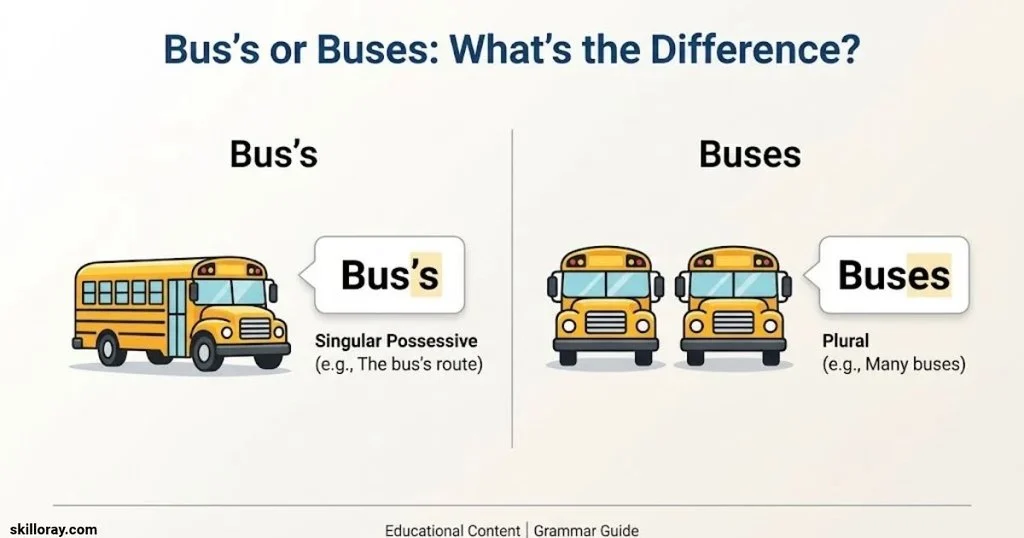
Bus’s and buses look similar, but they serve different grammatical purposes.
- Buses: The plural form of bus. It means more than one vehicle.
- Bus’s: The possessive form of bus. It shows that something belongs to one bus.
Consider these examples:
| Word | Example | Explanation |
| Bus | One bus is parked outside. | Singular noun |
| Buses | The buses are parked outside. | Plural noun |
| Bus’s | The bus’s engine needs repair. | Possessive noun |
Don’t use an apostrophe to form an ordinary plural.
For example, write The buses are late, not The bus’s are late.
This small distinction can prevent a common punctuation mistake.
Common Mistakes to Avoid
Even though the difference is straightforward, a few spelling and grammar mistakes are worth watching for.
1. Assuming Busses Is Always Incorrect
Some writers believe busses is never acceptable. However, dictionaries recognize it as an alternative plural of bus in American English.
Use buses as your default, but understand that the alternative exists.
2. Using an Apostrophe for the Plural
The plural of bus doesn’t need an apostrophe.
- Correct: The buses are full.
- Incorrect: The bus’s are full.
Use bus’s only when showing possession by one bus.
3. Confusing Bus With Buss
These are two separate words.
Bus refers to a passenger vehicle. Buss means a kiss and is now old-fashioned.
Their meanings are different even though their spellings look similar.
4. Switching Between Buses and Busses
Using both spellings in the same article can distract readers.
Choose one form and stick with it unless you’re quoting a source or discussing the spelling difference itself.
Frequently Asked Questions
Is Buses or Busses Correct?
Both are accepted plural spellings of bus. However, buses is the standard and more common form. Busses is also recognized as an American English alternative.
Is Busses a Real Word?
Yes. Busses can be an alternative plural of bus. It’s also the plural of buss, an old-fashioned word meaning a kiss.
What Is the Plural of Bus?
The standard plural of bus is buses. Some dictionaries also recognize busses as an alternative spelling.
Is Busses American or British English?
Busses is recognized as an American English alternative plural of bus. Buses is the standard spelling in both American and British English.
Is It Bus’s or Buses?
Use buses when referring to multiple vehicles. Use bus’s when something belongs to one bus.
For example, “The buses are clean” refers to several vehicles, while “The bus’s door is open” describes one vehicle’s door.
What Is the Plural of School Bus?
The plural of school bus is school buses. For example, “The school ordered four new buses for its students.”
Why Do We Add -es to Bus?
English commonly adds -es to nouns ending in s, sh, ch, x, and similar sounds. That’s why the standard plural is buses rather than bus’s.
Conclusion
Both buses and buses can be correct when referring to multiple vehicles. However, buses is the standard spelling and the better choice for most everyday writing. The alternative bus is recognized in American English and also has a separate meaning as the plural of buss, meaning a kiss.
When writing about public transportation, school trips, or travel, choose buses. It’s familiar, widely accepted, and unlikely to confuse your readers.

I am Olivia Brown, a professional English editor and grammar writer who believes that great writing begins with a strong foundation in grammar. I have spent years creating educational resources that help students and professionals improve their writing, avoid common errors, and communicate more effectively. I strive to provide clear explanations and practical examples that make grammar easy to understand and apply.
Books: English Grammar Essentials and Modern Writing Success
 Daniel Carter
 James Walker