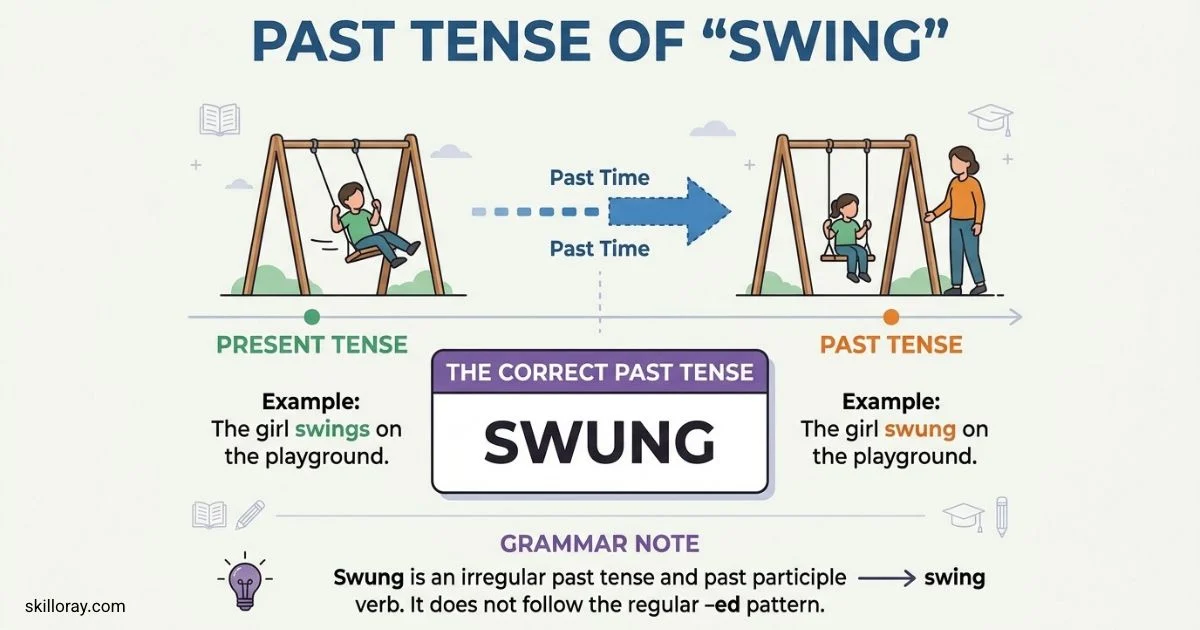
Have you ever paused while writing a sentence and wondered whether the past tense of swing is swung or swinged? You’re not alone! Even English learners who know the basic grammar rules sometimes find irregular verbs confusing.
I want to make this simple for you. The correct past tense of swing is swung, not swinged in standard English. Once you understand how this verb works, you’ll find it much easier to use it correctly in everyday conversations and writing.
In this guide, you’ll learn the past tense of swing, its past participle, and the differences between its verb forms. I’ll also share clear example sentences and common mistakes to help you build confidence and improve your English grammar.
What Are the Three Forms of Swing?
The verb swing has three main forms: the base form, the simple past tense, and the past participle.
| Verb form | Word | Example |
| Base form | Swing | I swing the bat during practice. |
| Simple past | Swung | I swung the bat yesterday. |
| Past participle | Swung | I have swung the bat before. |
| Present participle | Swinging | The child is swinging outside. |
| Third-person singular | Swings | He swings the racket confidently. |
Notice that swung serves as both the simple past form and the past participle. The auxiliary verb helps determine the tense when you use it in a longer sentence.
Is It Swung or Swinged?
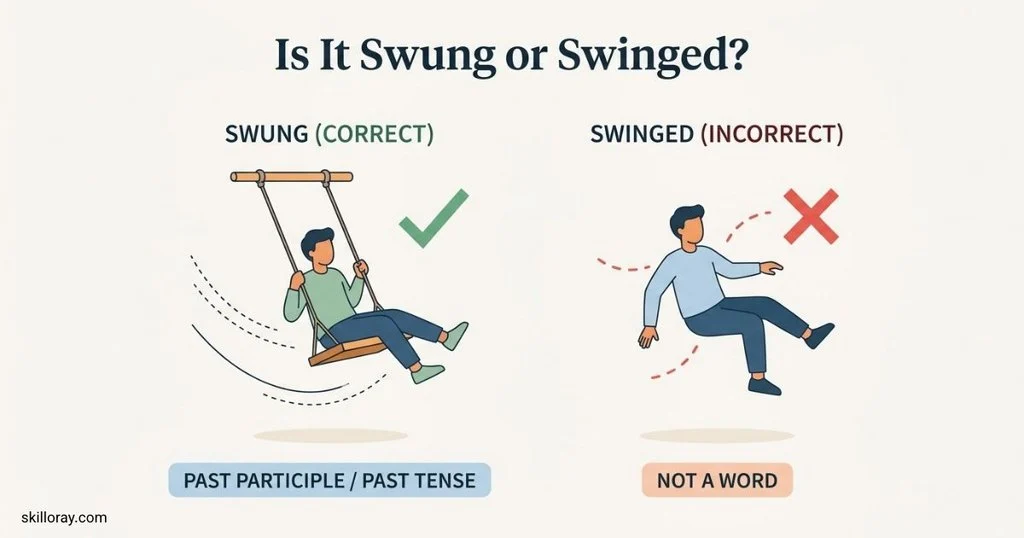
Swung is the standard past tense of swing. Although swinged may appear in unusual or nonstandard contexts, it’s not the correct choice in ordinary standard English.
Here are some examples:
- Correct: The door swung open in the wind.
- Incorrect in standard English: The door swinged open in the wind.
- Correct: He swung the golf club and missed the ball.
- Incorrect in standard English: He swinged the golf club and missed the ball.
Why does this happen? English has many irregular verbs that change their forms instead of simply adding -ed. For example, sing becomes sang, and ring becomes rang. Similarly, swing becomes swung.
If you’re unsure which form to use, remember this simple pattern: swing → swung → swung.
How to Use Swung in a Sentence
The word swung can describe physical movement, sports actions, or changes in direction and opinion. The meaning depends on the context.
1. Physical movement
Use swung when someone or something moved freely from one position to another.
- The gate swung shut behind us.
- The child swung from the monkey bars.
- A heavy branch swung over the path.
2. Sports and physical activities
In sports, swung often describes moving a bat, racket, golf club, or similar object.
- The batter swung at the pitch.
- Maya swung her racket but missed the ball.
- He swung the golf club with both hands.
3. Changes in direction or opinion
Swung can also describe a shift in attitude, support, or direction.
- Public opinion swung in favor of the proposal.
- The conversation swung toward a different topic.
- The team’s momentum swung after the second goal.
These examples show that swung isn’t limited to literal movement. It can also describe a noticeable change.
Swing in Different Tenses
Although swung is the simple past form and past participle, swing appears in several different tenses. The following examples show how to use it correctly.
| Tense | Example sentence |
| Simple present | I swing the bat every morning. |
| Simple past | I swung the bat yesterday. |
| Simple future | I will swing the bat tomorrow. |
| Present continuous | I am swinging the bat now. |
| Past continuous | I was swinging the bat when it started raining. |
| Present perfect | I have swung a golf club before. |
| Past perfect | I had swung the bat before the coach called time. |
| Future perfect | By noon, I will have swung the bat hundreds of times. |
Pay attention to the difference between the simple past and perfect tenses.
In “I swung the bat yesterday,” swung expresses a completed past action. In “I have swung the bat before,” the auxiliary verb have combines with the past participle to form the present perfect tense.
Common Mistakes When Using Swing
Even though swing has a straightforward pattern, a few mistakes are worth avoiding.
Mistake 1: Using swinged instead of swung
Incorrect: She swinged the door open.
Correct: She swung the door open.
Mistake 2: Using swing instead of swung for a completed past action
Incorrect: He swing the bat during yesterday’s game.
Correct: He swung the bat during yesterday’s game.
Mistake 3: Using swung after “is” to describe an ongoing action
Incorrect: The child is swung on the playground.
Correct: The child is swinging on the playground.
The first sentence could work in a different passive construction, but it doesn’t express the usual meaning of an ongoing action. Use is swinging when you mean that the child is moving on a swing right now.
Frequently Asked Questions
What is the past tense of swing?
The past tense of swing is swung. For example, “The door swung open.”
Is swinged ever correct?
Swinged is not the standard past tense of swing in ordinary English. Use swung in formal writing, schoolwork, and everyday conversation.
What is the past participle of swing?
The past participle is also swung. You can use it with auxiliary verbs, as in “She has swung the racket before.”
Is swing an irregular verb?
Yes. Swing is an irregular verb because its past tense doesn’t follow the regular -ed pattern. Its main forms are swing, swung, swung.
What is the difference between swung and swinging?
Swung is the simple past form and past participle. Swinging is the present participle, used in continuous constructions such as “He is swinging the bat.”
Final Answer
The past tense of swing is swung, and its past participle is also swung. Use swung to describe a completed past action or to form perfect tenses.
Remember the three main forms: swing, swung, swung. Once you know this pattern, you’ll have no trouble using the verb correctly in sentences.

I am Daniel Carter, a grammar enthusiast and language educator with over 10 years of experience helping students and professionals improve their English writing and communication skills. I enjoy simplifying complex grammar rules into easy-to-understand lessons that anyone can follow. My goal is to help learners write with confidence, avoid common mistakes, and develop strong communication skills for academic and professional success. I regularly create practical grammar guides, writing tips, and language resources that make learning both enjoyable and effective.
Books: Mastering English Grammar and The Complete Guide to Better Writing
 Olivia Brown
 James Walker