Have you ever paused while writing, wondering whether a colon or semicolon belongs in your sentence? You’re not alone. These two punctuation marks look similar in purpose, but they serve different roles, and choosing the wrong one can affect how clearly you communicate.
I know grammar rules can feel confusing when textbooks make simple ideas sound complicated. That’s why this guide breaks down the difference between a colon and a semicolon using straightforward explanations and practical examples. You don’t need to memorize complicated definitions to understand how they work.
By the end of this guide, you’ll know when to use a colon, when to choose a semicolon, and how to avoid common punctuation mistakes. Whether you’re a student, blogger, or professional writer, you can use these simple rules to make your writing clearer and more confident.
Colon or Semicolon: What’s the Difference?
The main difference is how each punctuation mark connects information.
| Punctuation | When to Use It | Example |
| Colon (:) | Introduces a list, explanation, or example | I need three things: a notebook, a pen, and a ruler. |
| Semicolon (;) | Connects two related independent clauses | I finished my homework; my brother was still working. |
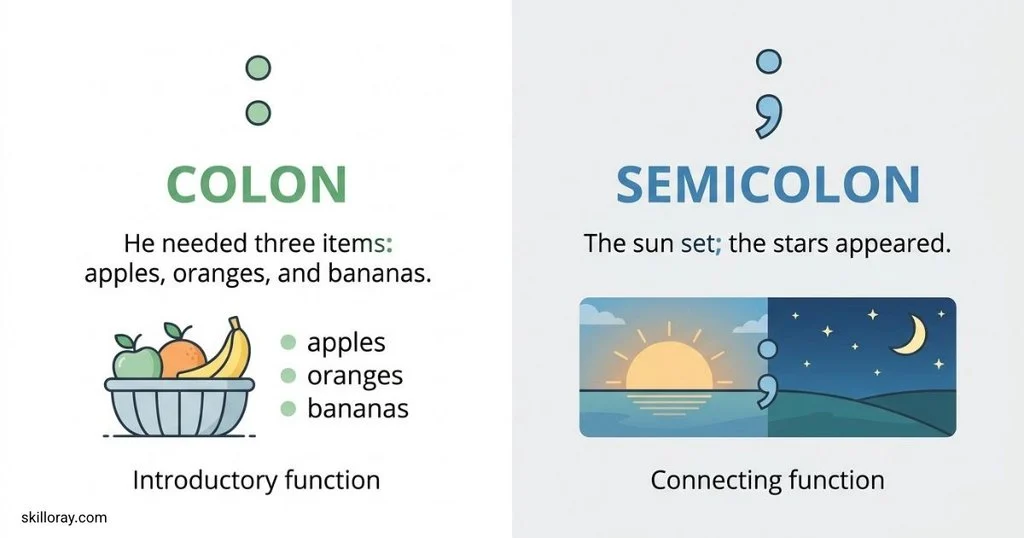
A simple way to remember the rule is to think of a colon as an introduction and a semicolon as a connection.
When to Use a Colon (:)
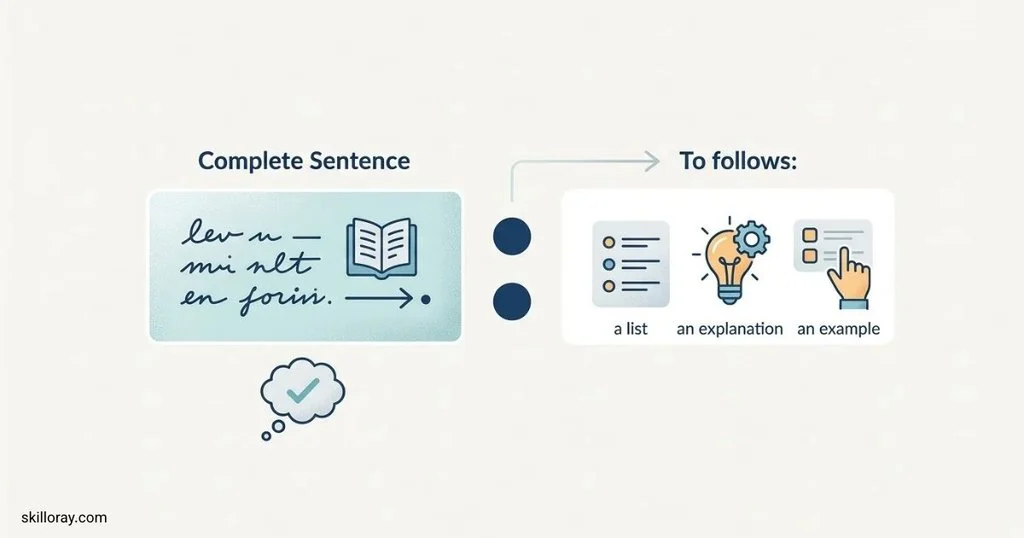
Use a colon when you want to introduce information that explains, illustrates, or expands on what comes before it. The words before the colon should generally form a complete sentence.
1. To introduce a list
A colon works well when a complete sentence leads into a list.
Example:
I need three ingredients for the recipe: flour, sugar, and butter.
The phrase I need three ingredients for the recipe forms a complete sentence, so a colon fits naturally.
Avoid placing a colon directly between a verb and its objects.
- Incorrect: My favorite subjects are: English, history, and science.
- Correct: My favorite subjects are English, history, and science.
2. To explain an idea
A colon can introduce an explanation that clarifies the preceding statement.
Example:
Maya made one mistake: she submitted the wrong file.
The second part explains what Maya did wrong.
3. To introduce an example
You can use a colon to present specific examples of a broader point.
Example:
Several everyday habits can save time: preparing meals in advance, organizing your workspace, and planning your schedule.
4. To introduce a quotation
A colon can introduce a quotation when the preceding clause sets it up as supporting information.
Example:
The teacher offered this advice: “Read each question carefully before answering.”
A colon isn’t necessary before every quotation. Often, a quotation fits directly into the sentence without one.
5. To emphasize a final point
Sometimes a colon draws attention to the most important part of a sentence.
Example:
She knew exactly what she needed to do: start again.
The final phrase emphasizes the action that matters.
When to Use a Semicolon (;)
A semicolon connects closely related independent clauses. An independent clause contains a subject and a verb and expresses a complete thought.
Use a semicolon when two ideas belong together but you don’t want to join them with a coordinating conjunction such as and or but.
1. To connect two related sentences
Example:
The library was closing; I still had two chapters to read.
Both sides can stand alone as sentences:
- The library was closing.
- I still had two chapters to read.
The semicolon links these related thoughts without separating them completely.
2. Before words such as “however” and “therefore”
A semicolon can come before a conjunctive adverb when it connects two independent clauses. These words include however, therefore, nevertheless, and consequently.
Examples:
- I prepared for the presentation; however, the meeting was postponed.
- The roads were flooded; therefore, we stayed home.
- The task looked difficult; nevertheless, she completed it.
Notice the comma after however, therefore, and nevertheless.
3. To separate items in a complicated list
Semicolons can make a list easier to read when individual items already contain commas.
Example:
The workshop attracted visitors from Austin, Texas; Toronto, Ontario; and Bristol, England.
The semicolons separate the three locations, while the commas remain part of each location’s name.
For a simple list, commas are usually enough. Save semicolons for lists that would otherwise be confusing.
Colon vs. Semicolon: Compare These Examples
Sometimes the easiest way to understand the difference is to see how the same general idea changes with punctuation.
<box border radius=”lg” padding={3} gap={3}> <box gap={1}> <title size=”md”>Colon: introducing an explanation</title> <text>He had one concern: the deadline was approaching.</text> <text color=”secondary” size=”sm”>The words after the colon explain his concern.</text> </box> <divider color=”subtle” /> <box gap={1}> <title size=”md”>Semicolon: connecting related thoughts</title> <text>The deadline was approaching; he needed to work faster.</text> <text color=”secondary” size=”sm”>Both sides are independent clauses, and the semicolon connects them.</text> </box> <divider color=”subtle” /> <box gap={1}> <title size=”md”>Comma: joining clauses with a conjunction</title> <text>The deadline was approaching, so he worked faster.</text> <text color=”secondary” size=”sm”>The comma works with the coordinating conjunction “so.”</text> </box> </box>
All three sentences are grammatically sound. The best choice depends on how you want to present the relationship between the ideas.
Can You Use a Colon and Semicolon Interchangeably?
Usually, no. Each punctuation mark follows different rules.
A colon typically introduces information that explains or develops the preceding statement. A semicolon usually connects independent clauses or separates complex list items.
Compare these sentences:
- Colon: She had one goal: to finish the project.
- Semicolon: She finished the project; her team celebrated.
In the first example, the colon introduces the goal. In the second, the semicolon connects two complete thoughts.
A colon can also introduce a complete explanatory clause, as in The conclusion was clear: the plan had failed. However, you shouldn’t use a colon and a semicolon as though they were interchangeable marks between any two sentences.
Common Colon and Semicolon Mistakes
A few simple checks can help you avoid the most frequent punctuation errors.
Using a colon after a verb
Incorrect: The supplies include: paper, pencils, and folders.
Correct: The supplies include paper, pencils, and folders.
The words before the list don’t form a complete sentence on their own. The colon isn’t needed.
Using a semicolon before a dependent clause
Incorrect: I stayed home; because I felt tired.
Correct: I stayed home because I felt tired.
The phrase because I felt tired depends on the main clause. A semicolon generally can’t join an independent clause directly to a dependent clause.
Joining independent clauses with a comma alone
Incorrect: I wanted to leave, I was enjoying the conversation.
Correct: I wanted to leave, but I was enjoying the conversation.
Also correct: I wanted to leave; I was enjoying the conversation.
A comma alone generally can’t join two independent clauses. This error is called a comma splice.
Putting a semicolon before “and”
Incorrect: I finished the report; and I sent it to my manager.
Correct: I finished the report, and I sent it to my manager.
A comma is normally used before a coordinating conjunction such as and when it joins two independent clauses. A semicolon is usually unnecessary in this construction.
Capitalizing automatically after a colon
American English generally uses lowercase after a colon, but some style guides capitalize a complete sentence that follows one.
For example:
- The reason was simple: we ran out of time.
- The reason was simple: We ran out of time.
Both conventions appear in published writing. Follow your chosen style guide and apply its rule consistently.
Colon or Semicolon in Academic and Professional Writing
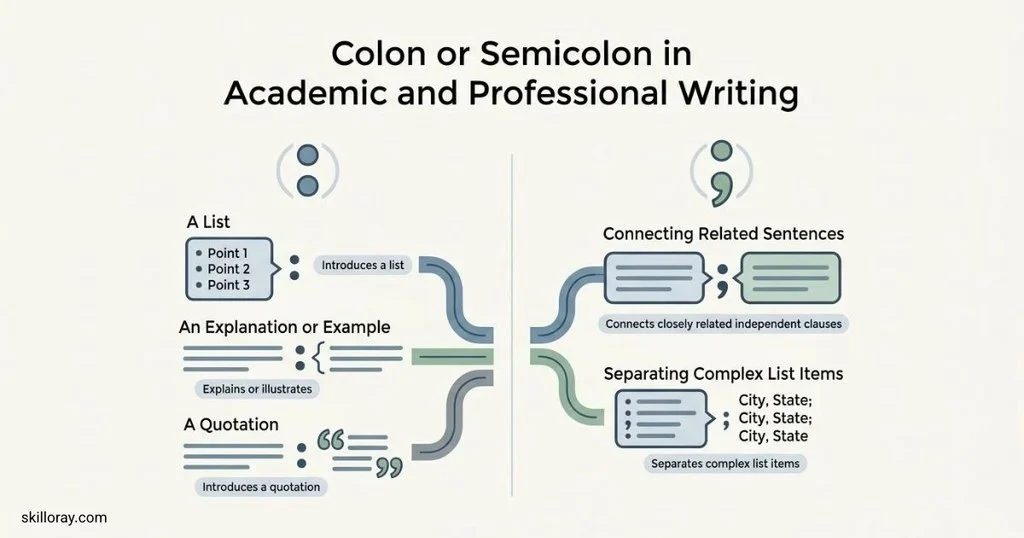
Both marks can improve formal writing when they clarify the relationship between ideas.
In academic writing, a colon can introduce a finding, explanation, or list of supporting details.
Example:
The study identified three major concerns: cost, accessibility, and reliability.
A semicolon can connect related claims without requiring two separate sentences.
Example:
The initial results were promising; further testing was still necessary.
In reports, essays, and professional emails, neither punctuation mark needs to appear in every paragraph. If a shorter sentence communicates the idea more clearly, a period may be the better choice.
Frequently Asked Questions
Is a colon or semicolon used before a list?
A colon is the usual choice when a complete sentence introduces a list. Semicolons are useful for separating complex list items that already contain commas.
Can a semicolon replace a period?
Yes. You can use a semicolon instead of a period when two independent clauses are closely related. A period separates the thoughts more distinctly.
Can a colon connect two complete sentences?
A colon can introduce a second clause that explains or expands on the first. For example: The conclusion was clear: the plan had failed. The second clause explains the conclusion.
Is a semicolon stronger than a comma?
A semicolon creates a stronger separation than a comma and can join two independent clauses. A comma has different uses, including separating list items and marking introductory phrases.
Do you capitalize the word after a colon?
In American English, lowercase is common after a colon. However, some style guides capitalize a complete sentence that follows. Check the style guide you’re using.
Which is more formal: a colon or semicolon?
Neither is automatically more formal. Both are appropriate in academic and professional writing when used correctly.
Final Rule: Colon or Semicolon?
Use a colon (:) to introduce information and a semicolon (;) to connect closely related independent clauses or separate complex list items.
When you’re unsure, check what comes before and after the punctuation mark. That quick check will usually help you choose the right one.

I am Olivia Brown, a professional English editor and grammar writer who believes that great writing begins with a strong foundation in grammar. I have spent years creating educational resources that help students and professionals improve their writing, avoid common errors, and communicate more effectively. I strive to provide clear explanations and practical examples that make grammar easy to understand and apply.
Books: English Grammar Essentials and Modern Writing Success
 Daniel Carter
 James Walker