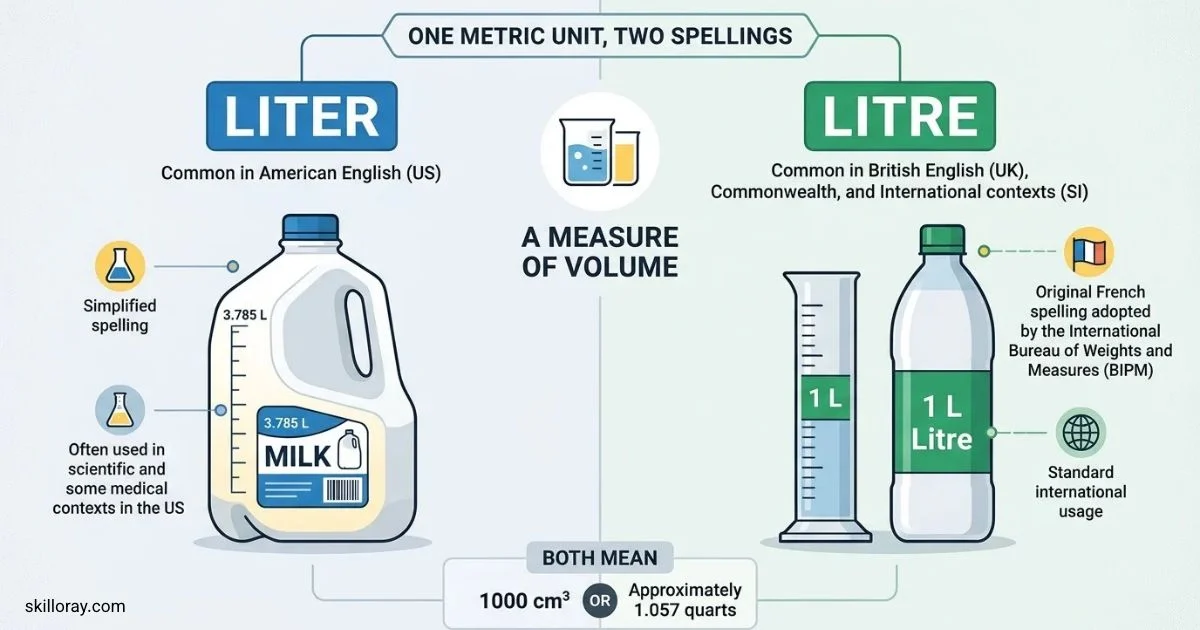
Have you ever wondered whether to write liter or litre? You’re not alone. These two spellings can be confusing, especially when you’re writing for an international audience or trying to follow American English spelling rules.
I want to make this simple for you. Both liter and litre refer to the same unit of volume, but the spelling depends on the variety of English you’re using. Once you understand this small difference, you’ll find it much easier to choose the right word.
In this guide, you’ll learn when to use liter or litre, how American and British English differ, and which spelling works best in different contexts. I’ll also share clear examples to help you avoid common spelling mistakes and write with confidence.
Liter or Litre: What’s the Difference?
The difference is regional spelling, not meaning or measurement.
| Word | Standard spelling | Example |
| Liter | American English | I bought a liter of milk. |
| Litre | British English | I bought a litre of milk. |
| Liters | American English plural | The bottles hold three liters. |
| Litres | British English plural | The bottles hold three litres. |
Neither spelling is more correct than the other. Each is standard in its respective variety of English.
What Does Liter or Litre Mean?
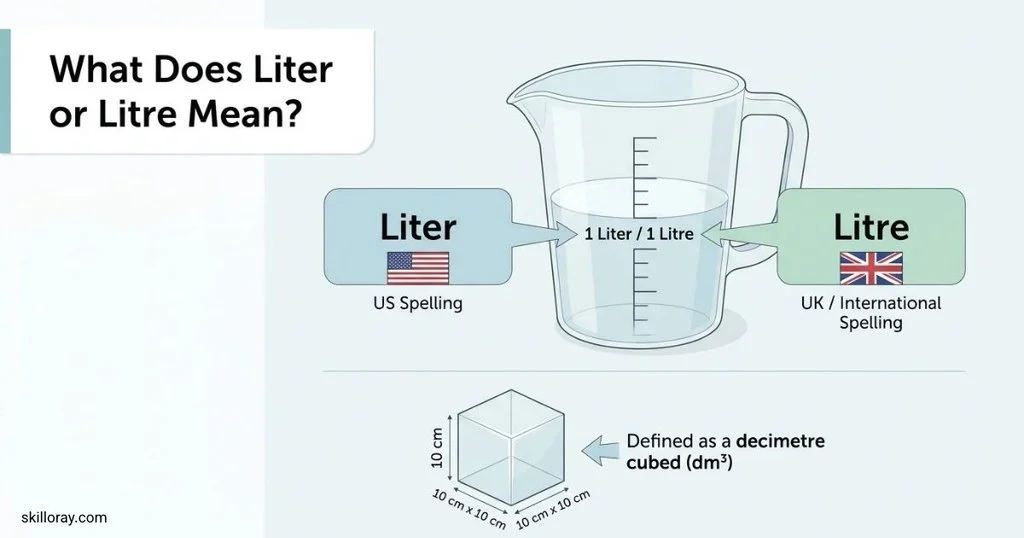
A liter or litre is a metric unit used to measure volume, especially the volume of liquids such as water, milk, juice, and fuel.
One liter equals 1,000 milliliters and one cubic decimeter. It’s also approximately 0.264 US gallons.
Here are a few everyday examples:
- A bottle contains one liter of water.
- A recipe calls for 500 milliliters of milk.
- A fuel container holds 10 liters of gasoline.
- A car’s engine capacity may be described as 2.0 liters.
The spelling changes across regions, but the quantity stays exactly the same.
When to Use Liter in American English
Use liter when writing in American English. This spelling is standard in the United States and appears in American dictionaries, recipes, product descriptions, and educational materials.
For example:
- Please add one liter of water to the mixture.
- The store sells two-liter bottles of soda.
- My car has a 2.0-liter engine.
- The container holds five liters of paint.
- I drink several liters of water throughout the day.
Pay attention to the hyphens in two-liter bottles and 2.0-liter engine. When a measurement forms a compound adjective before a noun, American English generally uses a hyphen.
However, you wouldn’t normally hyphenate the measurement when it follows the noun:
- Correct: The bottle holds two liters.
- Correct: The engine has a capacity of 2.0 liters.
When to Use Litre in British English
Use litre when following British English spelling conventions. It’s the standard form in the United Kingdom and is also common in countries and publications that follow British spelling.
For example:
- Please add one litre of water to the mixture.
- The shop sells two-litre bottles of lemonade.
- Her car has a 1.5-litre engine.
- The container holds five litres of paint.
- The tank can store 20 litres of fuel.
The same compound-adjective rule applies. British English generally uses a hyphen in expressions such as a two-litre bottle and a 1.5-litre engine.
If the measurement comes after the noun, the hyphen usually isn’t necessary:
- Correct: The bottle holds two litres.
- Correct: The engine has a capacity of 1.5 litres.
Why Do Liter and Litre Have Different Spellings?
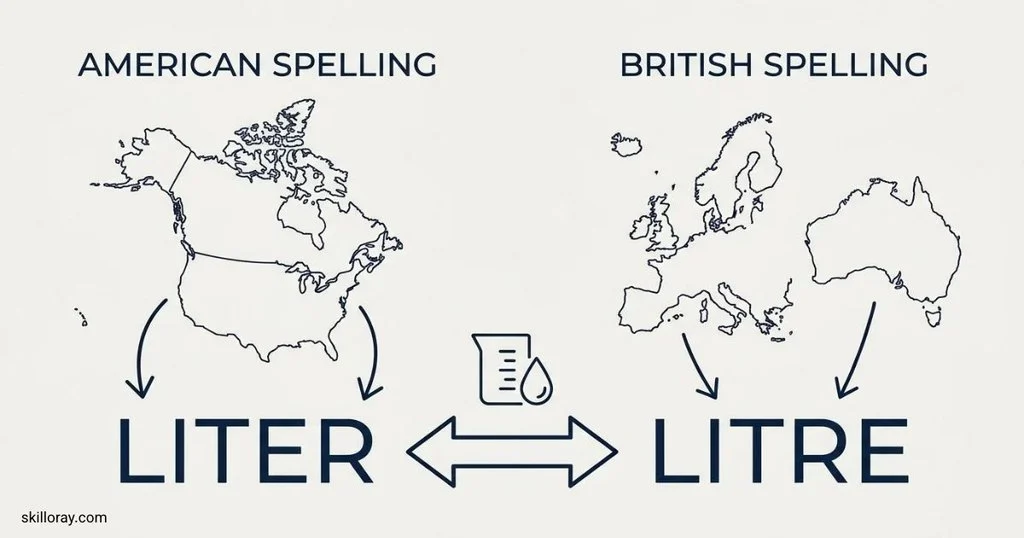
American and British English use different spelling conventions for several words. The same pattern appears in pairs such as color and colour, center and centre, and meter and metre.
The spelling liter follows the American preference for the -er ending in this group of words. British English generally retains the -re form in litre.
This difference doesn’t affect pronunciation or meaning in any significant way. It simply reflects the spelling convention used by the writer.
Does Canada Use Liter or Litre?
Canadian English generally favors litre, following the British spelling convention for this word. You’ll commonly see litre and litres in Canadian writing.
For example:
- The bottle contains one litre of juice.
- The tank holds 40 litres of fuel.
If you’re writing for a Canadian publication, litre is usually a sensible choice. However, always follow the publication’s style guide when one is available.
Is It 1 Liter or 1-Liter?
Both forms can be correct, depending on how you use the measurement.
Use 1 liter when the measurement stands on its own or follows a noun:
- The bottle contains 1 liter of water.
- The container holds 1 liter.
Use 1-liter when the measurement works as an adjective before a noun:
- She bought a 1-liter bottle.
- The machine requires a 1-liter container.
In British English, use litre instead:
- The bottle contains 1 litre of water.
- She bought a 1-litre bottle.
The same principle applies to other measurements, such as a 5-kilometer race in American English and a 5-kilometre race in British English.
Is the Abbreviation L or l?
The liter can be represented by either L or l. Both symbols are recognized, but the uppercase L is often preferred because lowercase l can look like the number 1.
For example:
- 1 L = 1 liter
- 500 mL = 500 milliliters
- 2 L = 2 liters
The symbol doesn’t change between American and British English. Unlike the written words liter and litre, measurement symbols are standardized across regions.
When writing scientific or technical content, follow the relevant style guide and use symbols consistently. Measurement symbols generally don’t take a plural s or a period.
Common Mistakes to Avoid
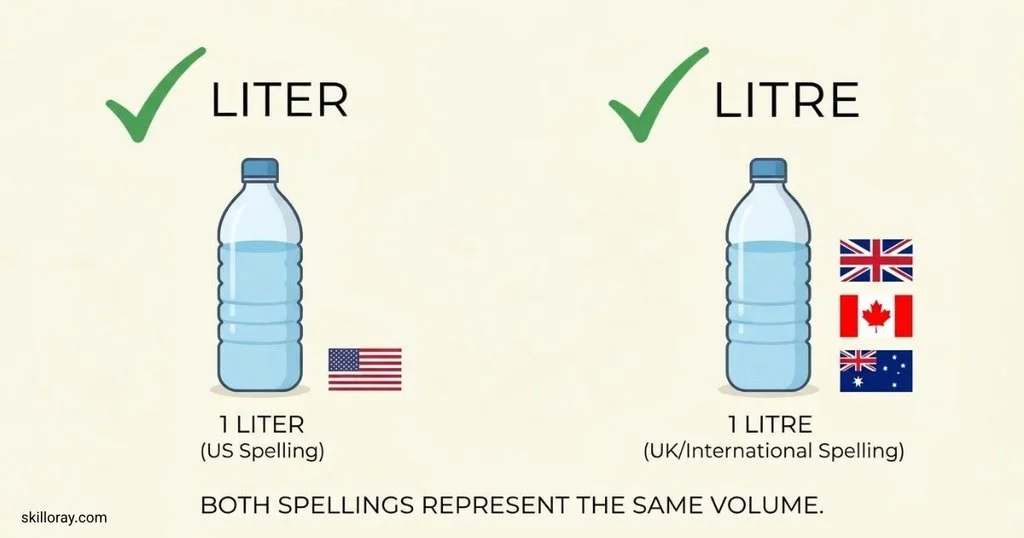
Even a simple spelling choice can make an article look inconsistent. Watch out for these common mistakes.
Using both spellings in the same article
If you’re writing for an American audience, use liter and liters throughout your article. For British readers, choose litre and litres. You can use both when directly comparing the spellings.
Assuming one spelling is wrong
Neither spelling is incorrect. The right choice depends on the variety of English you’re using.
Forgetting the compound-adjective hyphen
Write a two-liter bottle, not a two liter bottle, when following standard American compound-adjective conventions.
Changing the spelling but not the plural
American English uses liters, while British English uses litres. Keep the spelling consistent in both singular and plural forms.
Confusing the unit with its abbreviation
Write two liters in ordinary prose, but use 2 L when a measurement symbol is appropriate. The symbol doesn’t need a plural ending.
Which Spelling Should You Use?
Your audience is the easiest guide.
| Writing situation | Recommended spelling |
| US blog or website | Liter |
| UK publication | Litre |
| Canadian content | Usually litre |
| School assignment | Follow your teacher’s or textbook’s convention |
| Scientific or technical document | Follow the relevant style guide |
| International website | Choose a consistent spelling convention |
If your website targets American readers, use liter in the title, headings, and main text. If it targets British readers, use litre. You can mention the alternative spelling when it helps readers understand the difference.
For international content, consistency matters more than choosing one form over the other.
Frequently Asked Questions
Is liter or litre correct?
Both are correct. Liter is the standard American English spelling, while litre is the standard British English spelling.
Is litre British or American?
Litre is the standard British English spelling. American English uses liter.
Is a liter the same as a litre?
Yes. A liter and a litre are the same metric unit of volume. One liter equals 1,000 milliliters.
What is the plural of liter?
The American English plural is liters. The British English plural is litres.
Does Canada use liter or litre?
Canadian English generally uses litre, although individual publications and technical contexts may follow their own style requirements.
Should I use liter or litre for SEO?
Choose the spelling that matches your target audience. Use liter for a US-focused page and litre for a UK-focused page. If your article directly compares both spellings, include both naturally without forcing extra keyword repetitions.
Final Verdict: Liter or Litre?
The choice is simple: use liter in American English and litre in British English. Both spellings describe the same metric unit, so neither is universally better or more correct.
When writing for a particular audience, follow its spelling conventions and stay consistent. That’s all you need to get this word right.

I am James Walker, an English language specialist with extensive experience in grammar, editing, and academic writing. I enjoy helping students, bloggers, and professionals strengthen their writing by explaining grammar concepts in a clear and engaging way. My focus is on providing accurate, practical, and easy-to-follow guidance that helps learners communicate more effectively in everyday and professional situations.
Books: Perfect English Grammar Handbook and Advanced Writing Techniques
 Daniel Carter
 Olivia Brown