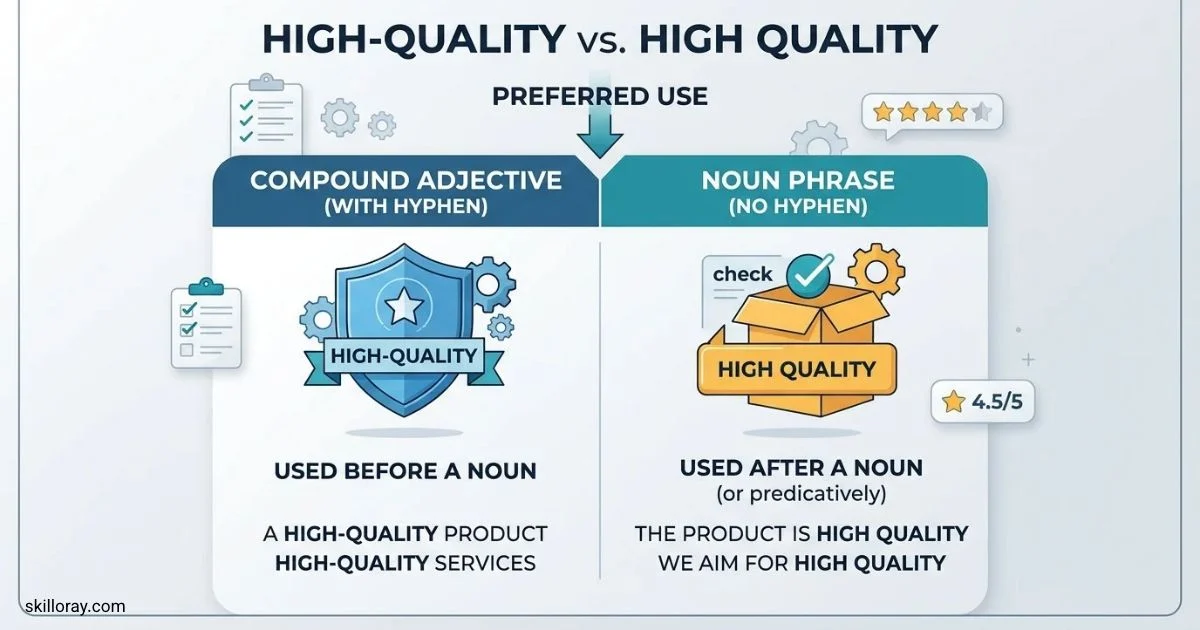
Have you ever paused while writing because you weren’t sure whether to use high quality or high-quality? You’re not alone. Even confident English speakers sometimes struggle with hyphens, especially when two forms look correct at first glance.
I want to make this grammar question simple for you. The good news is that both forms are correct, but their usage depends on how they function in a sentence. Once you understand this small difference, you can write more clearly and avoid a common mistake.
In this guide, you’ll learn when to write high quality as two words and when to use high-quality with a hyphen. I’ll share easy grammar rules and practical examples so you can apply them confidently in emails, blog posts, academic assignments, and everyday writing.
High Quality vs. High-Quality: Quick Answer
| Form | When to use it | Example |
| High-quality | Before a noun as a compound modifier | She bought a high-quality laptop. |
| High quality | After a linking verb | The laptop is high quality. |
| High quality | As a noun phrase | We expect high quality from every supplier. |
Both forms communicate a high standard. The hyphen signals how the words work together in the sentence; it doesn’t change the underlying meaning.
Compare these examples:
- Before a noun: The school provides high-quality learning materials.
- After a linking verb: The learning materials are high quality.
- As a noun phrase: High quality matters to our customers.
Once you recognize the phrase’s grammatical function, choosing the correct form becomes much easier.
When to Use High-Quality

Use high-quality when high and quality work together to describe a noun that follows them. This combination is called a compound modifier or compound adjective.
For example, in “We hired a high-quality photographer,” the phrase high-quality describes the photographer’s work or standard.
Here are some examples from everyday life:
- The store sells high-quality furniture.
- She bought a high-quality winter coat.
- Our school provides high-quality education.
- The restaurant uses high-quality ingredients.
- He invested in high-quality audio equipment.
- The website publishes high-quality content.
- They installed a high-quality security system.
In each sentence, the phrase appears immediately before a noun and describes its standard or level of excellence.
High-Quality in Professional Writing
You’ll often see high-quality in business documents, product descriptions, education, and marketing.
Consider these examples:
Business: We deliver high-quality customer service.
Education: Students need high-quality learning resources.
Technology: The camera produces high-quality images in low light.
Manufacturing: The factory uses high-quality materials to build durable products.
Content writing: The article provides high-quality information backed by reliable sources.
The hyphen helps readers understand that the two words function together as a single modifier.
However, calling something high-quality doesn’t automatically make the claim convincing. In professional writing, specific details about performance, reliability, or durability can explain what makes a product or service valuable.
When to Use High Quality
Use high quality without a hyphen when the phrase follows a linking verb and describes the subject.
Common linking verbs include is, are, was, were, seems, and looks.
For example:
- The product is high quality.
- Their customer service was high quality.
- These shoes are high quality for the price.
- The workmanship seems high quality.
- The photographs were high quality.
- The materials look high quality.
In these sentences, high quality describes the subject rather than modifying a noun that immediately follows it.
Compare these two sentences:
Before a noun: We ordered high-quality paper for the printer.
After a linking verb: The paper we ordered is high quality.
Both are correct. The difference lies in how the phrase functions within each sentence.
Can High Quality Function as a Noun Phrase?
Yes. High quality can also function as a noun phrase.
For example:
- We expect high quality from every supplier.
- The company is known for its high quality.
- High quality should be a priority in every project.
Here, quality is the main noun, and high describes its level. The phrase doesn’t modify a following noun, so the hyphen isn’t needed.
High Quality or High-Quality in a Sentence?
When you’re unsure which form to use, compare the phrase’s position in the sentence.
| Example | Correct form | Reason |
| We purchased ___ office chairs. | High-quality | It modifies the noun chairs. |
| The office chairs are ___. | High quality | It follows the linking verb are. |
| She creates ___ videos. | High-quality | It modifies the noun videos. |
| Her videos are ___. | High quality | It describes the subject after are. |
| We expect ___ from our suppliers. | High quality | It functions as a noun phrase. |
| The company offers ___ materials. | High-quality | It modifies the noun materials. |
This comparison shows why the hyphen depends on grammatical function rather than the meaning of the phrase alone.
Why Does High-Quality Need a Hyphen?
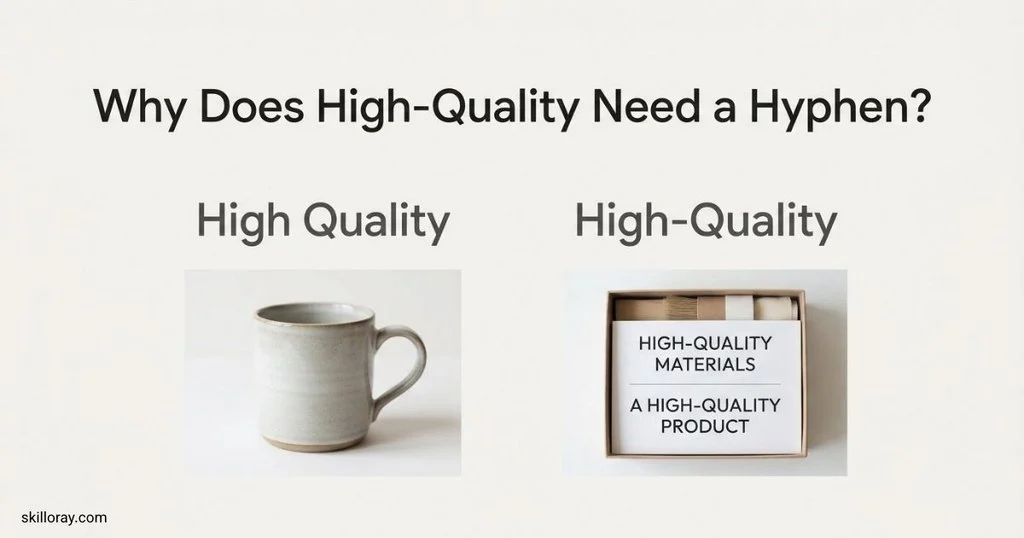
A hyphen joins words that work together as a single modifier. In high-quality service, the two words combine to describe the service.
Without the hyphen, readers can usually understand familiar expressions, but the hyphenated form is the standard choice when the compound modifier comes before a noun.
For example:
Preferred: We provide high-quality training.
Generally preferred: Our training is high quality.
The second sentence doesn’t need a hyphen because the phrase follows the linking verb is.
This is the usual convention in American English, although particular style guides may have their own preferences. If you’re writing for a publication, school, or organization, follow its style guide consistently.
Common Mistakes With High Quality and High-Quality
These examples show how small punctuation choices can improve your writing.
1. Forgetting the Hyphen Before a Noun
Less preferred: The company sells high quality furniture.
Preferred: The company sells high-quality furniture.
Why? The phrase modifies furniture, so the hyphen connects the words into one compound modifier.
2. Adding a Hyphen After a Linking Verb
Generally less preferred: The furniture is high-quality.
Preferred: The furniture is high quality.
Why? The phrase describes the furniture after the linking verb is. Standard general usage usually leaves out the hyphen here.
3. Hyphenating Every Use of the Phrase
Incorrect for this intended meaning: We expect high-quality from our suppliers.
Correct: We expect high quality from our suppliers.
Why? The phrase functions as a noun phrase rather than modifying a noun that follows it.
4. Assuming the Hyphen Changes the Meaning
The expressions high quality and high-quality generally communicate the same idea: a high standard or level of excellence.
The hyphen clarifies the phrase’s grammatical role. It doesn’t make the product better or change the underlying meaning.
High-Quality Alternatives for Better Writing
Although high-quality is useful, repeating it throughout an article can make your writing vague. Sometimes, a more specific word explains what you mean more clearly.
| Alternative | What it emphasizes | Example |
| Excellent | A high standard overall | The team delivered excellent results. |
| Durable | Resistance to wear and damage | The company makes durable backpacks. |
| Reliable | Consistent performance | We use reliable software. |
| Well-made | Careful construction | She bought a well-made wooden table. |
| Effective | Achieving the intended result | The team developed an effective solution. |
| Premium | An upscale market position | The store sells premium headphones. |
These words aren’t perfect substitutes in every situation. A durable product lasts, a reliable product performs consistently, and an effective solution achieves its purpose. Choose the word that describes the actual quality you want to communicate.
Quick Practice: High Quality or High-Quality?
Try these sentences before checking the answers.
- The editor praised the writer for producing ______ work.
- The work was ______ and carefully researched.
- We expect ______ from every supplier.
- The company manufactures ______ electronics.
Answers:
- High-quality — The phrase modifies the noun work.
- High quality — The phrase follows the linking verb was.
- High quality — The phrase functions as a noun phrase.
- High-quality — The phrase modifies the noun electronics.
If you got all four right, you’ve understood the main rule. If not, look at what follows the phrase and how it functions in the sentence.
Frequently Asked Questions
Is high quality one word or two?
High quality is written as two words. When the phrase functions as a compound modifier before a noun, it’s generally hyphenated as high-quality.
For example, “The store sells high-quality furniture” and “The furniture is high quality” are both correct.
Is high-quality grammatically correct?
Yes. High-quality is grammatically correct when the phrase works as a compound modifier before a noun.
Example: The company manufactures high-quality electronics.
Should I write high quality product or high-quality product?
Write high-quality product. The phrase modifies the noun product, so the hyphen is appropriate.
Example: Customers expect a high-quality product at a reasonable price.
Is it high quality work or high-quality work?
The preferred form is high-quality work because the phrase appears before and modifies the noun work.
Example: The editor praised the writer for producing high-quality work.
Is it high quality or high-quality service?
Use high-quality service when the phrase appears before the noun service.
Example: The hotel is known for its high-quality service.
However, you would generally write, “The service is high quality,” because the phrase follows a linking verb.
Can I write the product is high-quality?
In standard general usage, the product is high quality is preferred. The hyphen is usually unnecessary when the phrase follows the linking verb is.
Some editorial styles may differ, so follow your publication’s conventions when applicable.
Does high-quality mean the same as premium quality?
Not exactly. High-quality describes a high standard, while premium quality often suggests an upscale product or market position. The expressions overlap, but their meanings aren’t identical in every context.
Final Thoughts
The choice between high quality and high-quality depends on how the phrase functions in your sentence.
Write high-quality materials but the materials are high quality. The first phrase modifies a noun; the second describes the subject after a linking verb.
When you’re unsure, check the phrase’s position and grammatical role. That simple habit will help you use hyphens correctly and make your writing clearer.

I am Daniel Carter, a grammar enthusiast and language educator with over 10 years of experience helping students and professionals improve their English writing and communication skills. I enjoy simplifying complex grammar rules into easy-to-understand lessons that anyone can follow. My goal is to help learners write with confidence, avoid common mistakes, and develop strong communication skills for academic and professional success. I regularly create practical grammar guides, writing tips, and language resources that make learning both enjoyable and effective.
Books: Mastering English Grammar and The Complete Guide to Better Writing
 Olivia Brown
 James Walker