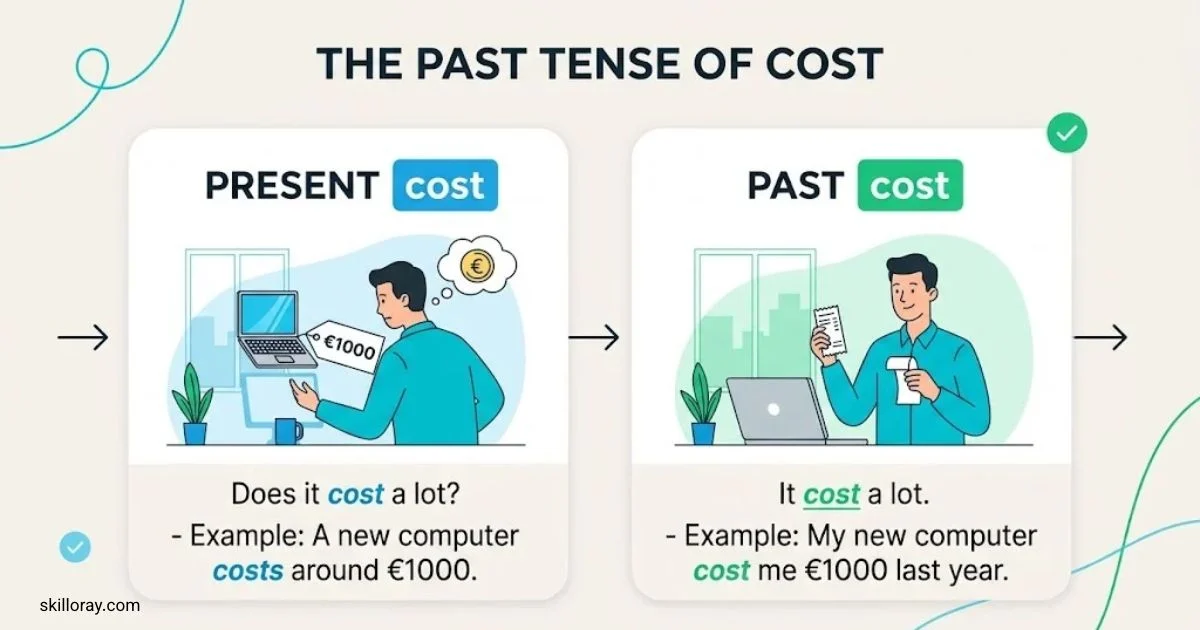
Have you ever wondered whether the past tense of cost is cost or costed? You are not alone. Many English learners find this word confusing because its past-tense form doesn’t always follow the usual grammar rules.
I want to help you understand this tricky verb with simple explanations and everyday examples. Once you learn how cost works in different situations, you will find it much easier to use the word correctly in conversations and writing.
In this guide, you will discover the past tense of cost, learn when to use costed, and explore common mistakes to avoid. By the end, you will have a clearer understanding of the correct forms and feel more confident using them.
Cost vs. Costed: What’s the Difference?
Use cost to describe a price, expense, or loss. Use costed when someone calculates or estimates the expenses involved in a project or plan.
| Form | When to use it | Example |
| Cost | Describing a price | The laptop cost $900. |
| Cost | Describing a loss or consequence | The delay cost us two hours. |
| Costed | Calculating or estimating expenses | The team costed the project before approval. |
In everyday English, cost is the form you’ll use most often. You wouldn’t normally say, “The laptop costed $900.” The natural sentence is “The laptop cost $900.”
By contrast, a finance team might say it costed a project when it calculated the expected expenses. This use is common in business and accounting contexts.
Examples of Cost in the Past Tense
These examples show how cost works when describing past prices, expenses, and consequences.
- The repair cost $250 last week.
- Our train tickets cost less than we expected.
- The delay cost us two valuable hours.
- The decision cost her an important opportunity.
In all four sentences, cost stays the same even though the events happened in the past. It can describe money, time, or something lost because of a decision.
Examples of Costed in a Sentence
Use costed when referring to the calculation or estimation of expenses.
- The finance team costed the project before approval.
- The contractor costed the proposed renovations.
- We costed several options before choosing a supplier.
In these sentences, costed describes working out the expenses involved. It doesn’t simply state how much something cost.
Is Cost a Regular or Irregular Verb?
Cost is generally an irregular verb when it refers to a price or loss. Its three main forms are the same:
| Verb form | Word |
| Base form | Cost |
| Past tense | Cost |
| Past participle | Cost |
For example:
- Present: These shoes cost $60.
- Past: These shoes cost $60 last year.
- Past participle: These shoes have cost more than I expected.
Unlike regular verbs such as walk and walked, the ordinary price-related verb cost doesn’t take an -ed ending in the past tense.
Frequently Asked Questions
What is the past tense of cost?
The past tense is cost. For example, “The phone cost $500 when I bought it.”
Is it cost or costed?
Both forms are correct in different contexts. Use cost to describe a price or loss. Use costed when referring to calculating or estimating expenses.
What is the past participle of cost?
The usual past participle is cost. For example, “The repairs have cost us more than expected.”
Can I say “It costed me $100”?
In standard everyday English, say “It cost me $100.” Use costed when describing the process of estimating expenses, not the amount paid.
Is cost an irregular verb?
Yes. In its ordinary price-related meaning, the forms are cost, cost, and cost. The word doesn’t change between the base form, past tense, and past participle.
Final Answer: Cost or Costed?
The past tense of cost is usually cost. Write, “The repair cost $300 last week.”
Use costed when someone calculates or estimates expenses, as in “The team costed the project before approval.”
Remember: Something cost a certain amount, while someone may have costed a project.

I am James Walker, an English language specialist with extensive experience in grammar, editing, and academic writing. I enjoy helping students, bloggers, and professionals strengthen their writing by explaining grammar concepts in a clear and engaging way. My focus is on providing accurate, practical, and easy-to-follow guidance that helps learners communicate more effectively in everyday and professional situations.
Books: Perfect English Grammar Handbook and Advanced Writing Techniques
 Daniel Carter
 Olivia Brown