Both afterward and afterwards are correct English spellings. They have the same meaning, but one is more common in American Have you ever paused while writing, wondering whether to use afterward or afterwards? You’re not alone. These two words look almost identical, and choosing the right one can feel confusing when you want your writing to sound natural and correct.
I want to make this grammar question simple for you. Both words refer to something that happens later, but their usage can depend on the variety of English you’re writing in. Understanding this small difference can help you write more confidently, whether you’re working on an essay, an email, or a blog post.
In this guide, you’ll learn the difference between afterward and afterwards, explore clear examples, and discover which spelling works best in American and British English. By the end, you’ll know how to choose the right word without second-guessing yourself.
Afterward vs. Afterwards: What’s the Difference?
The only difference between afterward and afterwards is the final s. Both words function as adverbs, and neither changes the meaning of a sentence.
| Feature | Afterward | Afterwards |
| Meaning | At a later time | At a later time |
| Part of speech | Adverb | Adverb |
| American English | Generally preferred | Also correct |
| British English | Also correct | Generally preferred |
| Example | We talked afterward. | We talked afterwards. |
You can substitute one spelling for the other without changing the meaning.
For example:
- We finished the meeting and grabbed lunch afterward.
- We finished the meeting and grabbed lunch afterwards.
Both sentences are grammatically correct. The difference is simply a matter of regional preference.
Should You Use Afterward or Afterwards in American English?
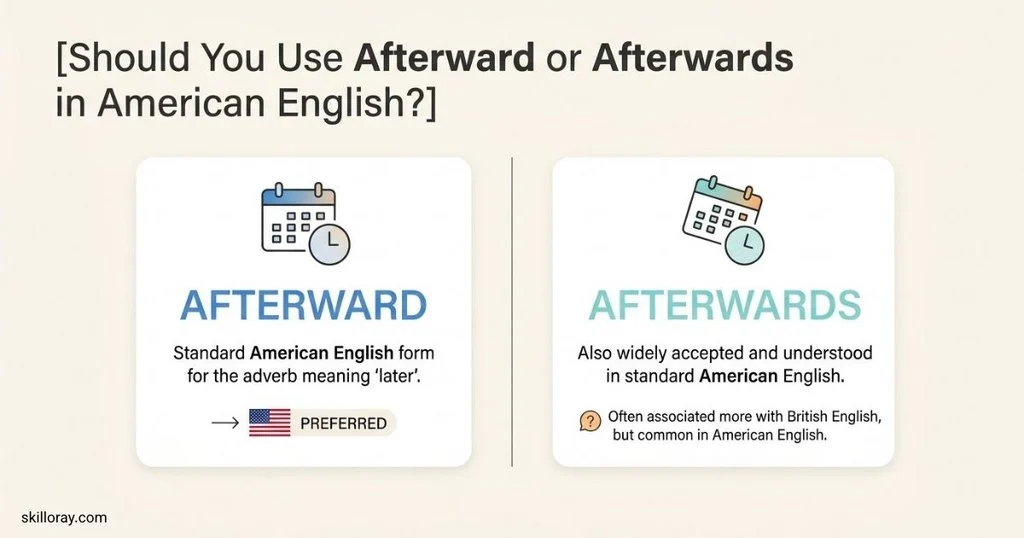
If you’re writing for an American audience, afterward is usually the better choice. It’s widely used in American books, newspapers, business writing, and everyday communication.
Here are a few examples:
- I’ll call you afterward to explain what happened.
- The students took a short break afterward.
- She finished the application and submitted the documents afterward.
- We discussed the results afterward.
You can still use afterwards in American English. It’s not a grammatical error. However, choosing afterward helps maintain a consistent American writing style.
If you’re following a publication’s style guide, use its preferred spelling throughout your work.
Is Afterwards Correct in British English?
Yes. Afterwards is widely used in British English and is completely correct.
For example:
- We went shopping and had lunch afterwards.
- He spoke to his teacher afterwards.
- They visited the museum and had coffee afterwards.
- She finished her homework and watched television afterwards.
British English also accepts afterward. You don’t need to change it every time you encounter it in British writing.
The same principle applies to American English: both spellings are acceptable, even though one is generally more common in each variety.
Afterward vs. After: When Should You Use Each?
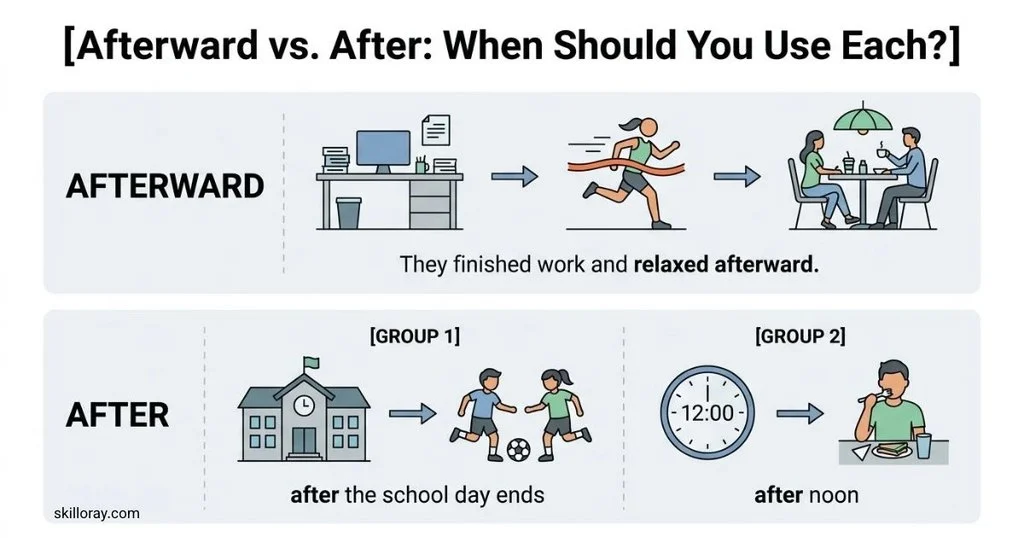
Although afterward and after have related meanings, they work differently in sentences.
Afterward is an adverb that refers to a later time. It doesn’t introduce a noun or a clause in the way after can.
Examples:
- We had dinner and watched a movie afterward.
- She called me afterward.
- The meeting ended, and everyone left shortly afterward.
After can function as a preposition, a conjunction, or an adverb.
Examples:
- We went home after dinner.
- I’ll call you after I finish work.
- Soon after, the weather began to change.
Notice how the words function in these sentences:
| Sentence | How the word works |
| We left after lunch. | After introduces the noun lunch. |
| We left after the show ended. | After introduces a clause. |
| We had lunch and left afterward. | Afterward refers to the later action. |
| We left soon after. | After is used adverbially. |
A useful rule is to use after when connecting an action to an event, and afterward when referring to what happens later.
For example, “We went for coffee after the meeting” identifies the event that came first. “We finished the meeting and went for coffee afterward” describes the sequence of events.
Afterward vs. Afterwards vs. Later
Afterward, afterwards, and later can all refer to a subsequent time, but their usage differs slightly.
| Word | Meaning | Example |
| Afterward | At a time following an event | We discussed the problem afterward. |
| Afterwards | At a time following an event | We discussed the problem afterwards. |
| Later | At a subsequent time | I’ll call you later. |
Afterward and afterwards usually refer to something that happens after a particular event. Later is more flexible because you can use it without mentioning what happens first.
For instance, “I’ll see you later” sounds natural when arranging to meet someone. “I’ll see you afterward” usually refers to a specific event that will happen before you meet.
Both afterward and afterwards work in the same contexts. Choose the spelling that best suits your audience.
Common Mistakes to Avoid
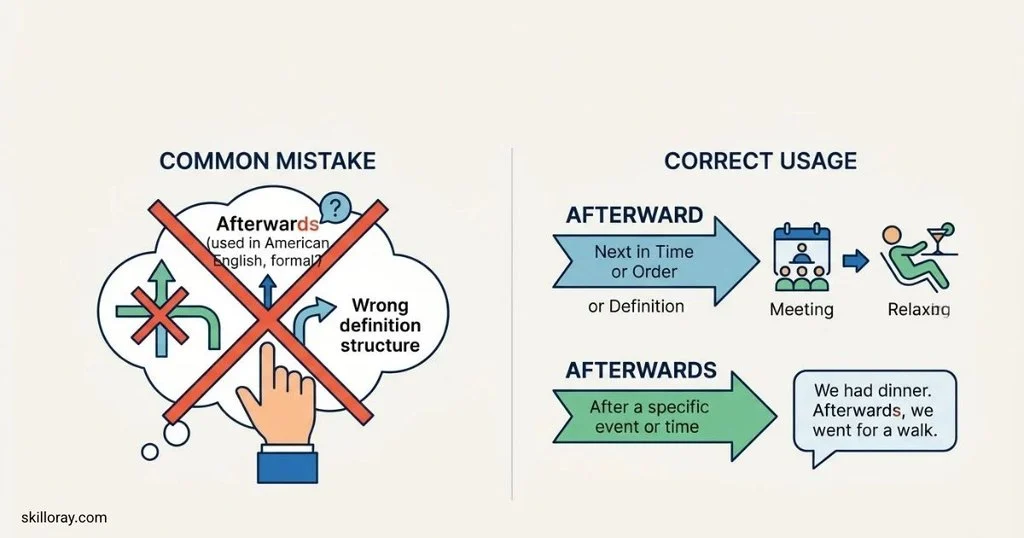
The two spellings are straightforward once you understand their relationship. Still, a few mistakes can make your writing less clear.
1. Assuming Afterwards Is Incorrect
Incorrect claim: “Afterwards” is always wrong in American English.
Correct explanation: Both spellings are acceptable. Afterward is simply more common in American English.
2. Treating Afterward as Two Words
Incorrect: We discussed the issue after ward.
Correct: We discussed the issue afterward.
Afterward is one word, with no space or hyphen. Afterwards is also written as one word.
3. Using Afterward Before a Noun
Incorrect: We ate afterward the meeting.
Correct: We ate after the meeting.
Use after before a noun phrase in this construction. You could also write, “We attended the meeting and ate afterward.”
4. Switching Spellings Without a Reason
Using both spellings isn’t automatically a grammar error. However, choosing one form throughout an article creates a more consistent style.
For American English content, use afterward as your default. For British English content, afterwards is a natural choice.
Frequently Asked Questions
Is it afterward or afterwards?
Both spellings are correct. Afterward is generally preferred in American English, while afterwards is more common in British English.
Is afterward one word or two?
Afterward is one word. It doesn’t require a space or hyphen.
Is afterwards one word?
Yes. Afterwards is also one word, with an s at the end.
Is afterward more formal than afterwards?
Neither spelling is inherently more formal. Both are suitable for formal and informal writing. Regional preference and the publication’s style guide usually determine which form to use.
Can I use afterwards in American English?
Yes. Afterwards is correct and understood in American English, although afterward is generally more common.
What is another word for afterward?
Depending on the context, alternatives include later, subsequently, and after that. For example, “We spoke afterward” could become “We spoke later.”
These alternatives aren’t interchangeable in every sentence, so choose one that preserves your intended meaning.
Which spelling should I use for SEO content?
If your content targets American readers, afterward is generally the better default. If you’re writing for British readers, afterwards may be more familiar.
Use your chosen spelling naturally throughout the page. You don’t need to repeat both variations in every section to make the article relevant to search engines.
Final Verdict: Afterward or Afterwards?
Both afterward and afterwards are correct, and they mean the same thing. The difference comes down to regional preference, not grammar.
If you’re writing for an American audience, choose afterward. If your readers are primarily British, afterwards is a natural choice.
When in doubt, follow your publication’s style guide and remain consistent. That simple approach will keep your writing clear, natural, and grammatically correct.

I am James Walker, an English language specialist with extensive experience in grammar, editing, and academic writing. I enjoy helping students, bloggers, and professionals strengthen their writing by explaining grammar concepts in a clear and engaging way. My focus is on providing accurate, practical, and easy-to-follow guidance that helps learners communicate more effectively in everyday and professional situations.
Books: Perfect English Grammar Handbook and Advanced Writing Techniques
 Daniel Carter
 Olivia Brown