
Have you ever wondered whether to write add or ad in a sentence? These two words sound exactly alike, but their meanings and uses are completely different. Mixing them up can make even a simple sentence confusing.
The word “add” means to include something or combine numbers, while “ad” refers to an advertisement that promotes a product, service, or idea. Understanding this small difference can help you avoid common spelling mistakes and communicate more clearly.
In this guide, I’ll explain the difference between add and ad with simple definitions, real-life examples, and practical usage tips. Whether you’re writing an email, doing math, or discussing marketing, you’ll learn exactly when to use each word.
Add vs Ad: Quick Comparison
| Feature | Add | Ad |
| Meaning | To include, combine, or increase | A promotional message |
| Part of speech | Verb | Noun |
| Pronunciation | /æd/ | /æd/ |
| Word origin | From the Latin addere | Short for advertisement |
| Example | Add your name to the list. | I saw an ad for a new phone. |
The easiest way to remember the difference is to look at the sentence. If you’re describing an action, use add. If you’re talking about an advertisement, use ad.
What Does Add Mean?

Add is a verb that means to put something together with something else, include an extra item, or increase an amount. It appears in everyday conversations, mathematics, instructions, and writing.
Here are its most common uses.
Add Means to Include Something
Use add when you want someone to include another person, item, detail, or piece of information.
Examples:
- Please add your phone number to the registration form.
- I want to add another name to the guest list.
- She added a new paragraph to her essay.
- Don’t forget to add the meeting date to your calendar.
In each sentence, something extra becomes part of an existing group or document.
Add Means to Combine Numbers or Amounts
In mathematics, add means to combine two or more numbers to find their total.
Examples:
- Add five and seven to get twelve.
- The teacher asked us to add the numbers on the board.
- If you add $20 to $30, the total is $50.
- She added the monthly expenses to calculate the household budget.
You can also use add up when talking about calculating a total.
Example: The bills add up to $450.
Add Means to Increase Something
Add can also describe putting more of something into an existing amount or situation.
Examples:
- Add a little more water to the mixture.
- The new feature will add value to the app.
- A fresh coat of paint can add brightness to the room.
- The extra information adds clarity to the report.
Add Can Mean to Say Something More
In conversations and writing, add can introduce an additional comment or piece of information.
Examples:
- “I agree with your decision,” he added.
- She added that the project would finish next week.
- Before leaving, the manager added one final reminder.
What Does Ad Mean?
Ad is a noun and a shortened form of advertisement. It refers to a message designed to promote a product, service, business, event, or idea.
You can find ads on websites, television, social media, newspapers, and many other platforms.
Examples:
- I saw an ad for a local restaurant on Facebook.
- The company published an ad to promote its new product.
- That ad appeared before the video started.
- She clicked on an ad while browsing the website.
In everyday English, ad is common in both casual and professional conversations.
Ad vs Advertisement
Ad and advertisement have the same basic meaning. The main difference is their level of formality.
| Word | Usage | Example |
| Ad | Shorter and more conversational | I saw an ad for a new laptop. |
| Advertisement | Full form, often more formal | The advertisement appeared in a national newspaper. |
Both forms are correct. Choose the one that sounds natural for your sentence and audience.
Add vs Ad in Sentences
Seeing both words in similar situations makes their difference easier to understand.
| Add | Ad |
| Please add your email address to the form. | I received an ad for an email service. |
| The teacher added another question to the test. | The school published an ad for new students. |
| Add some sugar to your tea. | I saw an ad for a sugar-free drink. |
| We need to add more details to the report. | The company created an ad for its latest campaign. |
| She added a new item to her shopping list. | That ad appeared while I was shopping online. |
Remember: Add describes an action, while ad names a promotional message.
Are Add and Ad Homophones?
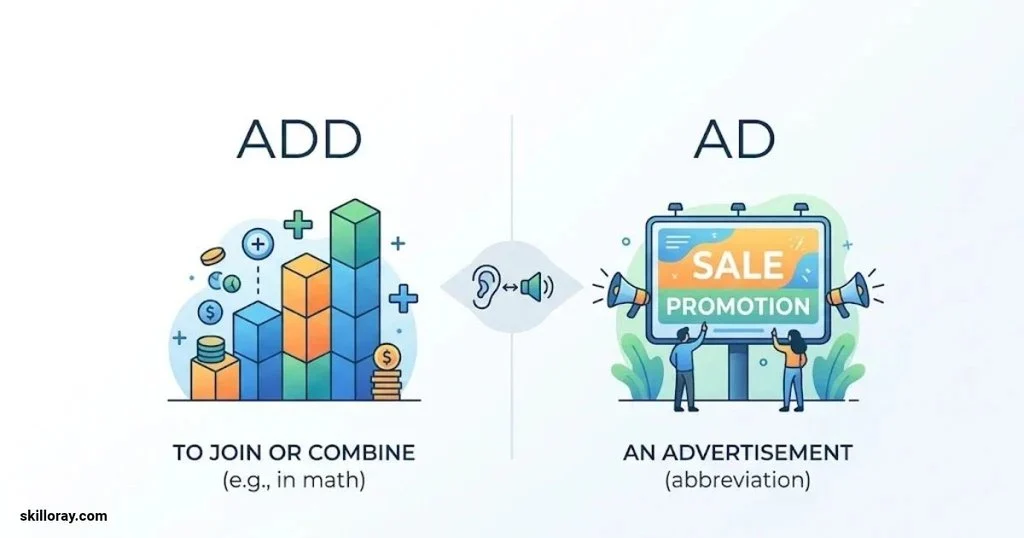
Yes. Add and ad are homophones in standard American English because they share the same pronunciation: /æd/.
Homophones are words that sound alike but have different meanings or spellings.
Other common examples include:
- To, too, and two
- Their, there, and they’re
- Right and write
- Sea and see
Although add and ad sound identical, their meanings are easy to distinguish from context. You cannot choose the correct spelling by listening alone.
Related Words and Forms
Understanding related word forms can help you use add and ad correctly.
Forms of Add
| Word | Meaning | Example |
| Add | Base verb | Add your name here. |
| Adds | Present-tense form | He adds sugar to his coffee. |
| Added | Past-tense form | She added a new section. |
| Adding | -ing form | I am adding the final details. |
| Addition | Noun | The addition of a new room increased the space. |
Words Related to Ad
| Word | Meaning | Example |
| Ad | Short form of advertisement | I saw an ad online. |
| Advertisement | A promotional message | The advertisement appeared on TV. |
| Advertise | To promote a product or service | They advertise their products online. |
| Advertising | The activity of promoting products or services | Advertising helps businesses reach customers. |
| Advertiser | A person or company that promotes something | The advertiser created a new campaign. |
Common Mistakes When Using Add and Ad
Because these words sound alike, people sometimes mix them up when writing. Here are a few mistakes to avoid.
Incorrect: Please ad your address to the form.
Correct: Please add your address to the form.
Why? The sentence describes an action: including an address.
Incorrect: I saw an add for a new restaurant.
Correct: I saw an ad for a new restaurant.
Why? The sentence refers to a promotional message, so ad is correct.
Incorrect: She will ad more information to the report.
Correct: She will add more information to the report.
Why? The sentence describes including extra information.
Incorrect: The company created an add for its website.
Correct: The company created an ad for its website.
Why? The word refers to an advertisement, not the verb add.
How to Remember Add vs Ad

Use this simple trick whenever you’re unsure which spelling to choose:
- Add = Action: You add something to a list, document, number, or mixture.
- Ad = Advertisement: You see, watch, publish, or click an ad.
Try replacing the word with include or advertisement.
For example:
- Please add your name to the list. You can replace add with include.
- I watched an ad before the movie. You can replace ad with advertisement.
If the replacement makes sense, you’ve probably chosen the correct word.
Frequently Asked Questions
What is the difference between add and ad?
Add is a verb meaning to include, combine, or increase something. Ad is a noun that means advertisement. They sound alike but have different meanings and uses.
Is it add or ad for an advertisement?
Use ad when referring to an advertisement. For example, “I saw an ad for a new car.” The word add refers to including or increasing something.
Are add and ad pronounced the same?
Yes. In standard American English, both words are pronounced /æd/. Their meanings and grammatical roles are different.
Is ad short for advertisement?
Yes. Ad is a common shortened form of advertisement. It is widely used in everyday English, business, marketing, and online communication.
What is the past tense of add?
The past tense of add is added. For example, “She added another item to the shopping list.”
Can ad be used as a verb?
In ordinary modern English, ad is generally used as a noun meaning advertisement. The verb for promoting something is advertise. For example, “The company advertises its services online.”
Are add and ad examples of homophones?
Yes. They are homophones because they have the same pronunciation but different spellings and meanings.
Conclusion
The difference between add and ad is simple once you understand their meanings. Use add when you want to include, combine, or increase something. Use ad when referring to an advertisement. Since both words sound the same, pay attention to the meaning of your sentence rather than pronunciation.

I am Daniel Carter, a grammar enthusiast and language educator with over 10 years of experience helping students and professionals improve their English writing and communication skills. I enjoy simplifying complex grammar rules into easy-to-understand lessons that anyone can follow. My goal is to help learners write with confidence, avoid common mistakes, and develop strong communication skills for academic and professional success. I regularly create practical grammar guides, writing tips, and language resources that make learning both enjoyable and effective.
Books: Mastering English Grammar and The Complete Guide to Better Writing
 James Walker
 Olivia Brown