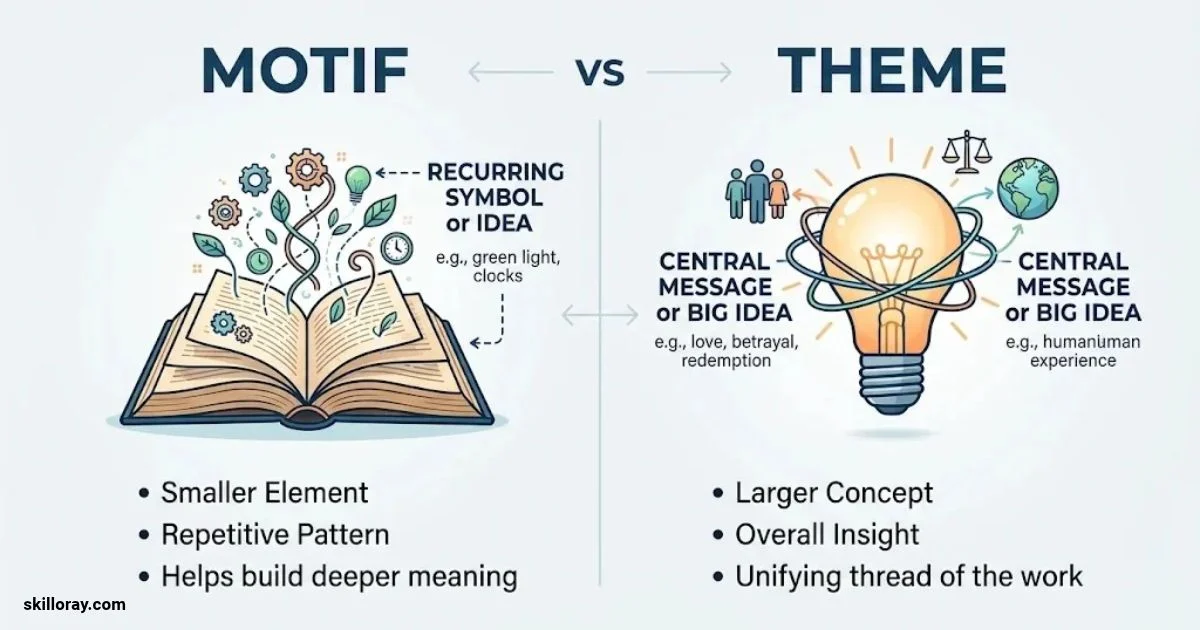
Have you ever confused a motif with a theme while reading a book or analyzing a story? You’re not alone. These two literary terms are closely connected, but they don’t mean the same thing. Understanding the difference can make reading and writing much easier.
A motif is a recurring element that helps develop a story, while a theme is the deeper message or central idea behind it. I’ll help you understand how these two literary concepts work together and what makes each one unique.
In this guide, you’ll explore the meanings of motif and theme, their key differences, and easy examples from literature. Whether you’re a student, writer, or curious reader, you’ll learn how to recognize both and use them correctly.
Motif vs Theme: What’s the Difference?
A motif is a repeated element, such as an object, image, phrase, color, or situation. A theme is the broader idea that a literary work explores.
For example, imagine a story about a woman who struggles to leave her past behind. The author repeatedly mentions old photographs, childhood belongings, and letters. These recurring details may form motifs connected to memory.
The theme might be that holding on to the past can make it difficult to move forward.
Here’s a quick comparison:
| Motif | Theme |
| A recurring element in a literary work | A central idea explored by the work |
| Can be an object, image, phrase, sound, or situation | Usually expresses an insight about life or human experience |
| Appears repeatedly throughout a story | Develops through the plot, characters, and conflicts |
| Adds layers of meaning and connects different scenes | Helps readers understand the story’s deeper message |
| Example: Repeated images of empty rooms | Example: Loneliness can make people feel disconnected |
Remember: A motif is something you notice repeatedly. A theme is what the story suggests about a larger subject.
What Is a Motif in Literature?
A motif is a recurring element that contributes to the meaning, atmosphere, or structure of a literary work. Writers use motifs to connect different parts of a story and draw attention to important ideas.
A motif might be a particular object, a repeated color, a familiar phrase, or even a situation that characters experience more than once.
Consider a fictional story about a teenager who moves to a new city. The author repeatedly describes train stations whenever the teenager feels uncertain about the future. As the story progresses, those stations become associated with change, separation, and new opportunities.
The train station is more than a setting detail. Its repeated appearance helps readers understand the character’s journey.
Common Types of Motifs
Motifs can appear in several forms. The important thing is not what the element looks like but how its repetition contributes to the story.
Visual Motifs
Visual motifs involve recurring images, colors, or objects.
Examples include:
- Rain appearing during moments of sadness or emotional conflict.
- Mirrors appearing when characters question their identities.
- Changing seasons reflecting different stages of life.
- Empty rooms appearing during moments of isolation.
A visual motif can establish an atmosphere or connect a character’s emotions with the surrounding world.
Object Motifs
An ordinary object can become a motif when it repeatedly appears during meaningful moments.
Examples include:
- An old photograph connected to memories of childhood.
- A locked door that appears whenever a character faces a difficult decision.
- A clock that emphasizes the passage of time.
- A family heirloom that connects different generations.
The object’s importance often grows as readers learn more about the characters and their experiences.
Verbal Motifs
A verbal motif involves repeated words, phrases, or expressions.
Imagine a character who keeps saying, “I’ll be back before sunset.” At first, the phrase may seem like an ordinary promise. Later, after several unexpected events, it could represent regret, uncertainty, or a desire to return to a familiar life.
The repetition gives the phrase additional meaning.
Situational Motifs
Situational motifs involve recurring events, conflicts, or patterns of behavior.
Examples include:
- A character repeatedly choosing between family and personal ambition.
- Different generations experiencing similar family disagreements.
- Someone leaving home and returning after major life changes.
- Characters facing repeated tests of loyalty and trust.
These patterns help writers connect separate events and develop the story’s larger ideas.
Motif Examples in Famous Literature
Several well-known literary works use recurring elements to develop their meanings.
| Literary Work | Motif or Recurring Element | Its Significance |
| The Great Gatsby by F. Scott Fitzgerald | The green light | Connects Gatsby’s longing for Daisy with his hopes and idealized future. |
| Macbeth by William Shakespeare | Blood imagery | Reinforces the play’s exploration of violence, guilt, and responsibility. |
| Lord of the Flies by William Golding | The conch shell | Repeatedly connects the boys’ attempts at organization with authority and order. |
| To Kill a Mockingbird by Harper Lee | The mockingbird image | Helps develop ideas about innocence and the harm caused by cruelty. |
These examples also show why a motif should not be confused with a simple repeated object. Its importance comes from the meaning it develops within the work.
What Is a Theme in Literature?
A theme is a central idea, insight, or message that a literary work explores. It helps readers understand what a story suggests about people, relationships, society, or human experience.
A theme isn’t simply a summary of the plot. It goes beyond what happens and considers what those events reveal.
For example, a story might follow a young woman who leaves her hometown to build an independent life. The plot describes her experiences, challenges, and decisions. The theme might explore how personal growth often requires people to step outside their comfort zones.
A literary work can explore several themes at once. Some are obvious, while others become clearer as the story develops.
Topic vs Theme: What’s the Difference?
A topic is the general subject of a story. A theme expresses what the story suggests about that subject.
This distinction is especially important when writing a school assignment or literary analysis.
| Topic | Possible Theme |
| Friendship | Genuine friendship requires trust and loyalty. |
| Revenge | Seeking revenge can destroy the person pursuing it. |
| Ambition | Uncontrolled ambition can damage important relationships. |
| Freedom | Personal freedom comes with responsibility. |
| Family | Family connections can remain meaningful despite disagreements. |
| Love | Love sometimes requires sacrifice and understanding. |
For example, writing “The novel is about friendship” identifies its topic. Writing “The novel shows that friendship can survive difficult circumstances” identifies a possible theme.
Common Types of Literary Themes
Literature explores a wide range of human experiences. The following themes appear in novels, short stories, plays, and poetry.
Love and Relationships
Stories about love often explore trust, loyalty, sacrifice, heartbreak, and emotional connection.
A writer might show that strong relationships require more than affection. They also need honesty, patience, and understanding.
Good vs. Evil
This theme explores moral choices and the conflict between right and wrong. Characters may struggle with temptation, injustice, revenge, or their own weaknesses.
Some stories make the difference between good and evil clear. Others show how difficult it can be to make the right decision.
Freedom and Independence
Many literary works explore people’s desire to control their own lives. Characters might challenge social expectations, family pressure, or political restrictions.
Their experiences reveal what freedom means and what it may cost.
Identity and Self-Discovery
This theme follows characters as they discover who they are and what they believe.
Their experiences may challenge old assumptions, change their relationships, or force them to make difficult decisions about their future.
Death and Mortality
Some stories explore aging, grief, loss, and the limited nature of human life.
These experiences often change how characters value their time, relationships, and personal choices.
Ambition and Power
Stories about ambition examine what people are willing to sacrifice to achieve success or gain control.
They may reveal how the desire for power changes a person’s behavior and relationships.
Theme Examples in Famous Literature
Here are examples of major themes explored in well-known literary works.
| Literary Work | Major Theme | Explanation |
| Pride and Prejudice by Jane Austen | Pride, prejudice, and personal growth | The novel explores how first impressions and personal assumptions affect relationships. |
| 1984 by George Orwell | Power and control | The story examines surveillance, manipulation, and authoritarian government. |
| To Kill a Mockingbird by Harper Lee | Justice and prejudice | The novel explores racial injustice, empathy, and moral courage. |
| The Great Gatsby by F. Scott Fitzgerald | The American Dream | The story questions wealth, social status, and the pursuit of an idealized future. |
| Macbeth by William Shakespeare | Ambition and guilt | The play shows the destructive consequences of unchecked ambition. |
A theme isn’t always a single sentence that every reader must accept. A literary work can support several interpretations, depending on its characters, events, and context.
Motif vs Theme: Five Key Differences
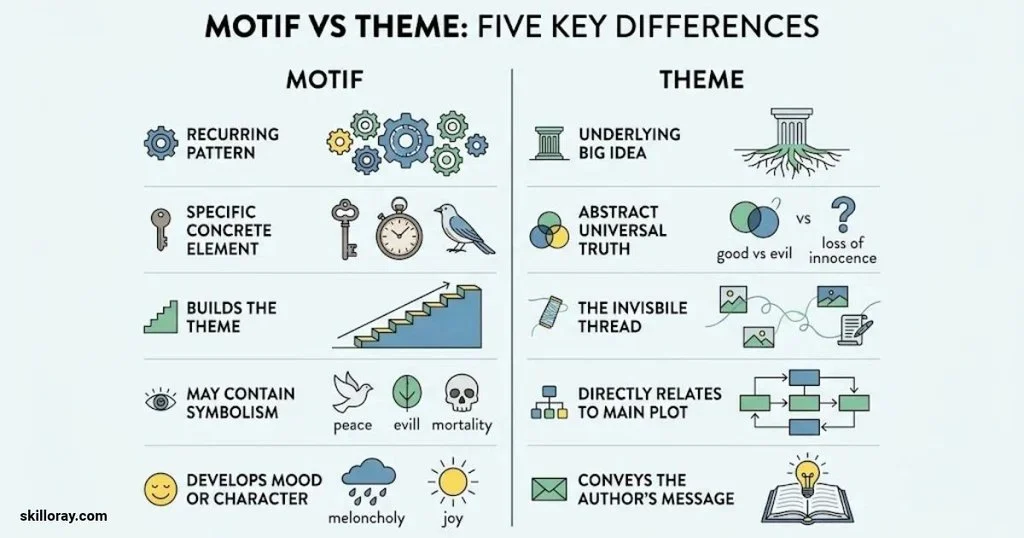
Motifs and themes work together, but they serve different purposes. These five differences make their relationship easier to understand.
Their Meaning Is Different
A motif is a recurring detail that carries meaning. A theme is a broader idea developed through the entire literary work.
For example, repeated references to family photographs might create a motif about memory. The theme could explore how memories shape personal identity.
They Appear in Different Ways
Readers can often identify a motif by noticing something that keeps appearing in different scenes.
Themes are less direct. They emerge through character decisions, relationships, conflicts, dialogue, and the story’s ending.
They Serve Different Purposes
Motifs connect scenes and add meaning to individual details. Themes give the story a deeper direction.
A recurring image of a broken watch might remind readers that a character cannot escape the past. The larger theme could explore regret and the difficulty of accepting change.
They Develop Differently
A motif may change its meaning as the story progresses.
For instance, a character might initially view a family home as a place of comfort. After a major conflict, returning to that home may bring back painful memories.
The theme can also become more complicated as characters experience new challenges.
A Story Can Have Several of Each
A novel can contain multiple motifs and themes.
A story about a family dealing with a difficult past might use photographs, old letters, and repeated references to childhood as motifs. Its themes could include forgiveness, belonging, identity, and personal growth.
These elements can work together without having a one-to-one relationship.
Motif vs Symbol: What’s the Difference?
Motif and symbol are closely related literary terms, but they describe different things.
A symbol is an object, image, person, or action that represents something beyond its literal meaning. A motif is a meaningful element that recurs throughout a literary work.
A symbol can appear only once. A motif generally involves repetition.
| Motif | Symbol |
| A meaningful recurring element | Something that represents an additional meaning |
| Usually appears more than once | Can appear once or repeatedly |
| Creates patterns throughout a literary work | Adds symbolic meaning to an object, image, or action |
| Can include recurring symbols | Can contribute to a motif when repeated |
For example, a single dove might symbolize peace in a story. If the author repeatedly includes doves during important scenes, they may also form a motif connected to peace, hope, or reconciliation.
The important distinction is that repetition helps establish a motif, while symbolic meaning gives an element significance beyond its literal form.
How Do Motifs Help Develop Themes?
Motifs often give readers a way to recognize a theme without the author directly explaining it.
Consider this fictional example.
A young man returns to his childhood home after spending ten years away. Throughout the story, the author repeatedly mentions three things:
- Old family photographs hanging in the hallway.
- An empty chair at the dinner table.
- Letters that were never sent.
Each detail appears during an important moment in the character’s journey.
The photographs remind him of the people and experiences he left behind. The empty chair reflects an absence in the family. The unsent letters reveal feelings he never expressed.
These recurring elements form motifs connected to memory, absence, and communication.
The story’s broader theme might be that unresolved feelings can prevent people from moving forward.
Notice how the motifs and theme work together. The photographs, chair, and letters don’t express the entire theme individually. Their repeated appearances gradually build its meaning.
A writer can use several motifs to develop one theme. The same motif can also support multiple themes, depending on the context.
How to Identify a Motif and Theme in a Story
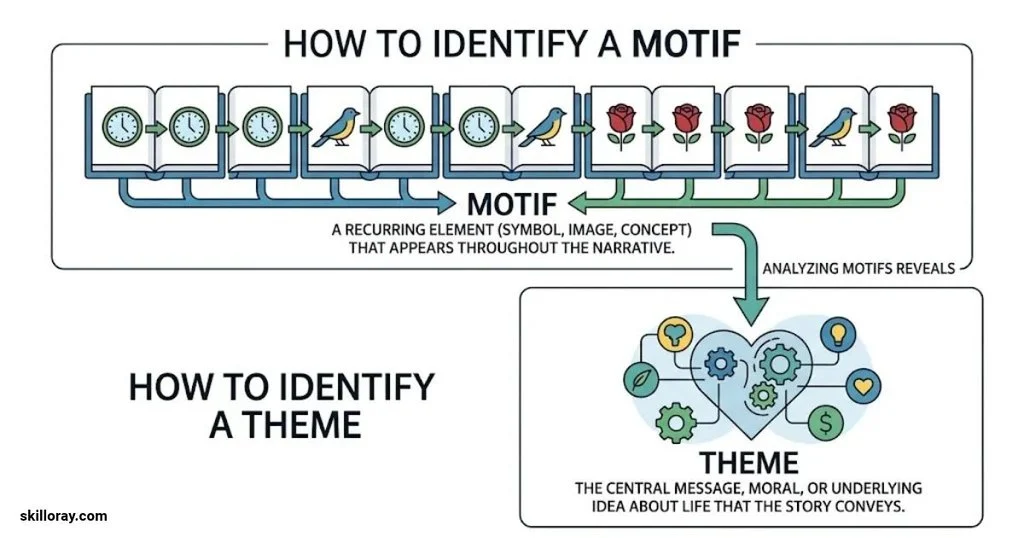
You don’t need advanced literary knowledge to recognize these elements. Start by paying attention to what appears repeatedly and what the characters experience.
Step 1: Notice Repeated Details
Look for objects, images, colors, sounds, phrases, or situations that appear more than once.
For example, if a novel repeatedly mentions locked doors, consider whether those details connect to an important character or conflict.
Step 2: Examine Where They Appear
A repeated element becomes more meaningful when you understand its context.
Does the locked door appear whenever a character feels trapped? Does it appear before an important decision?
The surrounding events can reveal why the writer keeps using that image.
Step 3: Identify the Main Conflict
Think about the central problem facing the characters.
Are they dealing with family disagreements, injustice, ambition, loneliness, or a struggle for independence?
The main conflict can help you recognize the subjects the story explores.
Step 4: Turn the Topic Into a Theme
Once you’ve identified the main subject, ask what the story suggests about it.
For example:
- Topic: Ambition.
- Possible theme: Ambition without self-control can lead to destructive decisions.
A theme should express an idea, not simply name a subject.
Step 5: Connect the Motif to the Theme
Finally, consider how the repeated element supports the larger idea.
If a story repeatedly mentions an unfinished painting whenever a character avoids making important decisions, the painting might become a motif representing unfulfilled potential.
The theme could explore how fear of failure prevents personal growth.
The connection should make sense within the story rather than relying on a universal meaning for every object.
Common Mistakes When Comparing Motif and Theme
These terms can be confusing, especially when a story uses several literary devices at once.
| Common Mistake | Correct Understanding |
| Calling every repeated object a motif | Repetition should contribute to the story’s meaning. |
| Treating a topic as a theme | A topic names a subject; a theme expresses an idea about it. |
| Assuming motif and theme mean the same thing | A motif is a recurring element, while a theme is a broader idea. |
| Thinking every symbol is a motif | A symbol can appear once; a motif involves a meaningful recurring pattern. |
| Assuming a story has only one theme | Literary works can explore multiple themes. |
| Giving an object a fixed meaning without context | Its meaning depends on how the author uses it in the story. |
One important point: a recurring detail doesn’t automatically have a symbolic meaning. Look at how the author uses it before deciding what it represents.
Frequently Asked Questions
What Is the Main Difference Between Motif and Theme?
A motif is a recurring element in a literary work, such as an image, object, phrase, or situation. A theme is a central idea the work explores. Motifs often help develop and reinforce themes.
Is a Motif the Same as a Theme?
No. A motif is something that repeatedly appears in a story, while a theme is the larger idea developed through its characters, events, and conflicts.
What Is an Example of a Motif and a Theme?
In a fictional story about loneliness, repeated descriptions of empty rooms could form a motif. The theme might explore how isolation affects people’s relationships and emotional well-being.
Can a Story Have More Than One Theme?
Yes. A novel, play, or short story can explore several themes. For example, a story about a family facing financial difficulties might explore responsibility, love, sacrifice, and personal growth.
Can One Motif Represent Multiple Themes?
Yes. A recurring image or object can support different ideas depending on the context. For example, a locked door might connect to secrecy, fear, isolation, or the desire for freedom.
What Is the Difference Between a Motif and a Symbol?
A symbol represents something beyond its literal meaning. A motif is a recurring element that contributes to a literary work’s meaning. A symbol can also become part of a motif when it appears repeatedly.
What Is the Difference Between a Motif and a Topic?
A topic is the general subject of a story, such as love, war, or friendship. A motif is a recurring element used throughout the work. A theme expresses what the story suggests about its subject.
How Do Writers Use Motifs to Develop Themes?
Writers repeat meaningful images, objects, phrases, or situations throughout a story. These recurring details connect important scenes and gradually help readers understand the larger ideas behind the plot.
Does Every Story Have a Motif?
Not every story has an obvious or easily identifiable motif. Some literary works use recurring elements prominently, while others focus more on character development, dialogue, and conflict to explore their themes.
Conclusion
The difference between motif and theme becomes clearer when you understand what each contributes to a story. A motif is a recurring element that adds meaning, while a theme is the broader idea the author explores.
When reading a novel or short story, notice what keeps returning. Ask why the writer includes those details and how they connect to the characters’ experiences.
Those repeated patterns can reveal the motifs, while the story’s deeper ideas point toward its themes.

I am Olivia Brown, a professional English editor and grammar writer who believes that great writing begins with a strong foundation in grammar. I have spent years creating educational resources that help students and professionals improve their writing, avoid common errors, and communicate more effectively. I strive to provide clear explanations and practical examples that make grammar easy to understand and apply.
Books: English Grammar Essentials and Modern Writing Success
 James Walker
 Daniel Carter