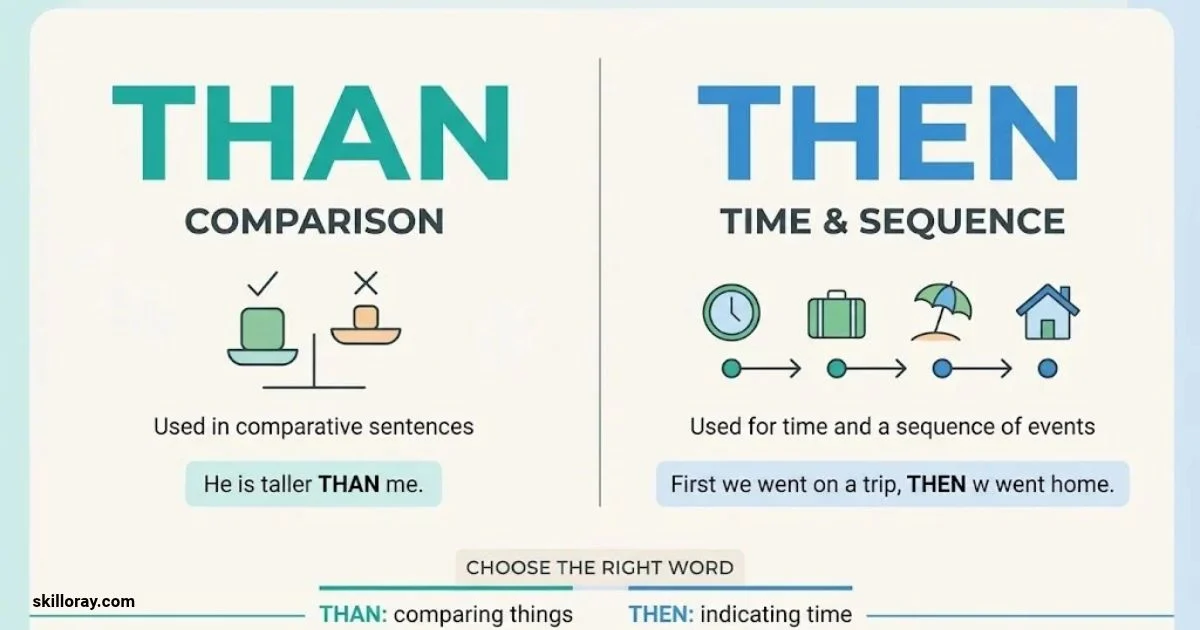
Have you ever paused while writing because you weren’t sure whether to use than or then? You’re not alone. These two words look and sound similar, but they have completely different meanings. Choosing the wrong one can change your sentence and make your writing less clear.
The good news is that understanding the difference between than and then is easier than you might think. I’ll show you simple rules and practical examples so you can choose the right word with confidence.
In this guide, you’ll learn what than and then mean, how to use each correctly, and how they work in everyday sentences. Whether you’re writing an email, completing schoolwork, or improving your English grammar, you’ll find easy explanations to help you avoid common mistakes.
Than or Then: Which One Is Correct?
Both spellings are correct, but you can’t freely replace one with the other.
| Word | Meaning | Example |
| Than | Used for comparisons | Sarah is taller than Emma. |
| Then | Refers to time or sequence | Sarah finished lunch, then left. |
| Than | Used in expressions of preference | I’d rather walk than drive. |
| Then | Shows a result or consequence | If you’re ready, then let’s begin. |
The right choice depends on what your sentence means. If you’re comparing something, choose than. If you’re explaining when something happened or what comes next, choose then.
When to Use Than
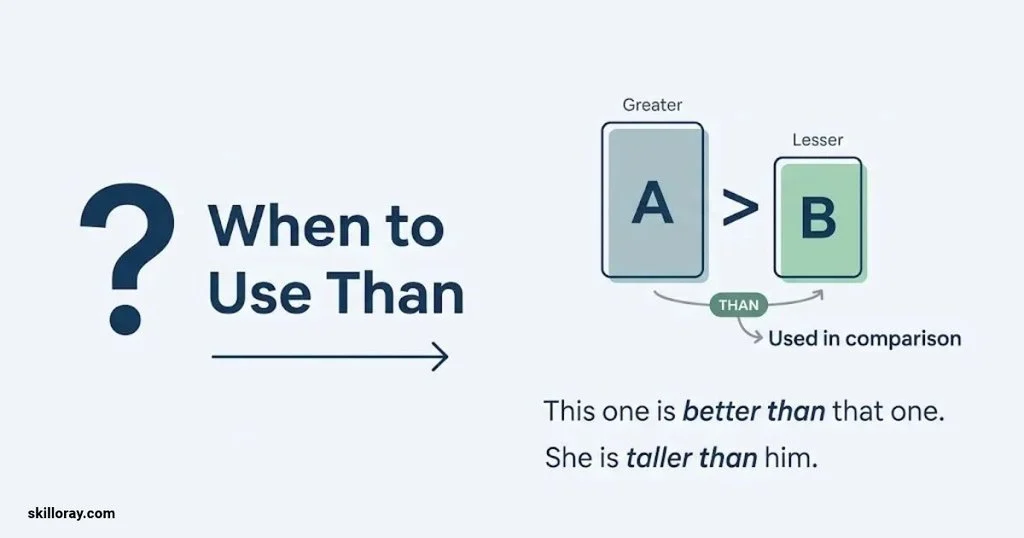
Than is mainly used to compare two or more things. It often appears after comparative words such as better, faster, older, smaller, more, and less.
Here are the most common ways to use it.
1. To Compare Two Things
Use than when describing how one person or thing differs from another.
Examples:
- My new phone is faster than my previous one.
- This road is shorter than the highway.
- The train arrived earlier than we expected.
- Her explanation was clearer than mine.
- Winter in this city is colder than winter in my hometown.
In each sentence, than introduces the second part of a comparison.
2. With More, Less, and Fewer
You’ll also find than after words that describe quantity, amount, or degree.
Examples:
- We need more time than we originally planned.
- This jacket costs less than the other one.
- Fewer students attended the meeting than expected.
- The project took more effort than we anticipated.
Remember that more than and less than are common expressions. They still use than because they compare amounts or degrees.
3. To Express Preferences
Use than in constructions such as would rather … than … to explain a preference between two choices.
Examples:
- I’d rather stay home than go out tonight.
- He would rather save money than buy a new phone.
- They’d rather take the train than drive through traffic.
- I’d rather finish the assignment today than worry about it tomorrow.
Be careful with the difference between prefer and would rather.
- Correct: I prefer tea to coffee.
- Correct: I’d rather drink tea than coffee.
In standard usage, prefer X to Y and would rather X than Y are the clearest patterns.
4. In Common Expressions
Several everyday expressions contain than. Their spelling stays the same even when the sentence changes.
| Expression | Meaning | Example |
| Other than | Except for | Nobody other than Mia knew the answer. |
| Rather than | Instead of | He walked rather than take a taxi. |
| More than | A greater amount | The repair cost more than $100. |
| Less than | A smaller amount | The trip took less than an hour. |
| No later than | By a specified deadline | Submit the form no later than Friday. |
| Better than | Of higher quality | This version works better than the old one. |
When to Use Then
Then usually refers to time, sequence, or a result. It helps readers understand when something happened, what happened next, or what follows from a condition.
1. To Talk About Time
Use then when referring to a particular time in the past, present, or future.
Examples:
- I lived in Chicago back then.
- Things were different then.
- We didn’t have smartphones back then.
- I’ll be busy this afternoon, but I’ll call you then.
- Until then, keep practicing.
In these sentences, then points to a time that the reader can identify from the context.
2. To Show What Happens Next
Use then to describe the order of events. It’s especially useful when explaining instructions, routines, or a series of actions.
Examples:
- First, wash the vegetables, then cut them into small pieces.
- She checked the address, then placed her order.
- Finish your homework, then you can watch television.
- We visited the museum and then had dinner nearby.
Think of then as a way to move the reader from one event to the next.
3. To Show a Result or Consequence
Then can introduce what follows from a condition or situation. It’s common in sentences that use an if-then structure.
Examples:
- If you finish early, then you can leave.
- If the weather improves, then we’ll go hiking.
- If you don’t understand the instructions, then ask for help.
- If the payment arrives today, then we’ll ship the order tomorrow.
In many everyday sentences, then is optional after an if clause.
For example:
- If you’re hungry, we can order food.
- If you’re hungry, then we can order food.
Both are correct.
4. To Describe Someone’s Former Position
Then can also work as an adjective before a noun. In this use, it describes a role or position someone held at a particular time.
Examples:
- The then-president announced a new policy.
- She spoke with the then-manager about the decision.
- The then-owner planned to sell the business.
Here, then-president means the person who was president at that time.
Than vs Then: Examples Side by Side
Seeing both words in similar situations can make the difference easier to remember.
| With Than | With Then |
| This car is cheaper than mine. | We bought the car, then drove home. |
| Emma is older than her brother. | Emma was younger then. |
| I prefer summer to winter. | Summer ended, then autumn began. |
| The task was harder than expected. | We finished the task, then took a break. |
| This route is longer than the other one. | Take this route, then turn left. |
| He would rather read than watch TV. | He read for an hour, then watched TV. |
Notice what each word does. Than introduces a comparison, while then connects events or refers to a time.
Common Than and Then Mistakes
Even experienced writers sometimes confuse these words. The following examples show how to correct the most common errors.
| Incorrect | Correct | Why? |
| This bag is cheaper then that one. | This bag is cheaper than that one. | The sentence compares prices. |
| I finished work, than went home. | I finished work, then went home. | The sentence describes a sequence. |
| She is more talented then her brother. | She is more talented than her brother. | Than introduces a comparison. |
| First, open the file, than save it. | First, open the file, then save it. | Then shows the next action. |
| I’d rather cook then order food. | I’d rather cook than order food. | Would rather … than … expresses a choice. |
A Quick Way to Avoid These Mistakes
Before choosing a word, ask yourself what the sentence is doing:
- Comparing something? Use than.
- Talking about time? Use then.
- Explaining what happens next? Use then.
- Showing a result after a condition? Use then.
This simple check will help you choose the right spelling in most everyday situations.
How to Remember Than vs Then
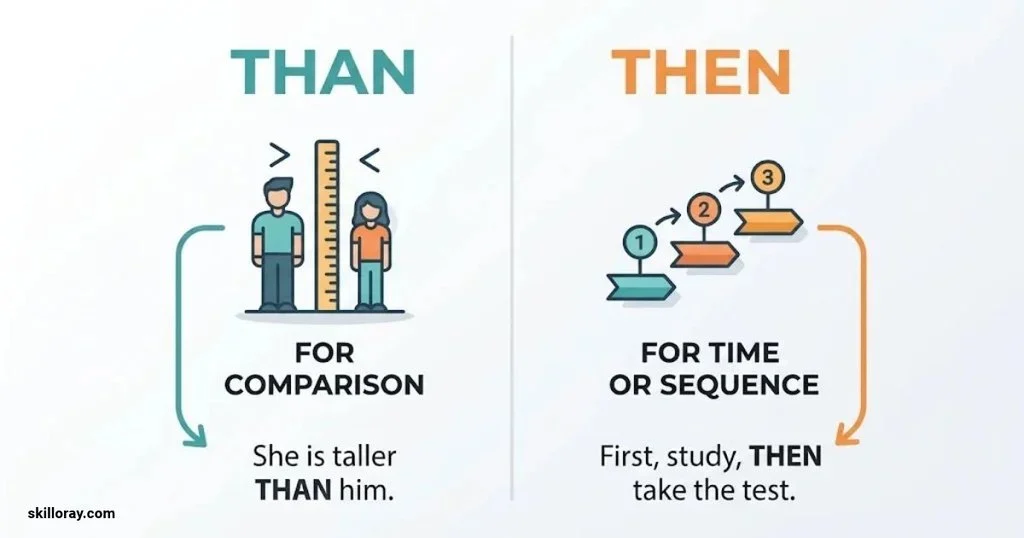
You don’t need a complicated grammar rule to remember these words. Focus on their main jobs.
Than = Comparison
Think of phrases such as:
- Better than
- Faster than
- More than
- Less than
- Rather than
Then = Time or sequence
Think of phrases such as:
- Back then
- Until then
- And then
- First, then
- Every now and then
A simple memory trick is to associate then with when. Both relate to time, although they don’t have the same meaning. When you’re comparing two things, than is the word you need.
Frequently Asked Questions
1. What Is the Main Difference Between Than and Then?
Than is used mainly for comparisons, while then refers to time, sequence, or a result. For example, “My house is bigger than yours” uses than, while “I ate dinner, then went to bed” uses then.
2. Is It Better Than or Better Then?
The correct expression is better than. Use it when comparing the quality, condition, or performance of two things.
Example: This new computer is better than my old one.
3. Should I Write More Than or More Then?
Write more than when comparing amounts, numbers, or degrees.
Example: The repair took more than two hours.
4. Is It And Then or And Than?
The correct phrase is usually and then when describing what happens next.
Example: We finished dinner and then watched a movie.
5. Is It No Later Than or No Later Then?
The correct expression is no later than. It establishes the latest acceptable time for something to happen.
Example: Please send your application no later than Monday.
6. Are Than and Then Homophones?
No. In standard US English, they generally have different vowel sounds. Than is commonly pronounced /ðæn/, while then is pronounced /ðɛn/. Their similar appearance and sound can still make them easy to confuse.
7. Can Then Be Used at the Beginning of a Sentence?
Yes. You can start a sentence with then when describing the next event or referring to a particular time.
Example: Then we decided to take a different route.
8. Is Different Than or Different From Correct?
Both expressions are used in American English. Different from is widely accepted, while different than is also common, particularly before a clause. The best choice can depend on sentence structure and your preferred style guide.
Conclusion
The difference between than and then comes down to their purpose. Use than when comparing people, objects, quantities, or ideas. Use then when referring to a time, describing the next event, or showing a result.
Remember one simple rule: than compares; then connects events or refers to time. Once you understand that distinction, choosing the correct word becomes much easier.

I am James Walker, an English language specialist with extensive experience in grammar, editing, and academic writing. I enjoy helping students, bloggers, and professionals strengthen their writing by explaining grammar concepts in a clear and engaging way. My focus is on providing accurate, practical, and easy-to-follow guidance that helps learners communicate more effectively in everyday and professional situations.
Books: Perfect English Grammar Handbook and Advanced Writing Techniques
 Daniel Carter
 Olivia Brown