Traveller or Traveler is a small spelling difference that can cause a surprising amount of confusion. I’ll show you the simple rule behind both forms, so you can quickly understand which spelling fits your writing.
If you’re writing for an American audience, you may wonder which version You should choose. The answer becomes much easier once you understand the difference between US and British English.
By the end, I’ll help you use the right spelling with confidence. You’ll know when to write “traveler,” when “traveller” is appropriate, and why both forms exist.
Quick Answer
Both traveller and traveler are correct spellings of the same noun meaning a person who travels.
- Traveller is the preferred spelling in British English, Australian English, and Canadian English.
- Traveler is the standard spelling in American English.
The meaning and pronunciation are identical. The choice depends on your audience and the English variety you follow.
Traveller or Traveler Spelling
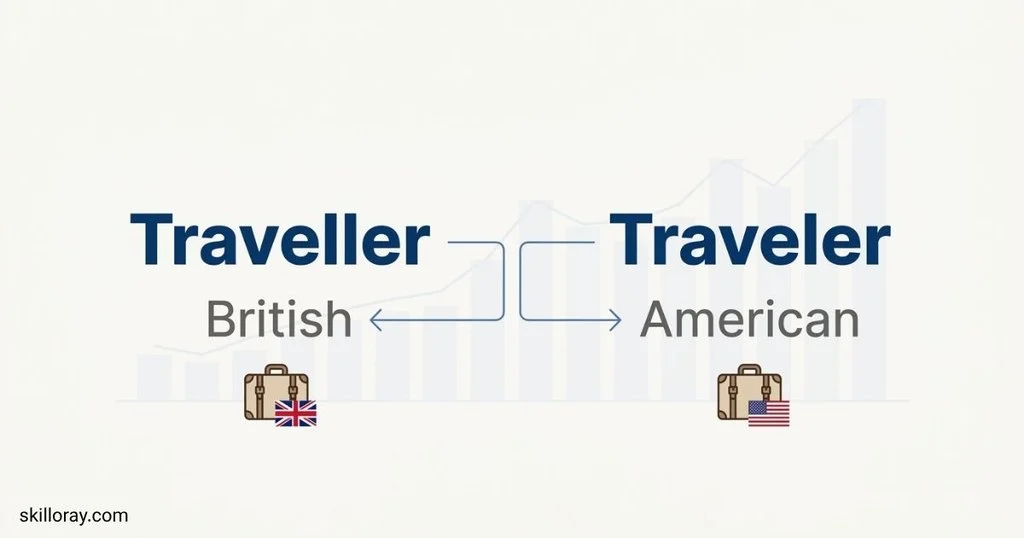
The correct spelling depends on the variety of English you are using. Traveller contains a double l and is the preferred British English spelling. Traveler contains a single l and is the standard American English spelling.
The same pattern appears in related forms:
| British English | American English |
|---|---|
| Traveller | Traveler |
| Travelling | Traveling |
| Travelled | Traveled |
Both spelling systems are accepted in modern English. Neither form is universally more correct than the other.
If you are writing a British English article, use traveller, travelling, and travelled. For an American English article, use traveler, traveling, and traveled. Consistency helps your writing look professional and makes it easier for readers to follow.
Quick Comparison Table
| Feature | Traveller | Traveler |
| Meaning | Person who travels | Person who travels |
| Part of Speech | Noun | Noun |
| Pronunciation | Same | Same |
| British English | Preferred | Rare |
| American English | Uncommon | Preferred |
| Canadian English | Common | Sometimes used |
| Australian English | Preferred | Rare |
| Academic Writing | Depends on style guide | Depends on style guide |
| Professional Writing | Regional preference | Regional preference |
How Are These Words Pronounced?
Both spellings have exactly the same pronunciation.
IPA Pronunciation
Traveller: /ˈtræv.ə.lər/
Traveler: /ˈtræv.ə.lər/
Syllable Breakdown
Trav-el-er
Three syllables:
- Trav
- el
- er
Pronunciation Difference
There is no pronunciation difference between traveller and traveler. Only the spelling changes.
Traveller or Traveler in English
In English, traveller and traveler are two accepted spellings of the same noun. Both refer to someone who journeys between places.
British English generally uses traveller, whereas American English uses traveler. These differences developed through regional spelling conventions, not because the words have different definitions.
For example, a British writer might write, “The traveller enjoyed exploring London,” while an American writer would write, “The traveler enjoyed exploring New York.”
Both sentences are grammatically correct. The important thing is to use the spelling appropriate for your audience and remain consistent throughout your writing.
Meaning and Usage

Meaning of Traveller
A traveller is a person who travels from one place to another, especially for pleasure, business, exploration, or work.
Examples
- The experienced traveller visited more than fifty countries.
- Every traveller should carry travel insurance.
- The traveller shared stories from Africa.
Meaning of Traveler
A traveler is also a person who travels.
The definition is identical to traveller.
Examples
- The traveler booked a flight to Japan.
- Every traveler needs a valid passport.
- The traveler enjoyed exploring local cultures.
Traveller vs. Tourist
A traveller is anyone who travels from one place to another, while a tourist usually refers to someone visiting a destination for sightseeing, recreation, or leisure.
| Feature | Traveller | Tourist |
|---|---|---|
| Main meaning | A person who travels | A visitor, often traveling for leisure |
| Common purpose | Business, leisure, work, study, or exploration | Sightseeing, holidays, and recreation |
| Typical usage | Broad term | More specific term |
| Example | A traveller visiting several cities for work | A tourist visiting museums on holiday |
For example, a person flying to another country for a business meeting is a traveller but may not be considered a tourist. Someone visiting the same country to see its landmarks can be both a traveller and a tourist.
Neither term is universally better. Choose the word that best describes the person’s purpose or situation. The spelling difference between traveller and traveler remains a separate issue: the former is preferred in British English, while the latter is standard in American English.
What Is a Traveler Gypsy?

The phrase “Traveler Gypsy” can refer to different things depending on the context. It may be used informally to describe a traveling person, but it should not automatically be treated as a synonym for traveler.
The terms Gypsy and Traveller can refer to distinct ethnic or cultural communities. For example, Romani people and Irish Travellers have distinct histories and identities. The word Gypsy is considered offensive by some people, so it is important to understand the context and use the name a community prefers.
In ordinary English, if you simply mean someone who journeys from place to place, traveler or traveller is usually the clearer word.
Main Difference Between Traveller and Traveler
The only meaningful difference is spelling preference based on regional English standards.
| Aspect | Traveller | Traveler |
| Meaning | Same | Same |
| Pronunciation | Same | Same |
| Grammar | Same | Same |
| Usage | British English | American English |
| Dictionaries | UK dictionaries | US dictionaries |
| Publishing Preference | UK publishers | US publishers |
| SEO Targeting | UK audiences | US audiences |
Grammar Rule Behind the Different Spellings
The difference comes from how British and American English handle consonant doubling when adding suffixes.
British English Rule
British English often doubles the final consonant when adding endings.
Examples:
- Travel → Traveller
- Travel → Travelling
- Cancel → Cancelled
- Label → Labelled
American English Rule
American English often keeps a single consonant.
Examples:
- Travel → Traveler
- Travel → Traveling
- Cancel → Canceled
- Label → Labeled
This spelling difference is systematic and appears in many English words.
Origin and Etymology

Historical Origin
The word comes from the Old French word travailler, meaning:
- To work
- To labor
- To struggle
The French term originated from Medieval Latin.
Over time, English adopted the word and connected it to journeys and movement.
Evolution of Meaning
Initially, traveling often involved hardship and effort. Because journeys were difficult centuries ago, the concept of travel was associated with labor and struggle.
Eventually, the modern meaning developed:
A person who journeys from one place to another.
Dictionary Comparison
Let’s see how major dictionaries treat these spellings.
| Dictionary | Traveller | Traveler |
| Oxford Dictionary | Preferred UK spelling | Preferred US spelling |
| Cambridge Dictionary | Standard UK spelling | Standard US spelling |
| Merriam-Webster | Listed variant | Primary entry |
| Collins Dictionary | Primary UK form | American variant |
The major dictionaries agree that both forms are correct.
Are Both Words Correct?
Yes.
Both spellings are fully accepted in modern English.
When Traveller Is Correct
Use traveller when writing for:
- United Kingdom
- Australia
- New Zealand
- Many Canadian publications
When Traveler Is Correct
Use traveler when writing for:
- United States
- American businesses
- US publications
- American audiences
Neither spelling is wrong.
British vs American English
The distinction between traveller and traveler is one of the most recognized spelling differences between British and American English.
Comparison Table
| British English | American English |
| Traveller | Traveler |
| Travelling | Traveling |
| Travelled | Traveled |
| Cancelled | Canceled |
| Labelled | Labeled |
| Modelled | Modeled |
This pattern appears consistently throughout English spelling systems.
Traveller or Traveler in the UK
Traveller is the standard British English spelling. British writers generally use traveller, travelling, and travelled.
Example: The traveller arrived in London early in the morning.
Traveller or Traveler in Canada
Traveller is widely used in Canadian English, although traveler also appears in Canadian writing. Canadian publications and organizations may follow their own spelling conventions, so check the relevant style guide when consistency matters.
Example: The traveller explored the Canadian Rockies.
Traveller or Traveler in Australia
Traveller is the usual Australian English spelling. Australian writers generally use travelling and travelled as well.
Example: Every traveller should check local travel requirements before leaving.
Traveller or Traveler in India
British-style spellings are common in Indian English, so traveller is a natural choice in many Indian publications and educational contexts. However, spelling practices can vary between organizations and publishers.
Example: The traveller visited several historic cities in India.
For professional writing, follow the spelling convention used by your publication, school, employer, or target audience.
Which Form Is More Common?
Publishing Usage
American publishing dominates much of the internet.
As a result:
Traveler often appears more frequently worldwide online.
British Publications
Major British newspapers typically use:
- Traveller
- Travelling
- Travelled
American Publications
Major American newspapers typically use:
- Traveler
- Traveling
- Traveled
Online Search Trends
Search volume tends to vary by country:
- United States → traveler
- United Kingdom → traveller
- Australia → traveller
- Canada → traveller (though traveler also appears)
When Should You Use Each Word?
Academic Writing
Follow the style guide required by your institution.
Examples:
- APA → usually American English
- Oxford Style → British English
Professional Writing
Match your audience.
Examples:
- US clients → traveler
- UK clients → traveller
Casual Writing
Either spelling is acceptable as long as you remain consistent.
Journalism
Most news organizations follow their house style.
Examples:
- British publications → traveller
- American publications → traveler
World Traveller or Traveler
Both world traveller and world traveler are correct. These phrases describe someone who travels around the world or visits many different countries.
- World traveller: Preferred in British English.
- World traveler: Standard in American English.
Examples:
- She hopes to become a world traveler and explore different cultures.
- The experienced world traveller has visited countries across several continents.
- Every world traveler can benefit from learning about local customs.
The phrase does not require someone to have visited every country. It is a general description of a person who travels widely around the world.
When writing a travel blog, biography, or social media profile, choose the spelling that matches your intended audience. Both expressions communicate the same basic idea.
Solo Traveller or Traveler
Both solo traveller and solo traveler are correct expressions. They describe a person who travels alone rather than with friends, family, or an organized group.
- Solo traveller: British English and other varieties that prefer the double-l spelling.
- Solo traveler: American English.
Examples:
- The solo traveler planned a trip to Japan.
- A solo traveller researched accommodation before leaving.
- Solo travelers often plan their itineraries according to their own interests.
The phrase solo traveler does not necessarily mean that someone prefers to be alone in everyday life. It simply describes how they are traveling on a particular journey or as a general travel preference.
For travel websites, blogs, and guides, choose the version that matches your target audience and keep the spelling consistent throughout the content.
Common Mistakes
Mistake 1: Mixing Spellings
❌ The traveler enjoyed travelling across Europe.
✅ The traveler enjoyed traveling across Europe.
✅ The traveller enjoyed travelling across Europe.
Explanation: Keep spelling consistent.
Mistake 2: Assuming One Is Wrong
❌ Traveler is incorrect English.
✅ Traveler is correct American English.
Explanation: Both forms are accepted.
Mistake 3: Switching for SEO Without Consistency
❌ Traveler guide for travellers visiting Europe.
✅ Traveler guide for travelers visiting Europe.
Explanation: Consistency improves readability and professionalism.
Real-Life Examples
Travel Blog
- Every traveler should respect local customs.
- The experienced traveller always packs light.
Business Context
- Frequent travelers often join airline loyalty programs.
- Business travellers spend considerable time on the road.
Education
- The traveler documented his research journey.
- The traveller kept detailed field notes.
Tourism Industry
- Modern travelers rely heavily on smartphones.
- International travellers often require visas.
Traveller or Traveler in Synonyms
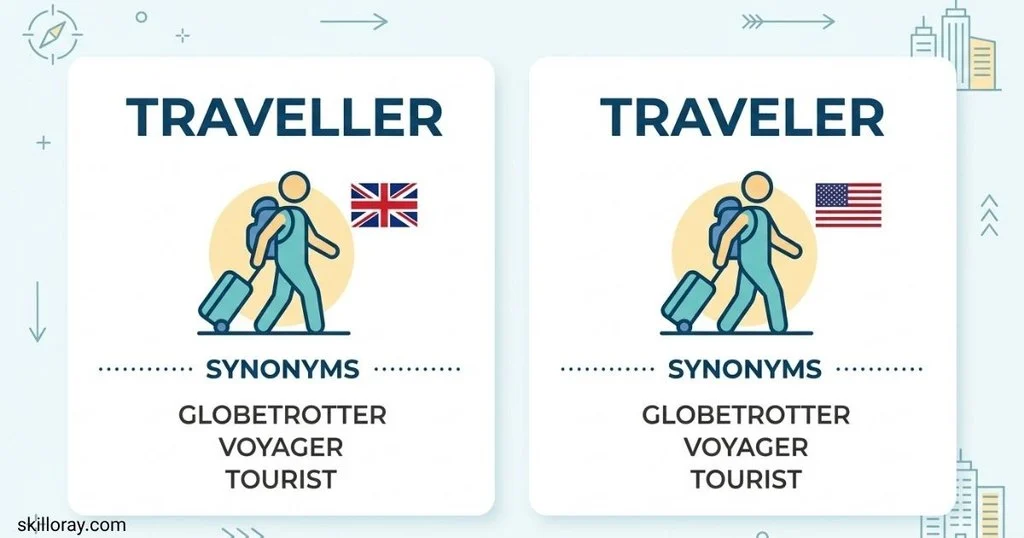
Traveller Synonyms
- Tourist
- Voyager
- Explorer
- Journeyer
- Globetrotter
- Backpacker
- Pilgrim
- Passenger
- Wayfarer
- Adventurer
Traveler Synonyms
Since both words mean the same thing, the synonyms are identical.
- Tourist
- Voyager
- Explorer
- Globetrotter
- Adventurer
- Backpacker
- Passenger
- Pilgrim
- Wayfarer
- Nomad
Antonyms of Traveller
Traveller Antonyms
- Resident
- Local
- Settler
- Homebody
- Nontraveler
- Stay-at-home
Traveler Antonyms
- Resident
- Local
- Homebody
- Settler
- Nontraveler
- Native
Memory Trick
A simple way to remember the difference:
Think of Double-L British English
Traveller = UK
British English often doubles the letter L.
Examples:
- Travelled
- Travelling
- Labelled
Think of Single-L American English
Traveler = USA
American English often keeps one L.
Examples:
- Traveled
- Traveling
- Labeled
Similar Confusing Words
If you’re interested in spelling differences, you may also compare:
- Colour vs Color
- Centre vs Center
- Favourite vs Favorite
- Organise vs Organize
- Jewellery vs Jewelry
- Theatre vs Theater
- Licence vs License
- Mould vs Mold
These pairs follow similar British-American spelling patterns.
Why Do People Search “Traveller or Traveler”?

People search this phrase because they want to know:
- Which spelling is correct
- Whether one version is wrong
- Which form should be used professionally
- Which spelling is preferred in America
- Which spelling is preferred in Britain
- How dictionaries treat the words
- Which version helps with SEO targeting
Common Search Queries
- Is traveller or traveler correct?
- What’s the difference between traveller and traveler?
- Traveler vs traveller spelling
- British spelling of traveler
- American spelling of traveller
- Which spelling should I use?
Traveller or Traveler in Genshin Impact
In the English-language version of Genshin Impact, Traveler is the official spelling of the playable protagonist’s name. The character is associated with the two selectable protagonists, Aether and Lumine.
In ordinary English, traveler and traveller are regional spelling variants. However, when referring to the character or using the game’s English terminology, use Traveler, following the official in-game spelling.
Examples:
- The Traveler explores the world of Teyvat.
- Players can choose Aether or Lumine as the Traveler.
- The Traveler meets many characters during the journey.
The spelling used for a fictional character’s official name can differ from the regional spelling preferred in general writing.
FAQs
Is traveller or traveler correct?
Both are correct spellings.
Which spelling is used in the United States?
Traveler is the standard American spelling.
Which spelling is used in the United Kingdom?
Traveller is the preferred British spelling.
Do they have different meanings?
No. Both words mean a person who travels.
Is traveler wrong in British English?
Not necessarily, but traveller is preferred.
Is traveller wrong in American English?
No, but traveler is the standard form.
Which spelling should bloggers use?
Use the spelling that matches your target audience.
How do dictionaries treat these words?
Major dictionaries recognize both spellings.
Are traveler and traveller pronounced differently?
No. The pronunciation is identical.
Which spelling should students use?
Follow your school’s style guide or regional English standard.
Can I use both in the same article?
It’s best to choose one spelling and remain consistent.
Is traveller or traveler the correct spelling?
Both spellings are correct. Traveler is standard in American English, while traveller is preferred in British English.
How do you spell traveller or traveler in English?
Both spellings are accepted. Use traveler for American English and traveller for British English, and follow your chosen style consistently.
Is traveller or traveler used in Canada?
Traveller is widely used in Canadian English, although traveler also appears. Follow your publisher’s or organization’s preferred spelling.
Is traveller or traveler used in India?
Traveller is common in Indian English, which often follows British spelling conventions. Individual publishers and organizations may differ.
What is the difference between a solo traveller and a solo traveler?
There is no difference in meaning. Both phrases describe someone traveling alone. Solo traveler is American English, and solo traveller is British English.
Is world traveller or world traveler correct?
Both are correct. Use world traveler in American English and world traveller in British English.
Does Genshin Impact use Traveler or Traveller?
The English-language version of Genshin Impact uses Traveler as the official spelling of the protagonist’s name.
Is a traveler the same as a tourist?
Not always. A traveler is anyone who journeys from place to place, while a tourist usually travels for leisure or sightseeing.
Is Gypsy another word for traveler?
Not generally. The term can refer to particular ethnic or cultural communities and may be offensive to some people. For a person who simply journeys from place to place, traveler or traveller is usually more appropriate.
Expert Recommendation
Editors, teachers, dictionaries, publishers, and style guides agree on one important point:
Both traveller and traveler are correct.
The best choice depends on your audience.
Recommended Usage
| Audience | Recommended Form |
| United States | Traveler |
| United Kingdom | Traveller |
| Australia | Traveller |
| Canada | Traveller |
| International Audience | Choose one and stay consistent |
Professional editors prioritize consistency more than the specific spelling choice.
Final Verdict
The debate over traveller or traveler is not about right versus wrong. It is about regional spelling preferences.
Key Takeaways
- Both words are correct.
- Both mean exactly the same thing.
- Traveller is preferred in British English.
- Traveler is preferred in American English.
- Pronunciation is identical.
- Major dictionaries recognize both spellings.
- Consistency matters more than choosing one over the other.
Practical Usage Advice
If you’re writing for a British, Australian, or Canadian audience, use traveller.
If you’re writing for an American audience, use traveler.
For global content, select one style and use it consistently throughout your writing.

I am James Walker, an English language specialist with extensive experience in grammar, editing, and academic writing. I enjoy helping students, bloggers, and professionals strengthen their writing by explaining grammar concepts in a clear and engaging way. My focus is on providing accurate, practical, and easy-to-follow guidance that helps learners communicate more effectively in everyday and professional situations.
Books: Perfect English Grammar Handbook and Advanced Writing Techniques
 Olivia Brown
 Daniel Carter