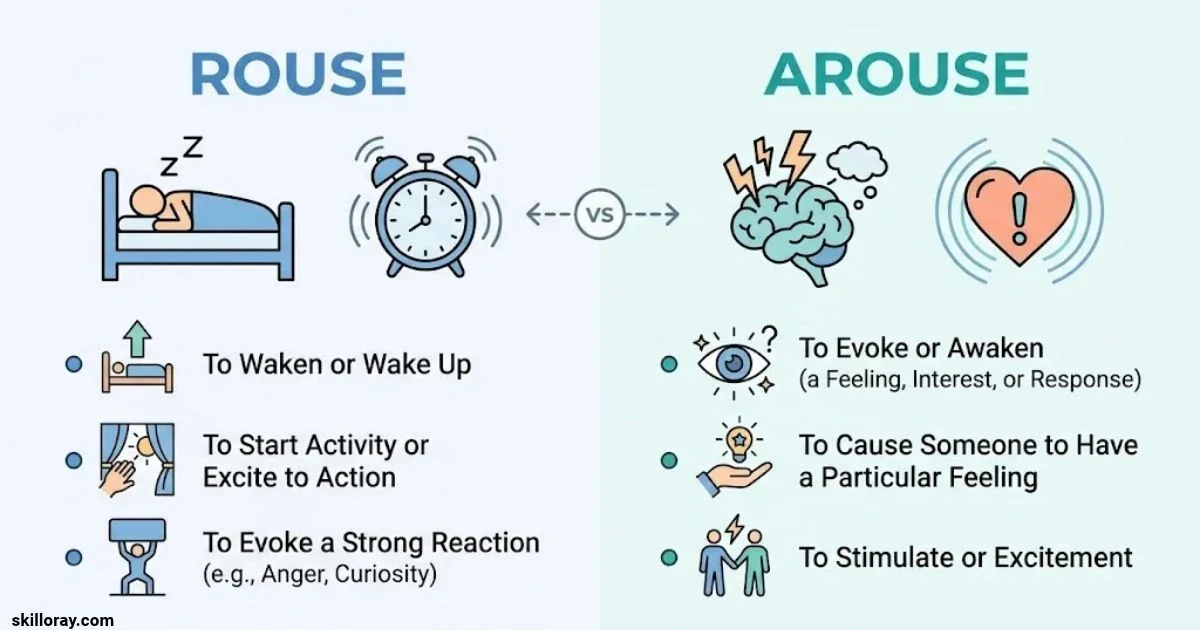
Have you ever wondered whether to use rouse or arouse in a sentence? These two words look and sound similar, but they carry different meanings depending on the context. Choosing the wrong one can change the message you’re trying to express.
Rouse generally means to wake someone up or stir them into action, while arouse means to awaken a feeling, interest, emotion, or response. Understanding this small but important difference can help you avoid confusion and communicate more clearly.
In this guide, you’ll learn the meanings of rouse and arouse, how they differ, and when to use each word. I’ll also share simple examples and practical tips to help you choose the right word with confidence.
What Is the Difference Between Rouse and Arouse?
The main difference is the type of response each verb emphasizes.
- Rouse: To wake someone or move a person from inactivity into action.
- Arouse: To bring about a feeling, reaction, interest, or desire.
| Word | Main meaning | Common expressions | Example |
| Rouse | Wake or stimulate someone into action | Rouse someone from sleep, rouse a crowd, rouse yourself | The phone roused me from sleep. |
| Arouse | Cause a feeling or reaction | Arouse curiosity, arouse suspicion, arouse anger | The strange message aroused my curiosity. |
The distinction isn’t absolute. Rouse can also describe emotional reactions, and arouse can mean waking someone in formal usage. However, the examples in the table show the most useful everyday patterns.
What Does Rouse Mean?
Rouse is a verb that means to wake someone, make someone more alert, or encourage someone to become active. It can describe a physical change, such as waking from sleep, or a figurative one, such as becoming motivated to act.
To Wake Someone From Sleep
Use rouse when something wakes a person who is sleeping or resting. The expression rouse someone from sleep is especially common in formal writing.
Examples:
- The doorbell roused the baby from sleep.
- A phone call roused me at five in the morning.
- She tried to rouse her brother before the school bus arrived.
- The rescue team struggled to rouse the unconscious passenger.
In everyday conversation, wake or wake up is often simpler. For example, you might say, “The alarm woke me up.”
To Encourage Someone to Take Action
Rouse can also describe getting someone out of a passive or inactive state. It often appears when a person or group needs encouragement to respond.
Examples:
- The coach gave a passionate speech to rouse the players.
- The community campaign roused residents to support the project.
- The warning finally roused the company into action.
- She tried to rouse herself from her afternoon laziness and finish her work.
Notice the expressions rouse someone to action and rouse yourself. Both describe moving from inactivity toward action.
To Stir Strong Feelings
Although arouse is frequently used with emotions, rouse can also describe stirring feelings such as anger, pride, or excitement.
Examples:
- The unfair decision roused anger among employees.
- The national anthem roused a sense of pride in the crowd.
- His speech roused the audience to enthusiasm.
- The final minutes of the match roused excitement among the fans.
In these sentences, rouse suggests that a feeling becomes active or intense.
What Does Arouse Mean?
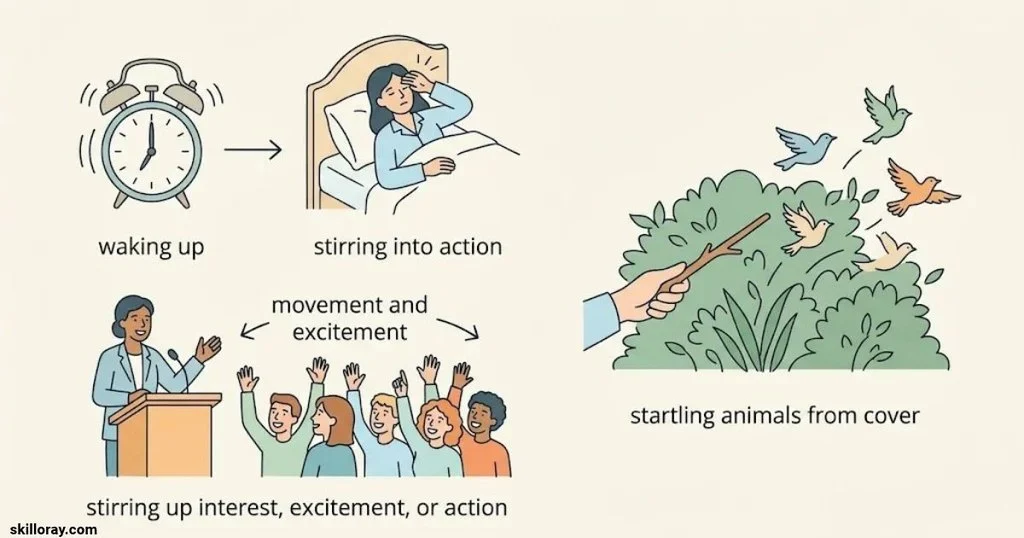
Arouse means to cause a particular feeling, emotion, attitude, or reaction. It often describes something that makes a person interested, curious, suspicious, angry, or excited.
The word also has a sexual meaning, so context matters when you use it.
To Create Interest or Curiosity
Use arouse when something makes a person want to learn more or pay closer attention.
Examples:
- The unusual photograph aroused my curiosity.
- Her research aroused interest among university students.
- The first chapter aroused readers’ interest in the mystery.
- The discovery aroused fresh questions about the old building.
Common expressions include arouse interest, arouse curiosity, and arouse someone’s attention.
To Cause an Emotional Reaction
Arouse can describe feelings such as anger, fear, sympathy, excitement, or concern.
Examples:
- The unfair treatment aroused anger among workers.
- The documentary aroused sympathy for the affected families.
- His unexpected decision aroused concern among his friends.
- The news aroused strong emotions throughout the community.
The focus is on the feeling that develops in response to something.
To Create Suspicion or Doubt
When someone’s behavior or an unusual event makes people question what is happening, arouse is a natural choice.
Examples:
- His changing explanation aroused suspicion.
- The missing documents aroused doubts about the report.
- The unusual transaction aroused the bank’s concerns.
- Her sudden silence aroused my suspicions.
The expressions arouse suspicion and arouse doubts are particularly useful in formal and everyday writing.
To Stimulate Sexual Feelings
Arouse can also mean to cause sexual excitement or desire. This meaning appears in everyday language as well as medical and psychological discussions.
For example:
- The romantic scene was intended to arouse desire.
When the intended meaning is not sexual, use a clear object such as curiosity, interest, or suspicion. That makes your meaning easier to understand.
Rouse vs Arouse in Example Sentences
Seeing the verbs side by side makes their differences easier to recognize. Pay attention to the object of each verb and the response it describes.
| Rouse | Arouse |
| The alarm roused me from sleep. | The strange noise aroused my curiosity. |
| The coach roused the tired players. | The announcement aroused public interest. |
| Her speech roused the crowd to action. | His behavior aroused suspicion. |
| The news roused anger among residents. | The decision aroused concern among parents. |
| He finally roused himself and started working. | The documentary aroused sympathy for the victims. |
When Can You Use Both Words?
Sometimes either verb works, especially when the sentence describes an emotional response.
Consider these examples:
Rouse:
The manager’s speech roused anger among the employees.
Arouse:
The manager’s speech aroused anger among the employees.
Both sentences are understandable. However, aroused anger focuses on the feeling that the speech caused, while roused anger gives a stronger sense of stirring an existing emotion.
Now consider a different situation:
- The loud noise roused the sleeping child.
- The loud noise aroused the sleeping child.
The first is the natural choice in ordinary English. The second is possible in a more formal sense, but it sounds less familiar in everyday conversation.
A useful rule is to choose rouse for waking or activating someone and arouse for creating a particular feeling or reaction.
Can Arouse Mean Wake Up?
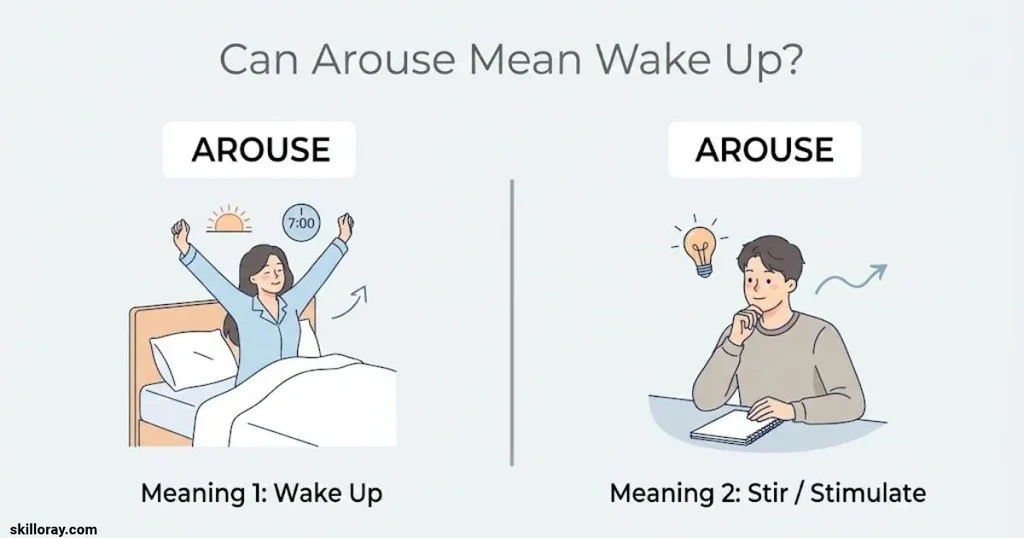
Yes. Arouse can mean to wake someone from sleep, but this use is generally formal. It can also describe making someone more active or alert.
For example:
- The sudden noise aroused him from a deep sleep.
- The emergency call aroused the residents from their beds.
These sentences are grammatically correct. However, most everyday speakers would probably choose woke or roused instead.
Compare the options:
| Sentence | Naturalness in everyday English |
| The noise woke me from sleep. | Very natural |
| The noise roused me from sleep. | Natural, slightly formal |
| The noise aroused me from sleep. | Correct, but more formal |
So, don’t treat arouse as incorrect when it refers to waking someone. Just remember that rouse is usually the more familiar choice for this meaning.
Rouse vs Arouse: Pronunciation and Word Forms
The two verbs have similar endings, but arouse has an extra unstressed syllable at the beginning.
| Word | US pronunciation | Syllables |
| Rouse | /raʊz/ | 1 |
| Arouse | /əˈraʊz/ | 2 |
Rouse rhymes with house and mouse. In arouse, the first syllable is unstressed, and the emphasis falls on the second syllable.
Both verbs follow regular English verb patterns:
| Form | Rouse | Arouse |
| Base form | Rouse | Arouse |
| Third-person singular | Rouses | Arouses |
| Present participle | Rousing | Arousing |
| Simple past | Roused | Aroused |
| Past participle | Roused | Aroused |
For example:
- The alarm rouses the entire household.
- The alarm roused everyone last night.
- The article arouses public interest.
- The article aroused curiosity among readers.
Common Mistakes When Using Rouse and Arouse
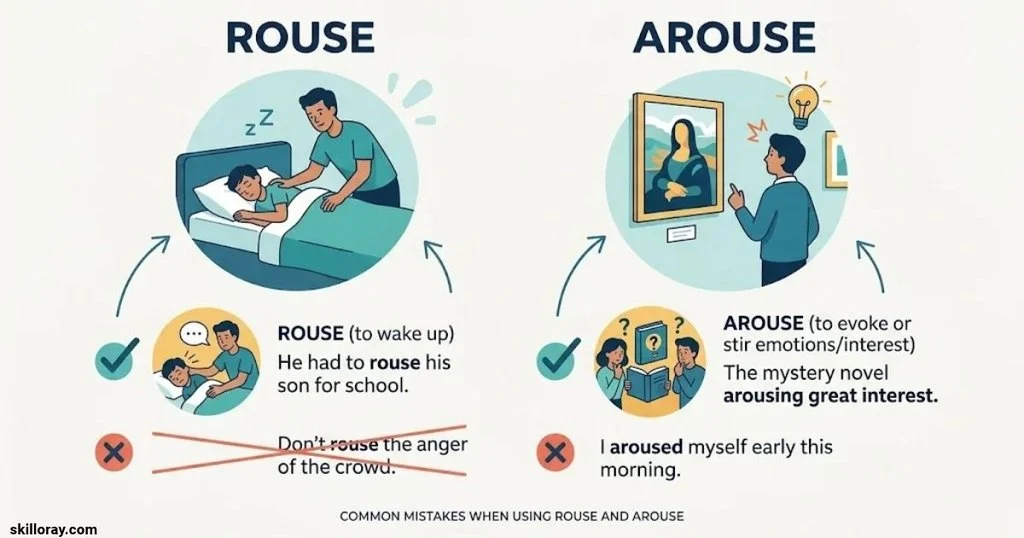
The words are related, but choosing one simply because it sounds similar to the other can change the tone or meaning of your sentence.
Using Arouse When Rouse Sounds More Natural
Arouse can mean waking someone, but rouse is usually the more familiar choice.
- Less natural: The alarm aroused me at six.
- Better: The alarm roused me at six.
- Also natural: The alarm woke me at six.
Assuming Rouse Only Refers to Sleep
Rouse has several uses beyond waking someone. It can also describe encouraging people to act or stirring strong feelings.
- Correct: The speech roused the crowd to action.
- Correct: The news roused anger among residents.
Thinking Arouse Always Has a Sexual Meaning
The word can describe many ordinary reactions. It doesn’t automatically refer to sexual excitement.
- The book aroused my curiosity.
- The decision aroused public concern.
- His unusual behavior aroused suspicion.
Treating the Two Words as Exact Synonyms
The verbs overlap in some emotional contexts, but they aren’t interchangeable in every sentence.
- Rouse someone from sleep: Wake someone up.
- Rouse a team to action: Encourage people to act.
- Arouse curiosity: Create interest.
- Arouse suspicion: Cause someone to become suspicious.
Learning these common expressions is more helpful than trying to replace one word with the other in every situation.
Frequently Asked Questions
What is the main difference between rouse and arouse?
Rouse usually means to wake someone, make them alert, or encourage action. Arouse generally means to create a feeling, emotion, interest, or desire. Both can describe emotional reactions in certain contexts.
Is rouse the same as wake?
They have similar meanings, but rouse can also mean stimulating someone into action or excitement. Wake is the simpler, more common word for ending someone’s sleep.
Can arouse mean to wake someone up?
Yes. Arouse can mean to wake someone from sleep, especially in formal usage. However, rouse or wake usually sounds more natural in everyday conversation.
Does arouse always have a sexual meaning?
No. Arouse can refer to curiosity, interest, anger, suspicion, sympathy, excitement, or sexual desire. The surrounding sentence determines its meaning.
What does rouse yourself mean?
Rouse yourself means making an effort to become active or alert, particularly when you feel tired, inactive, or reluctant to do something.
Example: She finally roused herself from the sofa and started preparing dinner.
What is the past tense of rouse and arouse?
Both verbs are regular. The past tense of rouse is roused, while the past tense of arouse is aroused.
What is the difference between rousing and arousing?
Rousing often describes something that wakes, motivates, or excites people, such as a rousing speech. Arousing usually describes something that creates a feeling or reaction, such as arousing curiosity or suspicion. It can also have a sexual meaning.
Which word should I use in formal writing?
Both words are suitable for formal writing. Use rouse for waking or motivating someone and arouse for causing a feeling or reaction. Remember that arouse can also mean waking someone in formal usage.
Conclusion
The difference between rouse and arouse comes down to the response you want to describe. Rouse usually means waking someone, making them alert, or encouraging action. Arouse generally means bringing out a feeling, interest, suspicion, or desire.
A loud noise can rouse you from sleep, while an unusual discovery can arouse your curiosity. Both words have overlapping meanings, but these common patterns will help you choose the right one.

I am James Walker, an English language specialist with extensive experience in grammar, editing, and academic writing. I enjoy helping students, bloggers, and professionals strengthen their writing by explaining grammar concepts in a clear and engaging way. My focus is on providing accurate, practical, and easy-to-follow guidance that helps learners communicate more effectively in everyday and professional situations.
Books: Perfect English Grammar Handbook and Advanced Writing Techniques
 Olivia Brown
 Daniel Carter