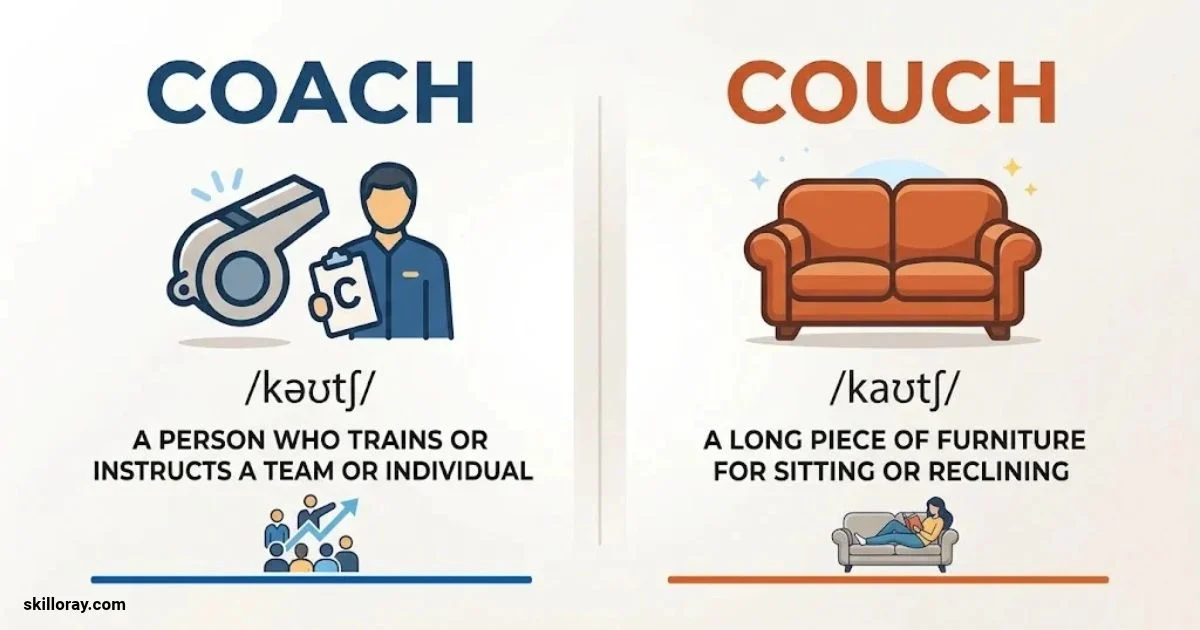
Have you ever confused coach with couch while writing or speaking? You’re not alone! These two words look and sound somewhat similar, but they have completely different meanings. Using the wrong one can change the message you’re trying to communicate.
A coach is someone who trains, guides, or teaches you, while a couch is a comfortable piece of furniture where you sit or relax. I’ll help you understand their meanings, differences, and correct usage so you never mix them up again.
In this guide, you’ll discover simple definitions, pronunciation tips, and practical examples of coach and couch in everyday sentences. Whether you’re learning English or improving your writing, you’ll find everything you need to use both words confidently.
Coach vs Couch: Quick Comparison
| Feature | Coach | Couch |
| Meaning | A trainer, instructor, or type of transportation | A comfortable upholstered seat |
| Part of speech | Noun and verb | Noun and verb |
| Pronunciation | /koʊtʃ/ | /kaʊtʃ/ |
| Common use | Sports, training, education, transportation | Furniture and home interiors |
| Example | Our coach prepared us for the tournament. | I relaxed on the couch after work. |
Quick tip: A coach trains or guides people. A couch is furniture.
What Does Coach Mean?

Coach can be used as both a noun and a verb. It commonly refers to someone who teaches, trains, or helps another person improve a skill. It also has a few meanings related to transportation.
Coach as a Noun
A coach is someone who provides instruction, training, or guidance. Coaches work in sports, business, education, fitness, and personal development.
Examples:
- The basketball coach changed the team’s strategy before the final quarter.
- My career coach helped me prepare for a job interview.
- Her swimming coach encouraged her to practice every morning.
- The new employees met their training coach on Monday.
A coach doesn’t always work in sports. Someone who helps you develop professional skills or reach a personal goal can also be called a coach.
Coach as a Verb
As a verb, coach means to train, guide, or help someone improve their performance.
Examples:
- She coaches young athletes at a local sports club.
- The manager coached his team through a difficult project.
- My teacher coached me for the public speaking competition.
- He was coached by an experienced business consultant.
In these examples, the word describes the act of teaching or guiding someone.
Coach in Transportation
Coach can also refer to a bus designed for longer journeys or a passenger carriage on a train.
Examples:
- We traveled to the next city by coach.
- The passengers boarded the coach at the station.
- Our train coach had comfortable seats and plenty of luggage space.
In American English, coach can also refer to the standard or economy class of an airplane.
Example: We booked coach seats to keep our travel costs low.
What Does Couch Mean?
Couch is mainly a noun referring to an upholstered piece of furniture designed for sitting or relaxing. It usually has a backrest and arms and can accommodate more than one person.
You might find a couch in a living room, office, waiting area, or family room.
Examples:
- We bought a new couch for our apartment.
- The dog jumped onto the couch as soon as we sat down.
- I left my glasses between the cushions of the couch.
- They moved the couch closer to the television.
Couch as a Verb
Although couch is most commonly used as a noun, it can also work as a verb. In this form, it means to express an idea or statement in a particular way.
This meaning is more formal and less common in everyday conversation.
Examples:
- She couched her disagreement in respectful language.
- The report was couched in technical terms.
- He couched his criticism as a suggestion for improvement.
In these sentences, couch doesn’t refer to furniture. It describes how someone expresses an idea.
Coach vs Couch: Pronunciation Difference
One important difference between coach and couch is their pronunciation. They share the same ending sound, but their vowel sounds are different.
| Word | Pronunciation | Similar sound |
| Coach | /koʊtʃ/ | Go, boat, approach |
| Couch | /kaʊtʃ/ | House, mouth, ouch |
Here’s how to pronounce them:
- Coach: The vowel sounds like the long O in go.
- Couch: The vowel sounds like OW in house.
Try saying this sentence aloud:
“My coach told me to get off the couch.”
Listen carefully to the first vowel in each word. Coach has an O sound, while couch has an OW sound.
Are Coach and Couch Homophones?
No. Coach and couch are not homophones because they don’t have the same pronunciation.
Homophones sound alike but have different meanings and spellings. For example, right and write are homophones.
Although coach and couch look similar, their vowel sounds make them easy to distinguish when spoken clearly.
Coach vs Couch in Sentences
The following examples show how both words appear in everyday English.
| Coach | Couch |
| My coach helped me prepare for the interview. | I placed my laptop on the couch. |
| The coach changed the team’s formation. | We ordered a new couch for the apartment. |
| She coaches children at a swimming club. | The cat sleeps on the couch every afternoon. |
| We traveled to Lahore by coach. | The delivery team brought the couch upstairs. |
| His coach encouraged him to keep practicing. | I fell asleep on the couch during the movie. |
Remember that the correct word depends on the meaning of your sentence, not just how similar the spellings look.
Coach vs Couch: What’s the Difference Between a Couch and a Sofa?
A common question is whether couch and sofa mean different things. In everyday American English, these words are generally interchangeable.
Both refer to upholstered furniture designed for sitting or relaxing.
| Word | Meaning | Example |
| Couch | A comfortable upholstered seat | We bought a new couch for the family room. |
| Sofa | An upholstered seat, commonly used in living rooms | The sofa looks beautiful beside the window. |
Some people associate sofa with more formal furniture and couch with casual seating. However, this is a matter of personal preference rather than a strict English grammar rule.
Common Mistakes When Using Coach and Couch
Because the words differ by only one letter, it’s easy to type the wrong one. These examples show how to avoid common mistakes.
Using Couch for a Sports Trainer
Incorrect: Our basketball couch explained the new game plan.
Correct: Our basketball coach explained the new game plan.
Why? The sentence refers to someone who trains a sports team. The correct word is coach.
Using Coach for Living Room Furniture
Incorrect: We bought a comfortable coach for our living room.
Correct: We bought a comfortable couch for our living room.
Why? The sentence describes furniture, so couch is the correct choice.
Confusing Coach Travel with Furniture
Incorrect: We traveled to another city by couch.
Correct: We traveled to another city by coach.
Why? A coach can refer to a bus used for longer journeys. A couch is a piece of furniture.
Using Couch Instead of Coach as a Verb
Incorrect: The manager will couch the new employees.
Correct: The manager will coach the new employees.
Why? The manager will train or guide the employees. In this context, coach is the correct verb.
How to Remember Coach vs Couch

You can remember these words by connecting each one with a familiar situation.
- Coach = Training: Think of a football coach, career coach, or fitness coach.
- Couch = Comfort: Picture a comfortable seat in your living room.
The pronunciation can help, too:
- Coach rhymes with approach.
- Couch rhymes with ouch.
If you’re talking about someone who teaches or trains others, choose coach. If you’re describing a sofa, choose couch.
Frequently Asked Questions
What is the difference between coach and couch?
Coach usually refers to a person who trains or guides others. It can also describe certain types of transportation. Couch refers to upholstered furniture used for sitting or relaxing.
Is it coach or couch for living room furniture?
Use couch when talking about living room furniture.
Example: “We bought a large couch for our new apartment.”
Are coach and couch homophones?
No. They are not homophones because their vowel sounds are different. Coach is pronounced /koʊtʃ/, while couch is pronounced /kaʊtʃ/.
How do you pronounce coach and couch?
Coach has the long O sound found in go. Couch has the OW sound found in house. Both words end with the same CH sound.
Can coach refer to a vehicle?
Yes. A coach can refer to a bus used for longer journeys or a passenger carriage on a train. In American English, it can also mean the standard class of an airplane.
Is couch another word for sofa?
Yes. In everyday American English, couch and sofa generally refer to the same type of upholstered seating furniture.
Can couch be used as a verb?
Yes. As a verb, couch means to express an idea in a particular way.
Example: “She couched her concerns in polite language.”
What is the past tense of coach?
The past tense of coach is coached.
Example: “He coached the school football team for two seasons.”
Conclusion
The difference between coach and couch comes down to their meanings and vowel sounds. Use coach for a trainer, instructor, or certain types of transportation. Use couch for a sofa or, less commonly, the act of expressing something in particular words. Remember the simple pronunciation trick: coach rhymes with “approach,” while couch rhymes with “ouch.”

I am Olivia Brown, a professional English editor and grammar writer who believes that great writing begins with a strong foundation in grammar. I have spent years creating educational resources that help students and professionals improve their writing, avoid common errors, and communicate more effectively. I strive to provide clear explanations and practical examples that make grammar easy to understand and apply.
Books: English Grammar Essentials and Modern Writing Success
 James Walker
 Daniel Carter