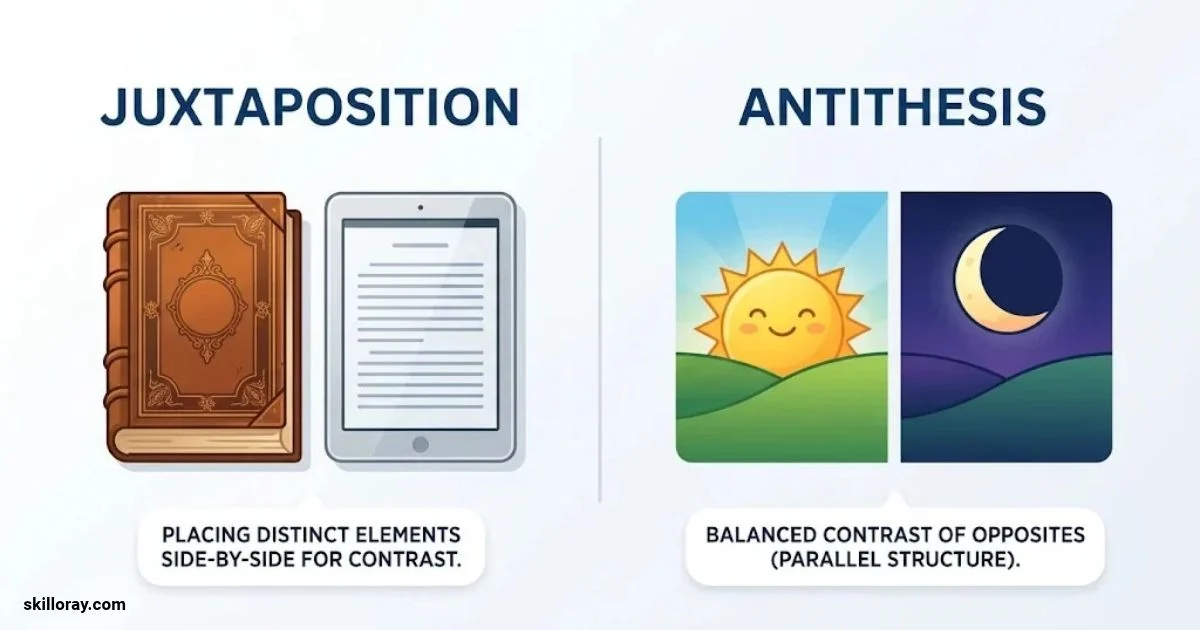
Antithesis and juxtaposition are two literary devices that writers use to make ideas more powerful and memorable. Although they may seem similar, they serve different purposes. If you’ve ever wondered how writers highlight opposing ideas or create meaningful contrasts, understanding these techniques can make reading and writing much easier.
Antithesis uses contrasting ideas in a balanced structure to emphasize a difference, while juxtaposition places two contrasting elements close together to highlight their differences. Both techniques can make writing more engaging, but knowing when and how to use each one can help you express your ideas more effectively.
In this guide, I’ll explain the differences between antithesis and juxtaposition with simple definitions, clear examples, and practical explanations. You’ll learn how each literary device works, when to use it, and how to recognize it in everyday writing and literature.
Antithesis vs Juxtaposition: Quick Comparison
| Feature | Antithesis | Juxtaposition |
| Meaning | A rhetorical device that presents contrasting ideas in a balanced expression | A literary technique that places elements close together for comparison |
| Structure | Often uses parallel grammatical patterns | Doesn’t require a specific sentence structure |
| Main purpose | Emphasizes opposing ideas | Highlights differences, similarities, or unexpected relationships |
| Common forms | Speeches, poetry, essays, and memorable expressions | Novels, films, poems, photography, and visual art |
| Scope | Usually a phrase, sentence, or connected statement | Can extend across a sentence, scene, chapter, or entire work |
| Example | “United we stand, divided we fall.” | A luxurious mansion shown beside a neglected neighborhood |
The easiest distinction to remember is this: antithesis is a specific way of expressing contrast, while juxtaposition is a broader technique for placing elements together and inviting comparison.
What Is Antithesis?
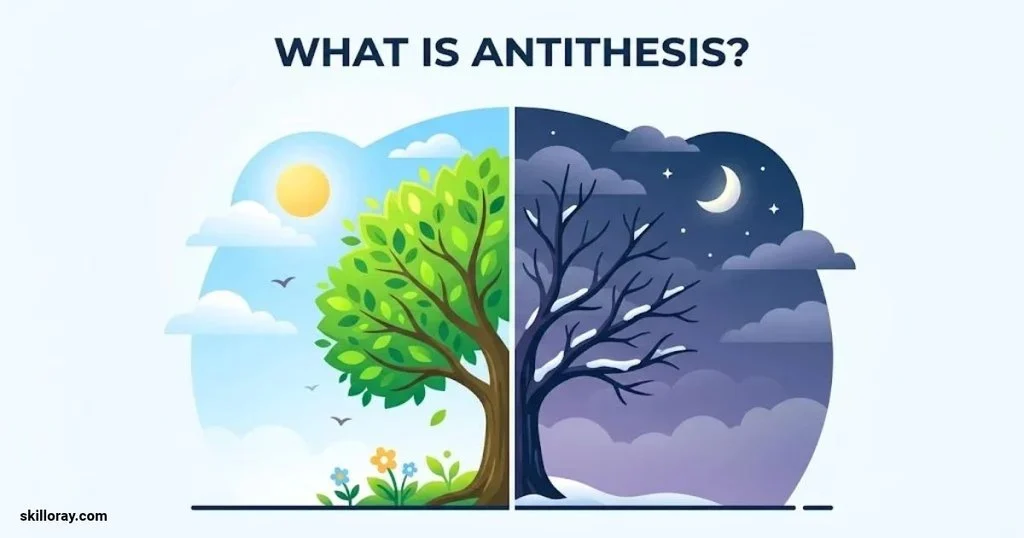
Antithesis is a rhetorical device that brings opposing ideas together in a balanced or parallel expression. Writers use it to make differences clear, strengthen arguments, and create memorable statements.
The word antithesis comes from Greek roots associated with opposition or setting something against another thing. In literature and rhetoric, it commonly appears when a writer contrasts two ideas through carefully arranged words, phrases, or clauses.
For example:
“United we stand, divided we fall.”
The words united and divided express opposing ideas. Both parts also follow a similar grammatical pattern, which gives the sentence its balance and impact.
Famous Examples of Antithesis
Antithesis appears in literature, public speeches, and familiar expressions. These examples show how writers use balanced contrasts to communicate powerful ideas.
1. “It was the best of times, it was the worst of times.” — Charles Dickens
This famous opening from A Tale of Two Cities places “best” and “worst” in a repeated sentence structure. Dickens uses the opposing descriptions to introduce an era marked by both progress and suffering.
2. “To err is human; to forgive, divine.” — Alexander Pope
In An Essay on Criticism, Pope contrasts human imperfection with the ideal of divine forgiveness. The balanced construction makes the thought memorable.
3. “Ask not what your country can do for you—ask what you can do for your country.” — John F. Kennedy
Kennedy’s famous inaugural address uses a reversal of sentence structure to contrast receiving help with serving others. The repeated wording strengthens the call for civic responsibility.
4. “United we stand, divided we fall.” — Traditional proverb
This familiar expression contrasts cooperation with separation. Its parallel structure makes the relationship between unity and failure easy to understand.
Common Features of Antithesis
Look for these characteristics when identifying antithesis:
- Contrasting ideas: The expression brings opposing concepts together, such as love and hate or hope and despair.
- Balanced wording: The ideas often appear in similar grammatical structures.
- Emphasis: The contrast makes the writer’s point more noticeable.
- Memorable language: A concise, balanced expression can make a message easier to remember.
Parallel structure is common in antithesis, but the essential feature is the deliberate presentation of contrasting ideas.
What Is Juxtaposition?
Juxtaposition is a literary technique that places two or more elements near each other so readers can notice their relationship. Writers can use people, objects, settings, images, or ideas to create this effect.
The elements may be opposites, but they don’t have to be. Sometimes a writer places two unexpected things together to reveal a connection or encourage readers to think differently.
For example, imagine a story that describes a crowded, noisy city immediately after showing a quiet village. The difference between the settings may highlight the contrast between urban and rural life.
Juxtaposition can also communicate ideas without explaining them directly. Readers notice the relationship and interpret what it means.
Examples of Juxtaposition in Literature
Juxtaposition can reveal social differences, develop characters, and make a story’s themes more noticeable.
1. Wealth and Poverty in The Great Gatsby
F. Scott Fitzgerald uses differences in wealth, lifestyle, and social position throughout The Great Gatsby. The contrast between the characters’ circumstances helps expose the inequality and social divisions of the world they inhabit.
2. Love and Family Conflict in Romeo and Juliet
William Shakespeare places the love story of Romeo and Juliet within the conflict between two rival families. The contrast between the young couple’s relationship and their families’ hatred makes the tragedy more powerful.
3. Two Cities in A Tale of Two Cities
Charles Dickens contrasts London and Paris during the French Revolution. Their different conditions and experiences help establish the novel’s atmosphere and explore social and political tensions.
4. Peace and Destruction in a Story Scene
Imagine a character standing in a beautiful garden while a damaged building remains visible in the background. The peaceful natural setting and signs of destruction appear together, encouraging readers to reflect on the contrast between beauty and suffering.
The last example is an illustrative scenario rather than a quotation from a published work.
Common Features of Juxtaposition
Juxtaposition has several recognizable characteristics:
- Close placement: Two or more elements appear near each other.
- Comparison: Their relationship encourages readers to notice differences or similarities.
- Flexible structure: It can appear in a single sentence, a conversation, a film scene, or a whole chapter.
- Different effects: It can create tension, humor, irony, symbolism, or emotional impact.
Unlike antithesis, juxtaposition doesn’t require a balanced sentence. A writer can create it through the arrangement of characters, settings, images, or events.
Antithesis vs Juxtaposition: Key Differences
The two devices can both create contrast, but their structures and uses are different.
| Point of comparison | Antithesis | Juxtaposition |
| Basic idea | Expressing opposing ideas in a balanced way | Placing elements together for comparison |
| Structure | Often parallel or balanced | Flexible |
| Main focus | A contrast between ideas | A relationship between elements |
| Typical length | A phrase, sentence, or connected statement | Anything from a short description to an entire story |
| Requires opposites? | Usually involves opposing ideas | No; elements can be similar or unexpected |
| Reader’s experience | Notices a deliberate rhetorical contrast | Compares elements and interprets their relationship |
The Same Contrast Expressed Through Both Techniques
The easiest way to understand the difference is to examine how a writer can present the same general idea in two ways.
Antithesis:
“Some people chase wealth, while others value happiness.”
The sentence places two contrasting priorities in a balanced construction. This is antithesis.
Juxtaposition:
A story follows two characters. One spends every day pursuing money and professional success, while the other chooses a simpler life centered on family and personal relationships.
The writer places the characters’ different lifestyles within the same story, allowing readers to compare their priorities. This is juxtaposition.
Both examples explore different ideas about a successful life. The first uses a balanced rhetorical expression; the second uses contrasting characters.
Can Antithesis and Juxtaposition Be Used Together?
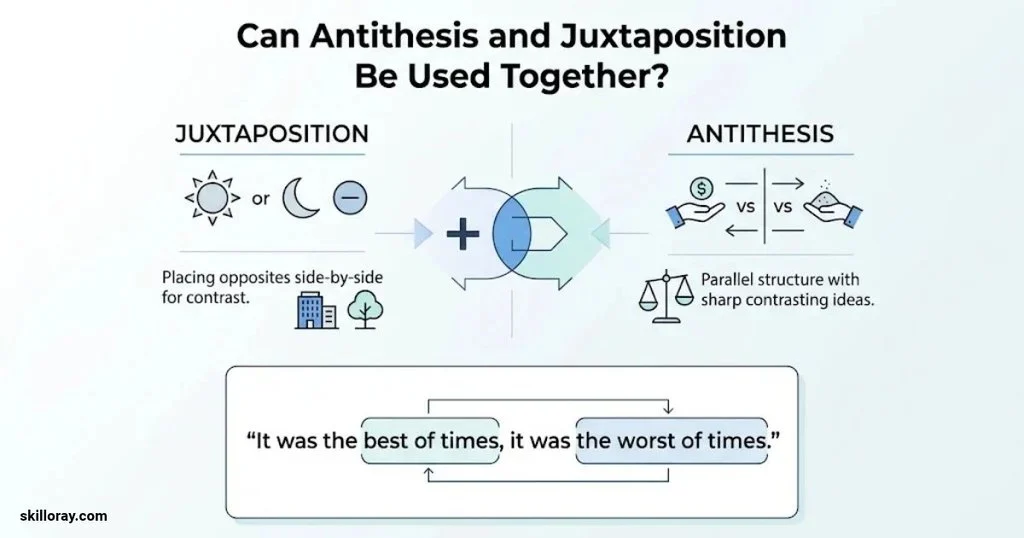
Yes. Antithesis and juxtaposition can appear in the same piece of writing because they aren’t mutually exclusive.
Antithesis often brings opposing ideas together, which means it can also create a form of juxtaposition. However, juxtaposition doesn’t automatically become antithesis.
Consider this sentence:
“Some people live to work, while others work to live.”
This is antithesis because the two clauses use a similar structure to express contrasting priorities.
Now imagine a novel that develops this contrast through two characters. One spends every evening at the office, while the other leaves work early to spend time with family.
The characters’ lifestyles create juxtaposition. The sentence that summarizes their opposing priorities uses antithesis.
The two techniques can reinforce each other: one makes the contrast clear through language, while the other develops it through the story.
Antithesis vs Juxtaposition vs Oxymoron
Antithesis and juxtaposition are sometimes confused with oxymoron because all three can involve contrasting ideas. The main difference is how the contrast appears.
| Literary device | Meaning | Example |
| Antithesis | Presents opposing ideas in a balanced expression | “United we stand, divided we fall.” |
| Juxtaposition | Places elements together to invite comparison | A celebration shown beside a funeral |
| Oxymoron | Combines contradictory words in a short expression | “Deafening silence” |
An oxymoron brings contradictory terms together in a compact phrase. Antithesis generally develops a contrast through a balanced statement. Juxtaposition can work across much larger sections of a literary or visual work.
For example, a writer might describe a character’s “bittersweet happiness” using an oxymoron, place that character beside someone experiencing deep sadness through juxtaposition, and summarize their opposing feelings through antithesis.
How to Identify Antithesis and Juxtaposition
When reading a novel, poem, or speech, use these steps to identify the techniques.
Look for Contrasting Ideas or Elements
Start by noticing what the writer places together. Common contrasts include:
- Love and hate
- Hope and despair
- Freedom and oppression
- Wealth and poverty
- Life and death
- Silence and noise
These contrasts may appear through words, characters, settings, or situations.
Examine the Sentence Structure
Ask whether the writer presents opposing ideas through a balanced expression.
For example:
“Actions speak louder than words.”
The sentence contrasts actions with words in a compact rhetorical form. It is commonly discussed as an antithetical expression.
Check How the Elements Are Arranged
If the writer places different characters, objects, or settings close together to encourage comparison, look for juxtaposition.
For example, a scene might show a crowded celebration in one room while a grieving family sits in the next.
Consider the Effect on the Reader
Ask what the contrast helps you understand.
- Does it make an argument more memorable?
- Does it reveal differences between characters?
- Does it create tension?
- Does it expose inequality?
- Does it encourage a deeper interpretation of a theme?
The writer’s purpose can help you identify the technique.
Try This Short Practice Exercise
Read each example and identify the literary device.
| Example | Answer |
| “United we stand, divided we fall.” | Antithesis |
| A luxurious mansion appears beside a neglected building. | Juxtaposition |
| “Deafening silence.” | Oxymoron |
| “Some seek fame; others seek peace.” | Antithesis |
| A peaceful garden appears in the background of a scene showing a damaged city. | Juxtaposition |
Why do the answers differ?
The antithesis examples express opposing ideas through a balanced statement. The juxtaposition examples place separate elements together for comparison. The oxymoron combines contradictory words into one expression.
Common Mistakes When Understanding Antithesis and Juxtaposition
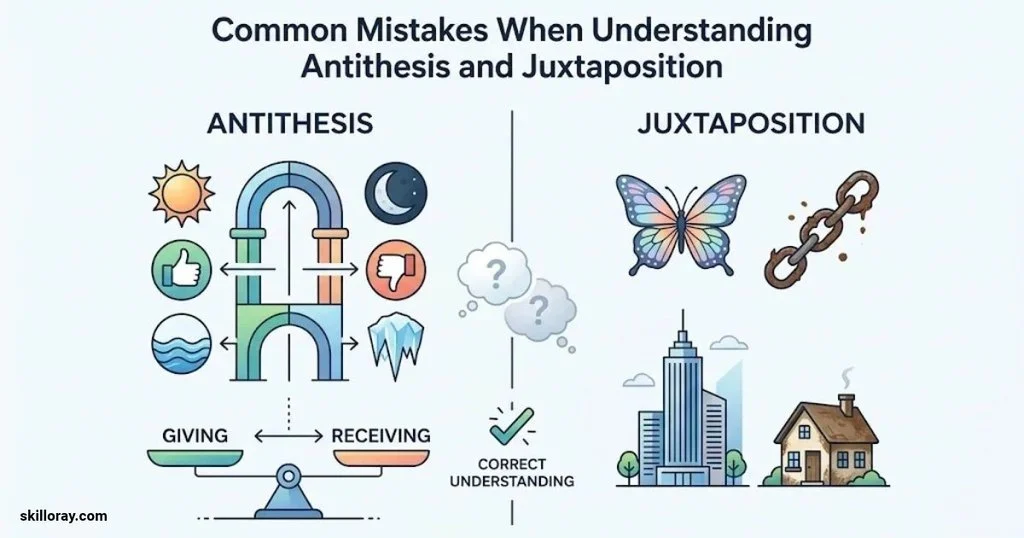
Treating Both Terms as Synonyms
Antithesis and juxtaposition are related, but they don’t mean exactly the same thing. Antithesis is a specific rhetorical device, while juxtaposition covers a wider range of comparisons.
Assuming Juxtaposition Always Involves Opposites
Juxtaposition doesn’t require two complete opposites. A writer can place similar or unexpected elements together to reveal a connection or create an interesting effect.
Calling Every Contrast Antithesis
A story that places a wealthy character beside a poor character uses juxtaposition. It doesn’t automatically use antithesis. Look for the deliberate rhetorical arrangement of opposing ideas before identifying antithesis.
Confusing Oxymoron With Antithesis
An oxymoron combines contradictory terms, such as “living death.” Antithesis presents contrasting ideas in a balanced expression. Both use contrast, but their structures are different.
Frequently Asked Questions
What is the main difference between antithesis and juxtaposition?
Antithesis presents opposing ideas in a balanced or parallel expression. Juxtaposition places two or more elements close together so readers can compare them. Antithesis is a specific rhetorical device, while juxtaposition is a broader literary technique.
Is antithesis a type of juxtaposition?
Antithesis can use juxtaposition because it brings contrasting ideas together. However, the terms aren’t interchangeable. Juxtaposition can involve characters, settings, objects, and situations without using the balanced structure commonly associated with antithesis.
Can juxtaposition include similarities?
Yes. Juxtaposition can place similar or unexpected elements together, not just opposites. Their arrangement may reveal a shared quality, relationship, or surprising connection.
What is an example of antithesis?
“United we stand, divided we fall” is a familiar example. It contrasts unity with division through a balanced sentence structure.
What is an example of juxtaposition?
A story that shows a wealthy neighborhood beside a community struggling with poverty uses juxtaposition. The two settings encourage readers to compare their living conditions.
What is the difference between antithesis and oxymoron?
Antithesis presents contrasting ideas in a balanced expression, such as “Some people live to work, while others work to live.” An oxymoron combines contradictory terms in a short phrase, such as “deafening silence.”
Why do writers use antithesis?
Writers use antithesis to emphasize opposing ideas, strengthen arguments, and create memorable expressions. It is especially useful in speeches, poetry, and persuasive writing.
Why is juxtaposition important in literature?
Juxtaposition helps readers compare characters, settings, and situations. It can reveal social differences, develop themes, create tension, and encourage readers to interpret events more deeply.
Conclusion
Antithesis and juxtaposition both make contrasts meaningful, but they work in different ways. Antithesis presents opposing ideas through a balanced expression, while juxtaposition places elements together so readers can examine their relationship. Remember that antithesis has a more specific rhetorical structure, whereas juxtaposition can shape anything from a single scene to an entire story. Recognizing the difference will help you understand how writers use contrast to communicate ideas more effectively.

I am Daniel Carter, a grammar enthusiast and language educator with over 10 years of experience helping students and professionals improve their English writing and communication skills. I enjoy simplifying complex grammar rules into easy-to-understand lessons that anyone can follow. My goal is to help learners write with confidence, avoid common mistakes, and develop strong communication skills for academic and professional success. I regularly create practical grammar guides, writing tips, and language resources that make learning both enjoyable and effective.
Books: Mastering English Grammar and The Complete Guide to Better Writing
 James Walker
 Olivia Brown