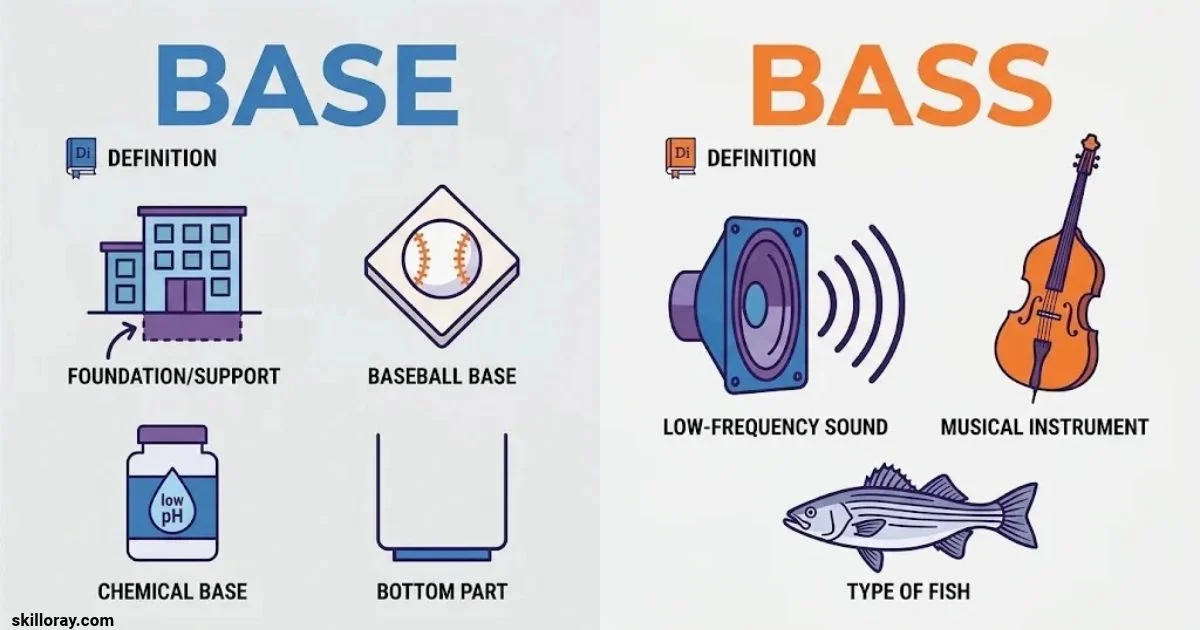
The words base and bass sound exactly alike, but they have completely different meanings. If you’ve ever paused while writing one of these words, you’re not alone. I know how confusing homophones can be, especially when two words share the same pronunciation but serve different purposes.
Base usually refers to a foundation, starting point, or main support, while bass relates to low-pitched sounds, musical instruments, or a type of fish. If you want to know which word fits your sentence, understanding this simple difference will help you avoid common spelling mistakes.
In this guide, I’ll explain the meanings of base and bass, show you how to use each word correctly, and provide clear examples to make the difference easier to remember. Whether you’re writing about a foundation, music, or fishing, you’ll know which spelling to choose.
Base vs Bass: Quick Comparison
| Feature | Base | Bass |
| Main meaning | Foundation, starting point, or support | Low musical sound, instrument, or fish |
| Part of speech | Noun, verb, adjective | Noun, adjective |
| Pronunciation | /beɪs/ | /beɪs/ in music; /bæs/ for fish |
| Common use | Home base, military base, base layer | Bass guitar, bass voice, sea bass |
| Example | The lamp has a heavy base. | She plays bass in a band. |
The easiest way to remember the distinction is to connect base with a foundation and bass with music or fish.
What Does Base Mean?
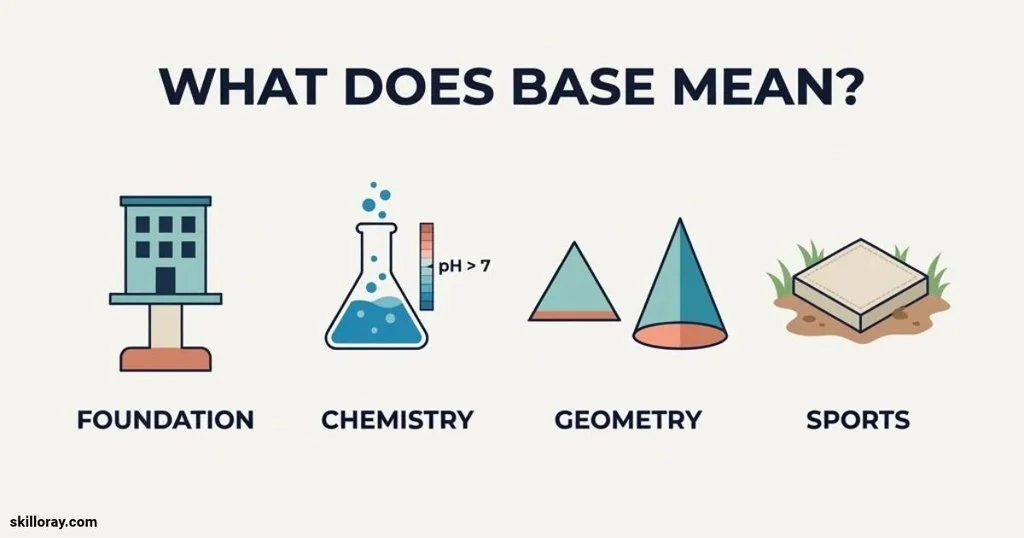
Base is a noun or verb most commonly associated with a foundation, starting point, or place used for a particular purpose. It can also describe something that serves as the main support for another thing.
Here are its common uses.
Base as a Noun
As a noun, base refers to the bottom part of something that supports it or keeps it stable.
Examples:
- The vase has a wide base.
- The statue stands on a stone base.
- A strong base keeps the bookshelf from tipping over.
- The lamp’s metal base is heavier than its shade.
The word can also describe a central location where people work, live, or carry out activities.
Examples:
- The rescue team returned to its base after the mission.
- The company operates from its main base in Chicago.
- The soldiers traveled back to their military base.
In baseball, players run between first, second, and third bases. The official term for the final scoring position is home plate, although people sometimes use home base in casual speech.
Base as a Verb
As a verb, base means to use something as the foundation for an idea, decision, or action.
Examples:
- The movie is based on a true story.
- We based our decision on customer feedback.
- The company bases its prices on production costs.
- Her research is based on reliable evidence.
You’ll often see the word in the expression based on, which introduces the information or evidence behind something.
Base as an Adjective
As an adjective, base can describe something dishonorable, dishonest, or morally low. This meaning is more formal and less common in everyday conversation.
Example:
- The character acted from base motives rather than genuine concern.
In ordinary writing, the noun and verb meanings are much more common.
What Does Bass Mean?
Bass has two main meanings. In music, it refers to low-pitched sounds, musical instruments, or a low vocal range. In fishing and wildlife contexts, it refers to several types of fish.
Although both meanings use the same spelling, they have different pronunciations.
Bass in Music
In music, bass describes the low end of the sound range. It can refer to low notes, a musical part, a voice, or an instrument that produces those notes.
Common examples include:
- Bass guitar: An instrument that produces low musical notes.
- Double bass: A large bowed or plucked string instrument used in orchestras and other musical styles.
- Bass drum: A large drum that produces a deep, low sound.
- Bass line: A sequence of low notes that supports a musical arrangement.
- Bass voice: The lowest common male vocal range.
Examples in sentences:
- My brother plays bass guitar in a local band.
- The song has a strong bass line.
- Turn down the bass because the speakers are vibrating.
- The singer has a deep bass voice.
In all these musical examples, bass is pronounced /beɪs/, exactly like base.
Bass as a Type of Fish
Bass also names several kinds of fish found in freshwater and saltwater environments. Different species are commonly called bass, including largemouth bass and sea bass.
Examples:
- We caught a large bass during our fishing trip.
- Largemouth bass are popular among freshwater anglers.
- The restaurant served grilled sea bass with vegetables.
- He bought fresh bass from the fish market.
When bass refers to a fish, it is pronounced /bæs/, with the short A sound heard in cat.
Base vs Bass Pronunciation: What’s the Difference?
Pronunciation is one of the most interesting differences between these words. Base has one standard pronunciation, but bass has two depending on its meaning.
| Word | IPA pronunciation | Rhymes with |
| Base | /beɪs/ | Face, place |
| Bass (music) | /beɪs/ | Face, place |
| Bass (fish) | /bæs/ | Class, mass |
Are Base and Bass Homophones?
Yes, base and bass are homophones when bass refers to music. Both are pronounced /beɪs/, even though they have different spellings and meanings.
However, base and bass are not homophones when bass refers to a fish. In that case, bass is pronounced /bæs/.
Compare these sentences:
- The speaker has a solid base.
- The speaker produces powerful bass.
The bold words sound alike in these examples.
Now compare:
- The fisherman caught a bass.
- The fisherman returned to his base.
These words have different vowel sounds.
Base vs Bass in Sentences
Seeing both words in everyday sentences makes the distinction easier to understand.
| Sentence with Base | Sentence with Bass |
| The table has a wooden base. | The musician plays bass in a band. |
| Our team returned to its base. | The song needs more bass. |
| The building has a strong base. | We caught a bass at the lake. |
| The article is based on research. | She enjoys listening to bass-heavy music. |
| The lamp’s base is made of metal. | The restaurant serves fresh sea bass. |
Pay attention to the meaning rather than the spelling alone. A foundation or starting point calls for base. A low musical sound or a fish calls for bass.
Base or Bass? Common Spelling Mistakes
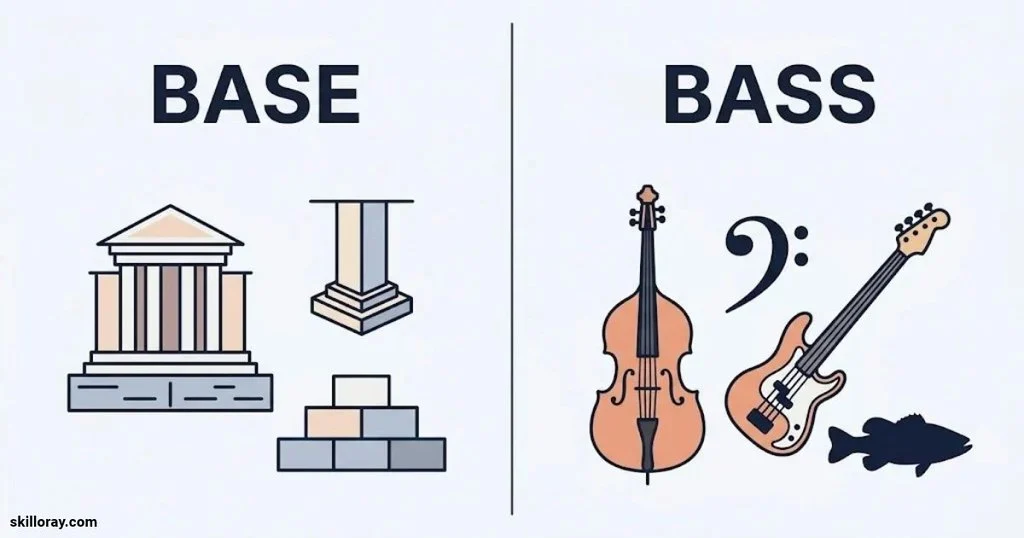
People sometimes confuse these words because their spellings differ by only one letter. The following examples show how to choose correctly.
Bass Guitar or Base Guitar?
The correct expression is bass guitar.
A bass guitar is a musical instrument designed to produce low notes. Base guitar is incorrect when referring to this instrument.
Correct: My cousin wants to buy a new bass guitar.
Incorrect: My cousin wants to buy a new base guitar.
Home Base or Home Bass?
The correct spelling is home base.
Home base refers to a central place or a familiar location where someone returns. In baseball, the official term for the scoring position is home plate.
Correct: After traveling for months, she was happy to return to her home base.
Incorrect: After traveling for months, she was happy to return to her home bass.
Based on or Bassed on?
The correct phrase is based on.
It comes from the verb base, meaning to use something as a foundation or source.
Correct: The documentary is based on real events.
Incorrect: The documentary is bassed on real events.
Bass Sound or Base Sound?
Use bass sound when discussing low-pitched audio.
Correct: The headphones produce a deep bass sound.
Incorrect: The headphones produce a deep base sound.
A useful rule is to remember that bass belongs to music and fish, while base usually relates to support, foundations, and starting points.
How to Remember Base vs Bass
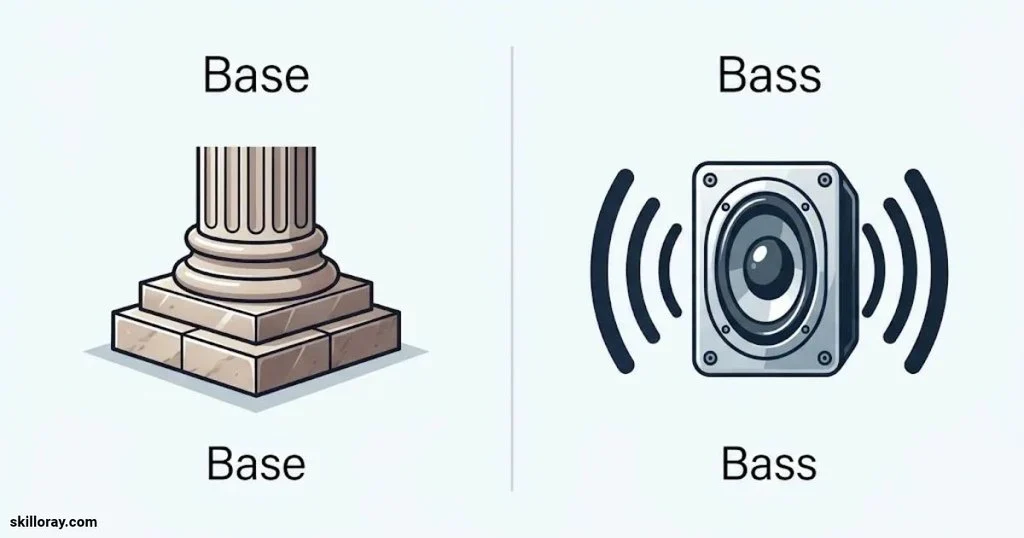
You don’t need to memorize complicated grammar rules to keep these words separate. Connect each spelling with a familiar example.
- Base = foundation: Think of the bottom of a building, table, or lamp.
- Bass = music: Think of a bass guitar or the deep sound in a song.
- Bass = fish: Think of a fish swimming in a lake or sea.
Remember this simple sentence:
“The building has a strong base, the musician plays bass, and the fisherman catches a bass.”
The context makes each meaning clear.
Frequently Asked Questions
What is the difference between base and bass?
Base usually means a foundation, starting point, or central location. Bass refers to low musical sounds, related instruments, or certain types of fish. Their pronunciations depend on the meaning of bass.
Are base and bass pronounced the same?
Sometimes. Base and musical bass are both pronounced /beɪs/. However, bass referring to a fish is pronounced /bæs/.
Is it bass guitar or base guitar?
The correct term is bass guitar. It is a musical instrument that produces low notes and helps provide the rhythm and harmonic foundation of a song.
Is it home base or home bass?
The correct expression is home base. It describes a central or familiar place. In formal baseball terminology, the scoring position is called home plate.
What does bass mean in music?
In music, bass refers to low-pitched sounds, notes, instruments, or vocal ranges. Examples include bass guitar, double bass, bass drum, and bass voice.
What does base mean in grammar?
Base can function as a noun, verb, or adjective. As a noun, it means a foundation or starting point. As a verb, it means to establish something on a particular foundation. As an adjective, it can describe something dishonorable or morally low.
Is bass a type of fish?
Yes. Bass is a common name for several fish species, including largemouth bass and different types of sea bass. Fish bass is pronounced /bæs/.
Can base and bass be used interchangeably?
No. Although base and musical bass sound alike, they have different meanings and spellings. Using one in place of the other can change the meaning of a sentence or create a spelling mistake.
Conclusion
Base and bass may look almost identical, but they serve different purposes. Use base when discussing a foundation, starting point, or central location. Use bass for low musical sounds, related instruments, or certain fish.
One pronunciation detail makes the distinction easier to remember: musical bass sounds like base, while fish bass has a short A sound. Choose the spelling that matches your meaning, and you won’t have to second-guess it.

I am James Walker, an English language specialist with extensive experience in grammar, editing, and academic writing. I enjoy helping students, bloggers, and professionals strengthen their writing by explaining grammar concepts in a clear and engaging way. My focus is on providing accurate, practical, and easy-to-follow guidance that helps learners communicate more effectively in everyday and professional situations.
Books: Perfect English Grammar Handbook and Advanced Writing Techniques
 Daniel Carter
 Olivia Brown