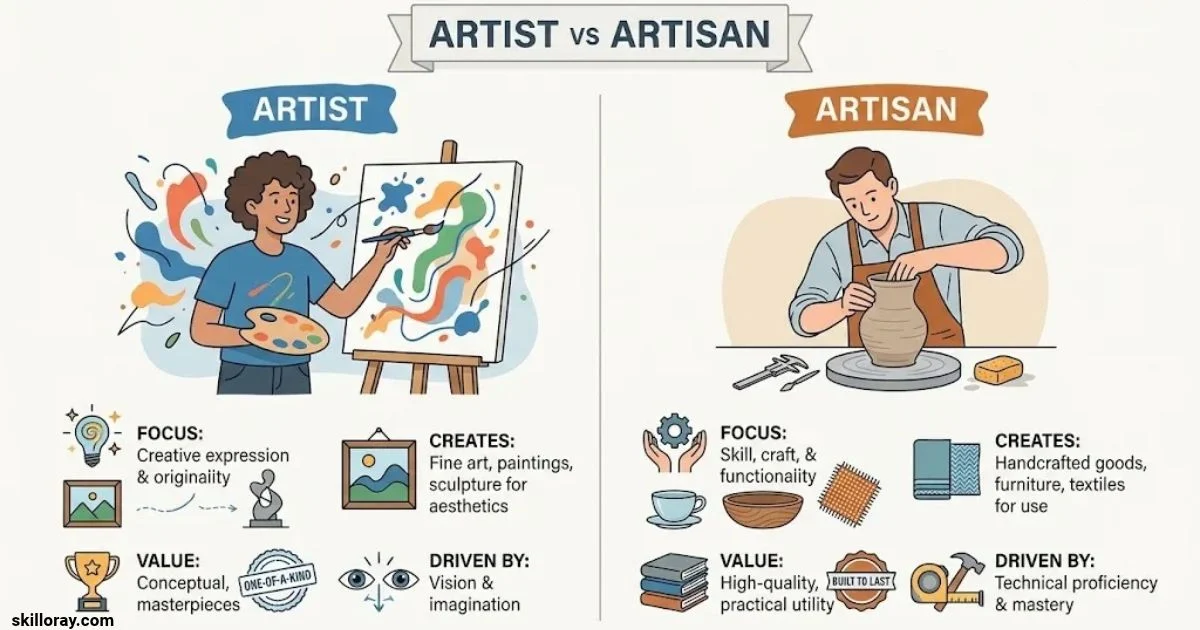
An artist and an artisan may both create beautiful things, but their skills, goals, and creative approaches aren’t always the same. While one often focuses on self-expression, the other emphasizes craftsmanship and practical skill. So, how do you tell them apart?
An artist turns ideas and emotions into creative expression, while an artisan uses specialized skills to craft beautiful, functional, or decorative objects. Understanding the difference between an artist and an artisan helps you use both terms correctly and appreciate their unique talents.
In this guide, I’ll explain the meaning of artist and artisan, explore their key differences, and share simple examples to make everything clear. Whether you’re learning English or simply curious about these creative professions, you’ll find the answer you need.
Artist vs Artisan: Quick Difference
The main difference between an artist and an artisan is the nature of their work.
- Artist: A person who creates work through imagination, creativity, and self-expression. Artists may produce paintings, sculptures, music, photography, or digital artwork.
- Artisan: A skilled craftsperson who makes objects using specialized techniques, practical knowledge, and careful craftsmanship. Common examples include potters, jewelers, woodworkers, and leatherworkers.
An artist might create a painting that communicates a personal message. An artisan might produce a handmade ceramic bowl that combines beauty with everyday functionality.
However, these definitions aren’t strict boundaries. An artisan can create expressive artwork, and an artist can produce practical objects. Many creative professionals fit both descriptions.
What Is an Artist?

An artist is someone who uses creative abilities to produce work that communicates ideas, emotions, experiences, or perspectives. Their creations can take many forms, from traditional paintings and sculptures to music, photography, dance, and digital illustrations.
Artists don’t always create something with a practical purpose. Sometimes, the entire point of a piece is to make people feel something, question an idea, or see an ordinary subject differently.
Imagine a painter who creates a series of pictures about childhood memories. Each painting might use different colors, shapes, and textures to communicate a particular feeling. The value of that work comes from its creative expression rather than its usefulness as an everyday object.
Artists also work in commercial settings. Illustrators design book covers, photographers create advertising images, and graphic designers develop visual identities for businesses. Their work can be both creative and commercially valuable.
Common Characteristics of an Artist
Although artistic professions vary widely, several qualities often define an artist’s approach.
- Creative thinking: Artists develop original concepts and explore different ways to communicate them.
- Imagination: They use ideas, memories, observations, and emotions as inspiration.
- Self-expression: Their creations may reflect personal experiences, beliefs, or individual perspectives.
- Originality: Many artists work toward developing a distinctive style or recognizable approach.
- Experimentation: They explore different materials, techniques, compositions, and creative methods.
- Visual or creative communication: They use their chosen medium to connect with an audience.
Not every artist shares all these characteristics equally. A commercial illustrator, for instance, may work within a client’s requirements, while a contemporary painter might have complete freedom over the subject and presentation.
Examples of Artists
Artists work across many creative disciplines. Here are some familiar examples:
| Type of Artist | What They Create |
| Painter | Paintings using oil, acrylic, watercolor, or other media |
| Sculptor | Three-dimensional artwork using stone, wood, metal, or clay |
| Musician | Songs, compositions, and musical performances |
| Photographer | Images that capture people, places, stories, or emotions |
| Digital artist | Digital illustrations, animations, and visual compositions |
| Illustrator | Artwork for books, magazines, advertisements, and other publications |
| Dancer | Creative performances through movement and choreography |
Each profession uses different techniques, but they share a common element: creative expression.
What Is an Artisan?
An artisan is a skilled craftsperson who creates objects through specialized knowledge, practical experience, and careful workmanship. Artisans often work with materials such as wood, clay, metal, leather, glass, and fabric.
Their work requires more than simply following instructions. They need to understand how materials behave, which tools produce the best results, and how individual steps affect the finished product.
Consider a potter making a handmade ceramic vase. The process involves preparing the clay, shaping it, allowing it to dry, applying glaze, and firing it in a kiln. A small mistake at any stage can affect the final result.
Artisans may create useful household products, decorative pieces, traditional crafts, or customized items. Some follow techniques passed down through generations, while others develop new methods to improve their work.
Common Characteristics of an Artisan
Good craftsmanship develops through practice and attention to detail. Artisans usually demonstrate several important qualities:
- Technical expertise: They understand the tools, materials, and methods required for their particular craft.
- Precision: Measurements, finishing, and small construction details matter.
- Practical knowledge: They know how to turn raw materials into finished products.
- Patience: Handcrafted work often involves several stages that require time and concentration.
- Consistency: They aim to maintain quality across different products.
- Traditional knowledge: Many artisans preserve techniques associated with particular communities, cultures, or industries.
An experienced artisan may recognize a material’s strengths and limitations simply by handling it. That understanding often comes from years of hands-on work.
Examples of Artisans
Artisans specialize in different crafts, depending on their materials and techniques.
| Type of Artisan | Their Craft |
| Potter | Shapes clay into bowls, vases, plates, and other ceramic objects |
| Blacksmith | Shapes metal into tools, decorative items, and functional objects |
| Carpenter | Builds furniture and wooden structures |
| Jeweler | Creates jewelry using metals, gemstones, and other materials |
| Weaver | Produces fabrics, rugs, and textiles |
| Leatherworker | Makes wallets, belts, bags, and leather accessories |
| Glassblower | Shapes heated glass into decorative and functional objects |
| Silversmith | Works with silver to create decorative objects and jewelry |
These professions demonstrate how much knowledge goes into producing well-made objects. A beautiful handmade item may look simple, but the process behind it can require years of experience.
7 Important Differences Between an Artist and an Artisan
Artists and artisans share several creative abilities, but their work often differs in purpose, process, and technical focus.
| Comparison | Artist | Artisan |
| Meaning | A person who produces creative or expressive work | A skilled craftsperson who creates carefully made objects |
| Main purpose | Expressing ideas, emotions, and imagination | Producing functional or decorative items through craftsmanship |
| Primary skills | Creative thinking, artistic techniques, and imagination | Technical knowledge, precision, and practical expertise |
| Materials | Paint, canvas, musical instruments, cameras, and digital tools | Wood, clay, metal, leather, glass, and fabric |
| Work process | Often involves experimentation and individual interpretation | Often involves practiced methods and detailed production steps |
| Final creations | Paintings, music, sculptures, photographs, and illustrations | Furniture, pottery, jewelry, textiles, and handmade goods |
| Main emphasis | Artistic vision and creative expression | Quality, construction, and skilled workmanship |
These distinctions describe common tendencies, not fixed rules. A handmade sculpture can be both an artistic creation and an example of skilled craftsmanship.
Purpose and Intention
An artist often starts with an idea they want to communicate. It might be a personal experience, a social issue, a memory, or simply an interesting visual concept.
An artisan usually starts with an object or product they want to make. A furniture maker, for instance, considers how a table should look, how much weight it needs to support, and which materials will last.
The two purposes can overlap. A decorative wooden table may be designed to communicate a Creative Skills and Technical Knowledge
Artists typically develop their ability to imagine, interpret, and communicate ideas through a chosen medium. Their skills might include drawing, composition, color theory, storytelling, or musical arrangement.
Artisans concentrate on mastering the techniques required for their craft. A jeweler needs to understand metalworking, stone setting, measurements, and finishing.
Neither profession lacks creativity or technical ability. The difference is simply which skills take priority in the work.
Materials and Tools
The materials artists use depend on their creative discipline. A painter might work with canvas and acrylic paint, while a digital illustrator uses a drawing tablet and design software.
Artisans often choose materials based on their physical properties and intended use. A carpenter selects wood according to its strength, grain, and suitability for a particular piece of furniture.
Some materials overlap. Clay, for example, can be used by both a sculptor creating expressive artwork and a potter producing functional ceramics.
Production Methods
An artist’s creative process can be flexible. They might sketch several concepts, experiment with different techniques, discard unsuccessful ideas, and change direction halfway through a project.
An artisan often follows a more structured process because each production stage affects the finished object’s quality. A leatherworker must cut, stitch, shape, and finish leather carefully to produce a durable item.
Still, artisans experiment too. Developing a new weaving pattern or improving a woodworking technique requires creative problem-solving.
Function and Practical Use
Artistic work doesn’t always need a practical function. A painting can exist purely for visual enjoyment, emotional expression, or intellectual exploration.
Artisan products frequently serve a practical purpose. A handmade chair provides seating, a ceramic plate holds food, and a leather bag carries personal belongings.
However, functionality doesn’t make an object less artistic. Many beautifully designed everyday objects demonstrate how usefulness and visual appeal can work together.
Training and Experience
Artists may study at universities, attend art schools, work with mentors, or develop their skills independently. Their learning often involves creative exploration and building a personal style.
Artisans may learn through apprenticeships, workshops, vocational programs, family traditions, or years of independent practice. They often develop deep knowledge of particular materials and production techniques.
Neither profession requires one specific educational route. Experience, consistent practice, and the quality of the finished work matter greatly.
Cultural and Social Contribution
Artists influence culture through paintings, performances, photography, music, and other creative forms. Their work can preserve memories, challenge social ideas, and communicate experiences across generations.
Artisans contribute by producing handmade goods and maintaining valuable craft traditions. Their work can preserve local techniques, support small businesses, and keep cultural skills alive.
Both professions help communities maintain a connection with creativity and cultural heritage.
How Artists and Artisans Approach Creativity Differently
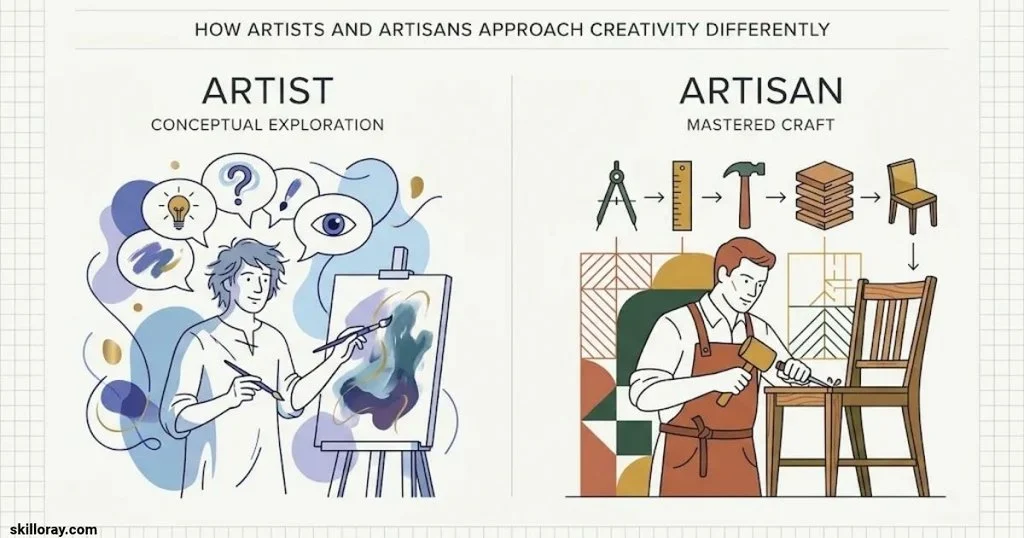
Creativity isn’t limited to people who paint pictures or create abstract sculptures. It also plays an important role in practical craftsmanship.
The difference becomes clearer when you look at how each person approaches a project.
An artist might begin with a question: “How can I represent the feeling of freedom?” They could experiment with color, movement, shapes, and composition until the final work communicates that idea.
An artisan might approach a similar concept by designing a handcrafted object. A metalworker could create a decorative sculpture using carefully shaped metal pieces, balancing the visual design with structural stability.
Both people make creative decisions. One may place greater emphasis on artistic interpretation, while the other gives additional attention to material properties and construction.
This is why craftsmanship and creativity should not be treated as competing qualities. Excellent work often requires both.
Can Someone Be Both an Artist and an Artisan?
Absolutely. A person can be an artist and an artisan at the same time.
The distinction between these terms describes different aspects of creative work. It doesn’t mean someone must choose one identity and abandon the other.
Take a ceramic artist who creates original pottery. They might design unusual shapes, develop distinctive patterns, and use color to communicate a particular theme. At the same time, they need the technical ability to prepare clay, operate a pottery wheel, apply glaze, and control the firing process.
That person combines artistic expression with artisan craftsmanship.
Other examples include:
- Jewelry designers: They develop original designs and use metalworking techniques to produce finished pieces.
- Furniture makers: They combine creative design with woodworking and construction skills.
- Textile designers: They develop original patterns and use weaving or printing techniques to produce fabrics.
- Glass artists: They create expressive glass sculptures using specialized shaping methods.
- Wood sculptors: They develop artistic concepts and bring them to life through carving.
In each case, the person uses imagination and practical expertise to create something meaningful.
Artist vs Craftsperson: What’s the Difference?
An artist creates work through creative expression, while a craftsperson specializes in making objects using practical skills and established techniques.
The term craftsperson is broad. It can describe someone who makes, builds, repairs, or shapes objects with specialized knowledge. An artisan is generally a type of craftsperson, particularly one associated with skilled, high-quality, or traditional handmade work.
For example, a furniture maker may be called a craftsperson because they build objects using woodworking skills. If they specialize in traditional handmade furniture and detailed craftsmanship, artisan may be an equally appropriate description.
An artist, meanwhile, may focus on creating an expressive wooden sculpture rather than a functional piece of furniture.
| Term | Main Meaning | Example |
| Artist | Someone who creates expressive or creative work | A painter |
| Artisan | A skilled maker of handcrafted or carefully crafted objects | A traditional potter |
| Craftsperson | Someone skilled in making or repairing objects | A furniture maker |
The terms can overlap, especially when someone creates original work using advanced practical skills.
Artisan vs Craftsman: Are They the Same?
Artisan and craftsman are closely related words. Both describe people who have specialized skills and use them to make or work with objects.
The difference is mainly in emphasis and usage.
Craftsman traditionally refers to someone who has mastered a particular practical trade or craft. It often appears in descriptions of woodworking, metalworking, construction, and similar professions.
Artisan often carries an association with traditional techniques, handmade products, creative design, and attention to detail.
For example, someone who builds wooden cabinets may be called a craftsman. A person who produces decorative handmade wooden boxes using traditional carving methods might be described as an artisan.
These meanings aren’t absolute. Both words can describe the same person, and craftsperson is a useful gender-neutral alternative to craftsman.
Artist vs Artisan: Real-Life Examples
Consider a few everyday situations to see how these terms work outside dictionary definitions.
| Situation | Best Description | Why |
| Someone paints an abstract picture about loneliness | Artist | The work focuses on personal expression |
| A potter makes handmade dinner plates | Artisan | The person uses specialized ceramic techniques |
| A sculptor carves an expressive wooden figure | Both | The work combines creative vision and craftsmanship |
| A carpenter builds custom kitchen cabinets | Craftsperson or artisan | The work involves practical woodworking expertise |
| A photographer creates a visual story about city life | Artist | Photography communicates a creative perspective |
| A jeweler designs and makes original silver rings | Both | The person combines original design with technical skill |
| A traditional weaver produces handmade rugs | Artisan | The work relies on specialized weaving knowledge |
These examples show why the terms shouldn’t be used as rigid professional categories. The same person may be an artist in one context and an artisan in another.
What Is an Artisan Product?
An artisan product is an item made by a skilled craftsperson using specialized techniques, careful workmanship, or traditional production methods.
These products may be functional, decorative, or both. Unlike many mass-produced goods, artisan products often reflect the individual maker’s skills and design choices.
Common examples include:
- Handcrafted pottery and ceramic decorations.
- Handmade leather bags and wallets.
- Custom wooden furniture.
- Handwoven rugs and textiles.
- Decorative metalwork.
- Handmade jewelry and accessories.
- Traditional glassware.
An artisan product doesn’t automatically mean every part was made entirely by hand. Some craftspeople use modern tools and equipment while still applying specialized skills and maintaining individual control over the production process.
When Should You Use Artist or Artisan?
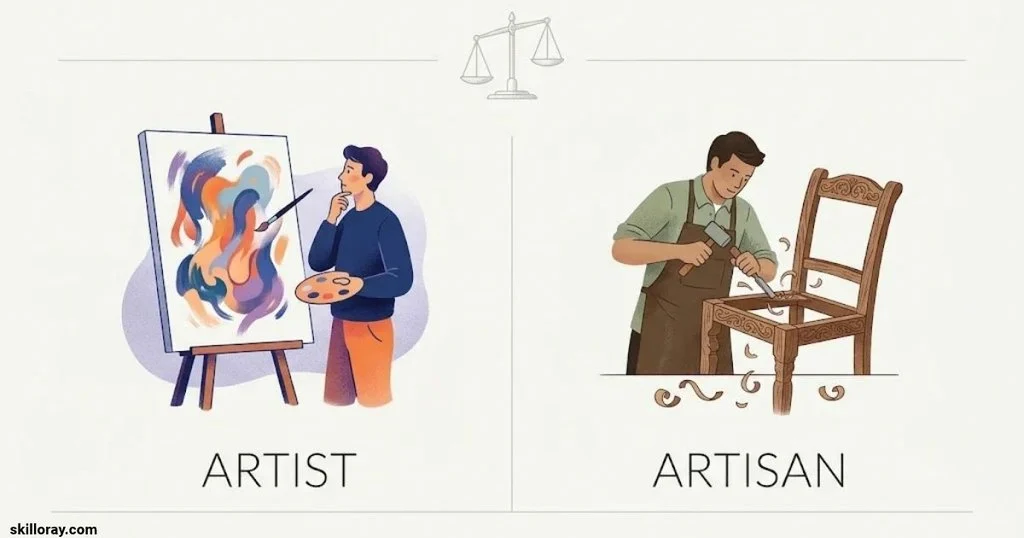
Choosing between artist and artisan depends on what the person creates and which part of their work you want to emphasize.
Use artist when the main focus is creative expression, artistic interpretation, or imaginative work.
Examples:
- She is a talented artist who creates colorful landscape paintings.
- The artist uses photography to explore social issues.
- He works as a digital artist for an independent animation studio.
- The musician is an artist known for expressive compositions.
Use artisan when describing someone who specializes in skilled craftsmanship or handmade products.
Examples:
- The artisan creates traditional ceramic pottery.
- We purchased a handmade leather bag from a local artisan.
- Several artisans displayed their work at the craft exhibition.
- This artisan specializes in decorative wooden furniture.
When someone combines both roles, you can use both words to describe their work accurately.
A simple rule can help: if you’re emphasizing the creative message, artist is usually appropriate. If you’re emphasizing the skill involved in making an object, artisan is often the better choice.
Frequently Asked Questions About Artists and Artisans
Is an artisan an artist?
An artisan can also be an artist, but the words have different primary meanings. An artisan specializes in skilled craftsmanship, while an artist generally focuses on creative expression. Someone who makes original pottery, sculptures, or decorative objects may fit both descriptions.
What is the main difference between an artist and an artisan?
An artist primarily creates work to express ideas, emotions, or imagination. An artisan uses specialized skills and techniques to produce carefully crafted objects. However, both professions involve creativity, technical knowledge, and practice.
Is a painter an artist or an artisan?
A painter is generally considered an artist because painting often involves visual expression and creative interpretation. However, someone who specializes in decorative painting or traditional painted crafts may also be described as an artisan.
What is the difference between an artisan and a craftsperson?
An artisan is generally a skilled craftsperson who creates carefully made products, often using traditional or specialized techniques. Craftsperson is a broader term that includes people who make, build, or repair objects through practical skills.
Are artisan and craftsman synonyms?
They have similar meanings, but their usage can differ slightly. Craftsman often emphasizes mastery of a particular trade, while artisan commonly highlights handmade work, traditional methods, and detailed craftsmanship. Both terms can describe the same professional.
What is the opposite of an artisan?
There isn’t one universally accepted opposite of artisan. Depending on the context, possible contrasts include an unskilled worker, an industrial manufacturer, or a mass-production worker. However, these terms describe different roles rather than exact dictionary opposites.
Do artists and artisans need formal education?
No. Both can develop their abilities through formal education, apprenticeships, workshops, mentorship, or independent practice. Many successful artists and artisans build their expertise through years of hands-on experience.
What does artisan-made mean?
Artisan-made describes a product created by a skilled craftsperson using specialized techniques and careful workmanship. The item may be handmade, individually finished, or produced with traditional methods. It often emphasizes the maker’s skill and attention to detail.
Final Thoughts
An artist and an artisan may work with similar materials, but their priorities often differ. Artists generally use creativity to communicate ideas and emotions, while artisans rely on specialized craftsmanship to make functional or decorative objects.
Still, the distinction isn’t always clear-cut. A potter can be an artist when developing original designs and an artisan when shaping, glazing, and firing each piece. The same applies to jewelers, woodworkers, sculptors, and many other creative professionals.
When choosing between the two words, think about what you want to emphasize. Use artist for creative expression and artisan for skilled craftsmanship. If someone combines both, there’s no reason to limit them to just one title.

I am Olivia Brown, a professional English editor and grammar writer who believes that great writing begins with a strong foundation in grammar. I have spent years creating educational resources that help students and professionals improve their writing, avoid common errors, and communicate more effectively. I strive to provide clear explanations and practical examples that make grammar easy to understand and apply.
Books: English Grammar Essentials and Modern Writing Success
 James Walker
 Daniel Carter