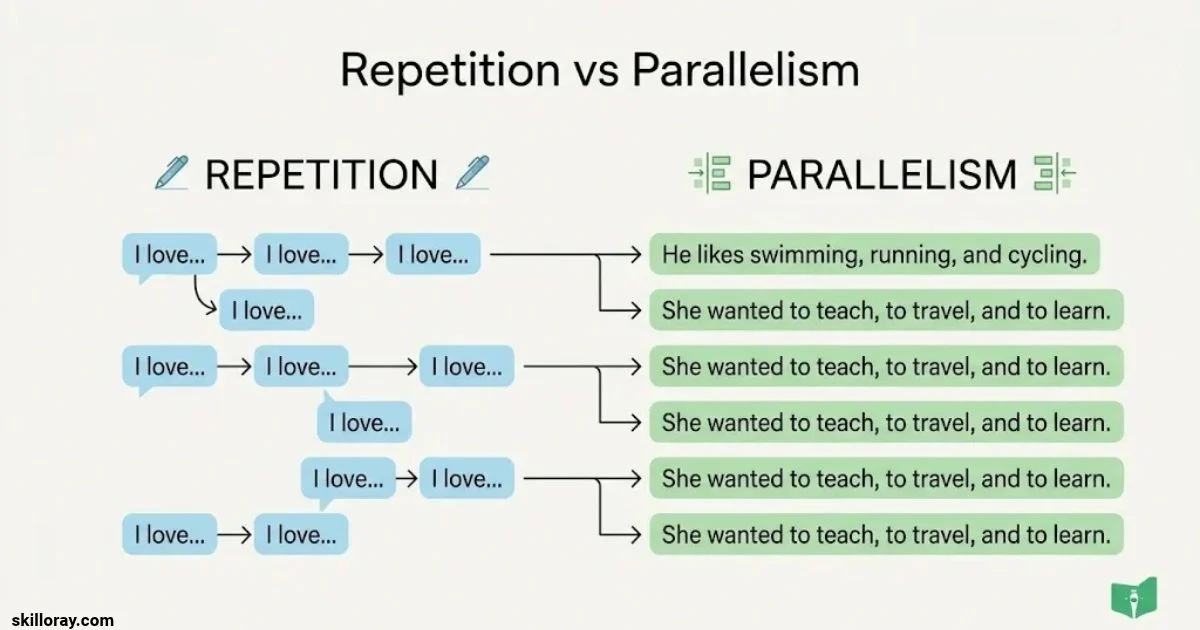
Repetition and parallelism are two powerful writing techniques that can make your words more memorable and effective. Although they may seem similar, each serves a different purpose. Understanding the difference can help you become a clearer, more confident writer.
Repetition emphasizes important words, phrases, or ideas to make them stand out. Parallelism creates balance by using the same grammatical structure across related words or sentences. If you’ve ever wondered when to use each technique, you’re about to discover the difference with simple explanations and real examples.
In this guide, I’ll explain repetition vs parallelism, including their definitions, key differences, and practical examples. You’ll also learn when to use each technique to make your writing smoother, stronger, and more engaging.
Repetition vs Parallelism: Quick Difference
The main difference between repetition and parallelism is what each technique repeats.
Repetition uses the same word, phrase, sound, or idea more than once to create emphasis, rhythm, or a memorable effect.
Parallelism uses similar grammatical structures to express related ideas in a balanced and consistent way.
Consider these examples:
Repetition:
The team needs patience, patience, and more patience.
The word patience appears several times to emphasize its importance.
Parallelism:
The team needs to plan carefully, communicate clearly, and work consistently.
Each item follows the same grammatical pattern: an adverb followed by a verb ending in -ly and an object or complement.
The two techniques can also work together. A writer might repeat a phrase while keeping each sentence in a parallel structure.
| Feature | Repetition | Parallelism |
| Main purpose | Emphasis and reinforcement | Balance and clarity |
| What it repeats | Words, phrases, sounds, or ideas | Grammatical patterns |
| Main effect | Creates emphasis and rhythm | Creates consistency and flow |
| Common uses | Speeches, poetry, persuasive writing | Essays, lists, speeches, professional writing |
| Example | “We need action, action now.” | “We need to listen, learn, and improve.” |
What Is Repetition?
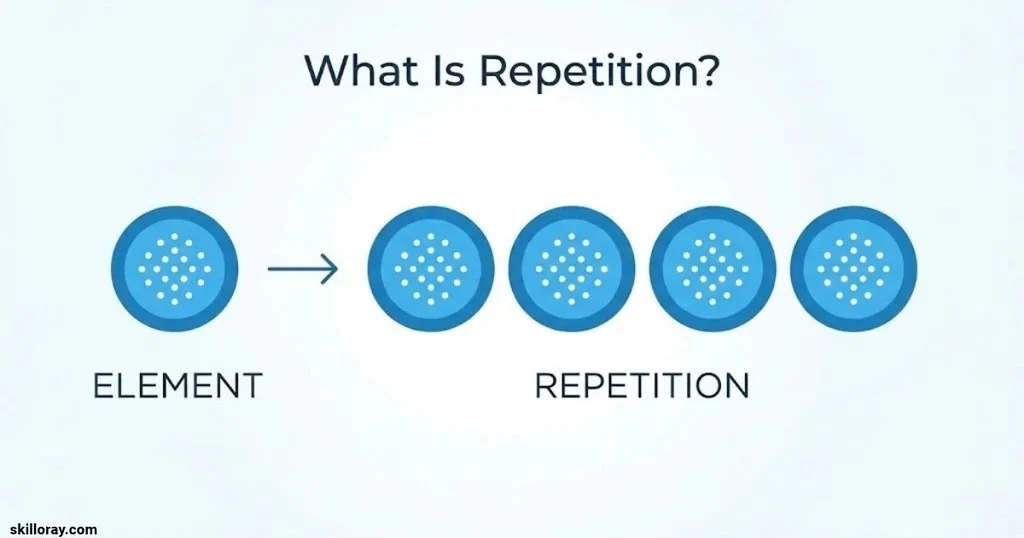
Repetition is a literary and rhetorical technique in which a writer or speaker deliberately uses a word, phrase, sound, or idea more than once.
Its purpose goes beyond simply repeating information. A carefully repeated expression can make a message memorable, communicate emotion, establish rhythm, or draw attention to a central point.
For example:
Every voice matters. Every opinion deserves respect. Every person deserves a chance.
The repeated opening, “Every,” gives the statements a shared emphasis. It also creates a steady rhythm that helps the message stick.
Writers use repetition in many forms of communication, including:
- Speeches: Speakers repeat key expressions to strengthen their messages.
- Poetry: Poets use recurring words and phrases to create rhythm and emotional connections.
- Advertising: Brands repeat slogans to improve recognition and recall.
- Academic writing: Writers may repeat important terminology when clarity requires it.
- Everyday conversation: People repeat words to express surprise, urgency, excitement, or frustration.
Repetition works best when each occurrence serves a purpose. If a word or sentence appears again without adding emphasis or meaning, the writing can become unnecessarily repetitive.
Common Types of Repetition
Writers use different forms of repetition depending on where the repeated element appears.
1. Anaphora
Anaphora is the repetition of a word or phrase at the beginning of successive clauses, sentences, or lines.
Example:
We deserve better schools. We deserve safer neighborhoods. We deserve equal opportunities.
The repeated opening, “We deserve,” creates a consistent rhythm and emphasizes a shared demand.
Writers often use anaphora in speeches, political writing, poetry, and persuasive communication.
2. Epistrophe
Epistrophe repeats a word or phrase at the end of successive clauses or sentences.
Example:
The community needs better schools for its children, safer streets for its children, and more opportunities for its children.
The repeated ending focuses attention on the people who benefit from the proposed improvements.
Epistrophe can make a statement sound deliberate and memorable, particularly when the repeated phrase carries emotional importance.
3. Anadiplosis
Anadiplosis repeats the final word or phrase of one clause at the beginning of the next.
Example:
Clear communication builds trust. Trust strengthens relationships. Relationships support successful teams.
The word “trust” connects the first and second sentences, while “relationships” links the next two ideas.
This technique creates a chain of connected thoughts. It works especially well when one idea naturally leads to another.
4. Symploce
Symploce combines anaphora and epistrophe. It repeats a phrase at the beginning and another phrase at the end of successive clauses.
Example:
When we choose honesty, we build stronger relationships. When we choose respect, we build stronger relationships.
The repeated beginning establishes a pattern, while the repeated ending reinforces the result.
Symploce can make persuasive statements sound organized and powerful.
Repetition Examples in Everyday Writing
Repetition isn’t limited to poetry or formal speeches. You can use it in ordinary communication when you want a particular idea to stand out.
| Example | What the repetition achieves |
| “Wait, wait, let me explain.” | Communicates urgency |
| “The decision was difficult, very difficult.” | Strengthens the emphasis |
| “Practice makes progress. Practice builds confidence.” | Reinforces the value of practice |
| “No excuses, no delays, no shortcuts.” | Creates a firm, rhythmic message |
| “The project needs time, attention, and more time.” | Highlights the importance of time |
Notice that repetition doesn’t always require an identical sentence structure. The repeated element can be a single word, an expression, or an idea.
What Is Parallelism?
Parallelism, also called parallel structure or parallel construction, is the use of matching grammatical forms in related words, phrases, or clauses.
The purpose is to make sentences easier to read and understand. When related ideas follow the same grammatical pattern, readers can recognize their relationship without struggling through inconsistent wording.
Consider this sentence:
The new manager enjoys planning projects, to organize meetings, and reviewing reports.
The list contains different grammatical forms:
- Planning projects: gerund phrase
- To organize meetings: infinitive phrase
- Reviewing reports: gerund phrase
This inconsistency makes the sentence less balanced.
A parallel version would be:
The new manager enjoys planning projects, organizing meetings, and reviewing reports.
Each item now uses a gerund phrase. The sentence flows more naturally because its elements follow the same pattern.
Parallelism is especially useful in essays, reports, presentations, instructions, professional emails, and persuasive writing.
Types of Parallelism
Parallelism can appear at different levels of sentence structure. These examples show how writers maintain grammatical consistency.
1. Word-Level Parallelism
Word-level parallelism uses the same grammatical category for related words.
Example:
The position requires creativity, patience, and flexibility.
The three items are nouns. They describe qualities the position requires.
A nonparallel version might be:
The position requires creativity, patience, and working carefully.
The first two items are nouns, but the third is a gerund phrase. A better version would be:
The position requires creativity, patience, and careful work.
2. Phrase-Level Parallelism
Phrase-level parallelism uses matching types of phrases in a series.
Example:
She enjoys reading historical novels, exploring old cities, and visiting museums.
Each item begins with a gerund and follows a similar structure.
Another example:
The company aims to reduce expenses, to improve customer service, and to increase productivity.
All three items use infinitive phrases.
3. Clause-Level Parallelism
Clause-level parallelism uses clauses with similar grammatical arrangements.
Example:
The teacher explained how the experiment worked, why the results mattered, and what the students should record.
Each clause follows a similar question-word structure.
This pattern helps readers follow multiple related points without losing the sentence’s main direction.
4. Antithetical Parallelism
Antithetical parallelism places contrasting ideas in balanced grammatical structures.
Example:
Some people spend time making excuses, while others spend time finding solutions.
Both parts use a similar structure, but their meanings contrast.
Writers often use this form in persuasive writing, speeches, and memorable statements because the balanced construction makes the difference easier to notice.
Parallelism in Grammar: Common Patterns
Parallelism is more than a literary device. It is also an important part of standard grammar and effective sentence construction.
Here are several situations where parallel structure matters.
Parallelism in Lists
Items in a series should normally follow the same grammatical form.
Nonparallel:
Our goals are improving customer service, reducing costs, and to increase sales.
Parallel:
Our goals are improving customer service, reducing costs, and increasing sales.
The corrected sentence uses three gerund phrases.
Parallelism With Coordinating Conjunctions
Words such as and, but, and or connect related grammatical elements. Those elements should usually have matching structures.
Nonparallel:
The applicant should be confident, communicate clearly, and have good organization.
Parallel:
The applicant should be confident, articulate, and organized.
The corrected version uses three adjectives.
Another valid version would be:
The applicant should speak confidently, communicate clearly, and organize information effectively.
This version uses three matching verb phrases.
Parallelism With Correlative Conjunctions
Correlative conjunctions work in pairs. Common examples include:
- Either … or
- Neither … nor
- Both … and
- Not only … but also
- Whether … or
The grammatical elements following each part should match.
Nonparallel:
She is not only responsible for managing the team but also organizes the training sessions.
Parallel:
She is responsible not only for managing the team but also for organizing the training sessions.
Both parts now use matching gerund phrases.
Parallelism in Comparisons
When comparing two actions, objects, or situations, use consistent grammatical structures.
Nonparallel:
Writing a report is easier than to prepare a presentation.
Parallel:
Writing a report is easier than preparing a presentation.
Both sides of the comparison now use gerund phrases.
Another example:
The new system is more reliable than the old system.
This sentence compares two noun phrases in a consistent way.
Parallelism in Academic Writing
Academic writing often includes lists of research objectives, methods, findings, and recommendations. Parallel structure makes these sections easier to scan.
Nonparallel:
This study aims to identify common errors, improving writing skills, and to evaluate teaching methods.
Parallel:
This study aims to identify common errors, improve writing skills, and evaluate teaching methods.
The revised version uses three coordinated base-form verbs: identify, improve, and evaluate.
Repetition vs Parallelism: Key Differences
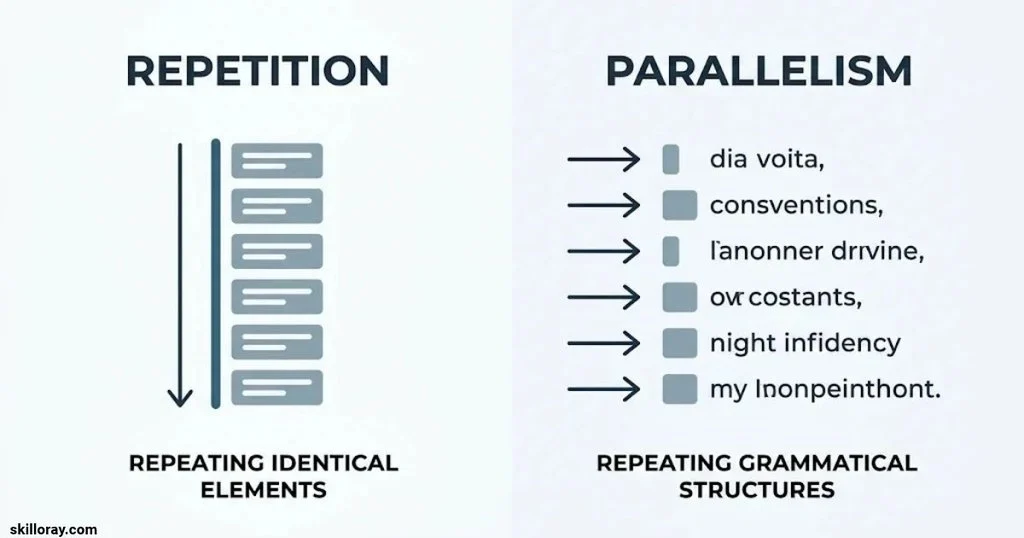
Both techniques can improve writing, but their functions and grammatical requirements differ.
Purpose
Repetition draws attention to an important word or idea. Parallelism organizes related ideas into a consistent structure.
For example:
- Repetition: “The problem requires attention, immediate attention.”
- Parallelism: “The solution requires careful planning, clear communication, and consistent action.”
The first emphasizes urgency. The second presents three balanced requirements.
Structure
Repetition depends on using an element more than once. It doesn’t require identical grammar in every sentence.
Parallelism depends on matching grammatical patterns. The words themselves don’t have to be identical.
Emphasis
Repetition strengthens a particular message through recurrence.
Parallelism gives related ideas equal structural weight, helping readers understand how they connect.
Rhythm
Both techniques can create rhythm, but they achieve it differently.
Repetition establishes rhythm by bringing back familiar words or phrases. Parallelism creates rhythm through balanced sentence construction.
Grammatical Requirements
Repetition doesn’t require a particular grammatical arrangement.
Parallelism requires consistency between related grammatical elements. A sentence can contain repetition and still have faulty parallelism.
Common Applications
Repetition is especially common in poetry, slogans, persuasive speeches, and emotional writing.
Parallelism appears frequently in essays, professional communication, instructions, comparisons, and lists.
Possible Problems
Excessive repetition can make writing sound redundant or monotonous.
Faulty parallelism can make a sentence confusing, awkward, or grammatically inconsistent.
| Difference | Repetition | Parallelism |
| Core technique | Reusing an element | Matching grammatical forms |
| Main benefit | Emphasis | Clarity and balance |
| Must repeat exact words? | Often, but not always | No |
| Must match grammar? | No | Yes, for related elements |
| Can create rhythm? | Yes | Yes |
| Common weakness | Unnecessary repetition | Faulty parallel structure |
How Are Repetition and Parallelism Similar?
Despite their differences, repetition and parallelism share several important qualities.
Both improve emphasis. Repetition highlights an expression directly, while parallelism gives related ideas equal attention.
Both create rhythm. Repeated words establish a recognizable pattern. Matching sentence structures create a balanced reading experience.
Both appear in persuasive writing. Writers use them to make arguments easier to follow and remember.
Both work in spoken and written communication. You can find them in speeches, essays, advertisements, poems, presentations, and everyday conversations.
Both require good judgment. Overusing either technique can weaken a message. The goal is to make writing more effective, not simply more elaborate.
Can Repetition and Parallelism Work Together?
Yes. In fact, combining these techniques can make a sentence more memorable.
Repetition provides the recurring expression, while parallelism gives the surrounding sentence structures a consistent pattern.
Consider this example:
We need to listen carefully, we need to speak honestly, and we need to act responsibly.
The phrase “we need to” appears repeatedly. That is repetition. Each clause also follows a similar grammatical structure:
- We need to listen carefully.
- We need to speak honestly.
- We need to act responsibly.
That is parallelism.
Here is another example:
She wanted to learn with confidence, work with confidence, and lead with confidence.
The repeated phrase “with confidence” reinforces the central idea. The three verb phrases also follow a balanced structure.
Combining the techniques is useful when you want a message to sound organized and emphatic. However, avoid forcing both into every sentence. A little structure often creates more impact than an overly elaborate statement.
Faulty Parallelism: Common Mistakes and Corrections
Faulty parallelism occurs when related elements in a sentence use inconsistent grammatical structures.
It often appears in lists, comparisons, and sentences containing conjunctions. The meaning may still be understandable, but the sentence sounds awkward or becomes harder to follow.
Here are common mistakes and their corrections.
| Nonparallel sentence | Corrected sentence |
| She enjoys cooking, reading, and to travel. | She enjoys cooking, reading, and traveling. |
| He is honest, hardworking, and works efficiently. | He is honest, hardworking, and efficient. |
| The job involves writing reports, managing accounts, and to answer calls. | The job involves writing reports, managing accounts, and answering calls. |
| I prefer walking to drive. | I prefer walking to driving. |
| The course teaches students to research, writing, and how to present findings. | The course teaches students to research, write, and present findings. |
How to Identify Faulty Parallelism
You can catch most parallelism problems by following a few simple steps:
- Find the connected elements. Look for lists, comparisons, and conjunctions such as and, or, and but.
- Identify their grammatical forms. Check whether the elements are nouns, adjectives, verbs, gerunds, or phrases.
- Compare their structures. Related elements should follow matching grammatical patterns.
- Rewrite inconsistent elements. Choose a grammatical form that fits every item.
- Read the sentence aloud. Awkward wording often becomes easier to notice when spoken.
A useful editing habit is to check every list in your writing. A single inconsistent item can interrupt an otherwise clear sentence.
Repetition vs Redundancy: What’s the Difference?
Repetition and redundancy are related, but they aren’t interchangeable.
Repetition is the deliberate reuse of a word, phrase, or idea for a particular effect. It can strengthen meaning, create rhythm, or emphasize an important point.
Redundancy occurs when information is repeated unnecessarily without adding meaningful emphasis or clarity.
Compare these examples:
Intentional repetition:
The team needs focus, focus, and complete focus during the final match.
The repeated word emphasizes how important concentration is.
Unnecessary redundancy:
The team needs to focus and concentrate on maintaining its concentration.
The sentence repeats essentially the same idea without improving the message.
Not all repeated words are bad. Sometimes repetition improves clarity, especially when a subject or important term needs to remain clear across several sentences.
The key question is whether the repeated element contributes something. If it strengthens the message, keep it. If it only makes the sentence longer, revise it.
How to Use Repetition and Parallelism in Different Types of Writing
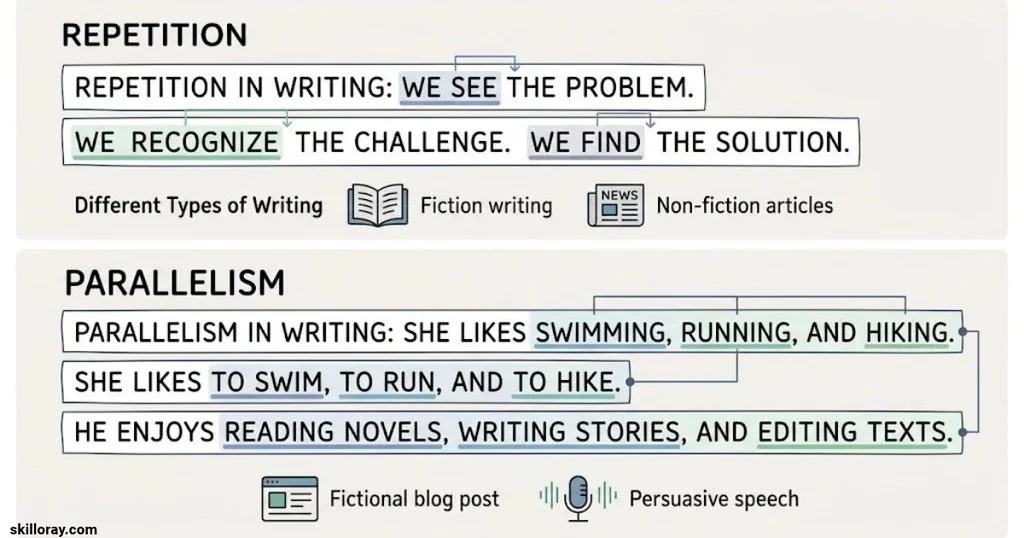
Choosing the right technique depends on your audience, purpose, and message.
In Academic Writing
Parallelism is especially useful in academic work because it keeps arguments, research objectives, and comparisons organized.
For example:
The research examines employee satisfaction, workplace productivity, and organizational performance.
The three noun phrases create a balanced list.
Repetition can also help maintain clarity when you need to refer to an important concept consistently. However, avoid repeating the same explanation in multiple paragraphs.
In Speeches and Persuasive Writing
Repetition helps speakers emphasize a central message. It can create emotional momentum and make important statements easier to remember.
Example:
We can build stronger communities. We can create better opportunities. We can make meaningful progress.
Parallelism adds balance to the message by giving each statement a similar structure.
These techniques work particularly well when a speaker wants the audience to remember several connected points.
In Business and Professional Communication
Parallelism makes instructions, proposals, and reports easier to understand.
For example:
Our priorities are improving response times, reducing errors, and strengthening customer relationships.
Repetition can be useful when reinforcing an important deadline, policy, or business objective. Use it carefully so professional messages remain concise.
In Creative Writing
Writers use repetition to develop themes, create atmosphere, and emphasize a character’s emotions.
Parallelism can make descriptions and dialogue more rhythmic. It also helps writers connect related images or ideas.
For example:
The city was loud by day, restless by night, and silent before dawn.
The matching descriptive phrases give the sentence a steady rhythm.
Frequently Asked Questions
Is repetition the same as parallelism?
No. Repetition means using a word, phrase, sound, or idea more than once. Parallelism means arranging related words, phrases, or clauses in matching grammatical structures. They can appear together, but they serve different purposes.
What is the main difference between repetition and parallelism?
Repetition emphasizes an element by bringing it back. Parallelism creates balance by using consistent grammatical patterns. For example, “Never stop learning, never stop improving” uses repetition, while “Learn carefully, practice regularly, and improve consistently” uses parallelism.
Can parallelism exist without repetition?
Yes. Parallelism doesn’t require repeating the same words. Consider this sentence: “She enjoys painting landscapes, writing stories, and designing websites.” The three activities use matching gerund phrases, but the main words are different.
Can repetition exist without parallelism?
Yes. A writer can repeat a word or phrase without using matching grammatical structures. For example: “The decision was difficult, very difficult.” The repeated word adds emphasis, but the sentence doesn’t rely on a series of parallel grammatical elements.
Is parallelism a grammatical device or a literary device?
It can serve both purposes. In grammar, parallelism means maintaining consistent structures between related sentence elements. In literature and rhetoric, writers use parallelism to create rhythm, emphasis, and balance.
What is faulty parallelism?
Faulty parallelism occurs when connected elements use inconsistent grammatical forms. For example, “She likes reading, swimming, and to dance” is not parallel. A corrected version is “She likes reading, swimming, and dancing.”
What is the difference between repetition and redundancy?
Repetition can be intentional and useful because it adds emphasis or rhythm. Redundancy usually involves unnecessary repetition that doesn’t contribute meaningful information. The difference depends on the purpose and effect of the repeated material.
Is alliteration a type of repetition?
Alliteration is a sound device that repeats similar initial consonant sounds in nearby words. For example, “Busy bees buzzed beside the bushes.” It is related to repetition, but it is more accurately classified as a sound device rather than a structural type of repetition such as anaphora or epistrophe.
Why do writers use repetition and parallelism together?
Writers combine them to make important messages more memorable. Repetition reinforces key expressions, while parallelism creates a consistent structure. Together, they can make speeches, slogans, and persuasive sentences more effective.
Final Thoughts
Repetition and parallelism may look similar because both can create rhythm and emphasis, but they work in different ways. Repetition brings important words and ideas back into focus. Parallelism gives related thoughts a consistent grammatical structure.
Use repetition when a message deserves extra attention. Choose parallelism when you want related ideas to sound balanced and clear. You can also combine both techniques when the situation calls for stronger emphasis.
As you edit your writing, check whether repeated words serve a purpose and whether connected sentence elements follow matching patterns. These small decisions can make your writing more natural, memorable, and easier to understand.

I am Daniel Carter, a grammar enthusiast and language educator with over 10 years of experience helping students and professionals improve their English writing and communication skills. I enjoy simplifying complex grammar rules into easy-to-understand lessons that anyone can follow. My goal is to help learners write with confidence, avoid common mistakes, and develop strong communication skills for academic and professional success. I regularly create practical grammar guides, writing tips, and language resources that make learning both enjoyable and effective.
Books: Mastering English Grammar and The Complete Guide to Better Writing
 James Walker
 Olivia Brown