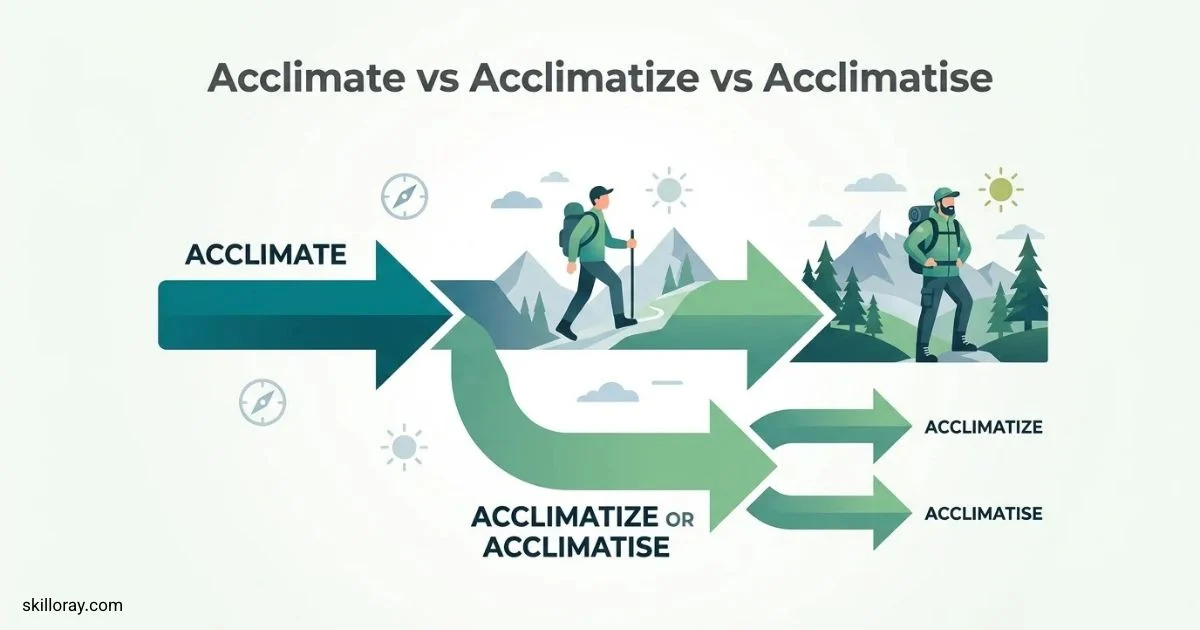
Have you ever wondered whether to write acclimate, acclimatize, or acclimatise? These three words look similar, and their meanings overlap, so choosing the right one can feel confusing when you want your English to sound natural and correct.
I know how frustrating it can be to second-guess your spelling, especially when different dictionaries and websites use different forms. The good news is that you don’t need to memorize complicated grammar rules to understand the difference.
In this guide, you’ll learn what acclimate, acclimatize, and acclimatise mean, how to use them in sentences, and which spelling works best in American and British English. By the end, you can choose the right word with confidence.
Acclimate vs Acclimatize vs Acclimatise: Quick Comparison
| Word | Meaning | Common usage |
| Acclimate | To adjust to a new environment or situation | Especially common in American English |
| Acclimatize | To become accustomed to different environmental conditions | Used in American and British English |
| Acclimatise | The same meaning as acclimatize | Common in British English |
For example, an American might say, “I need time to acclimate to the summer heat.” Another person might say, “I need time to acclimatize to the summer heat.” A British English speaker may write, “I need time to acclimatise to the summer heat.”
All three sentences are correct.
What Does Acclimate Mean?
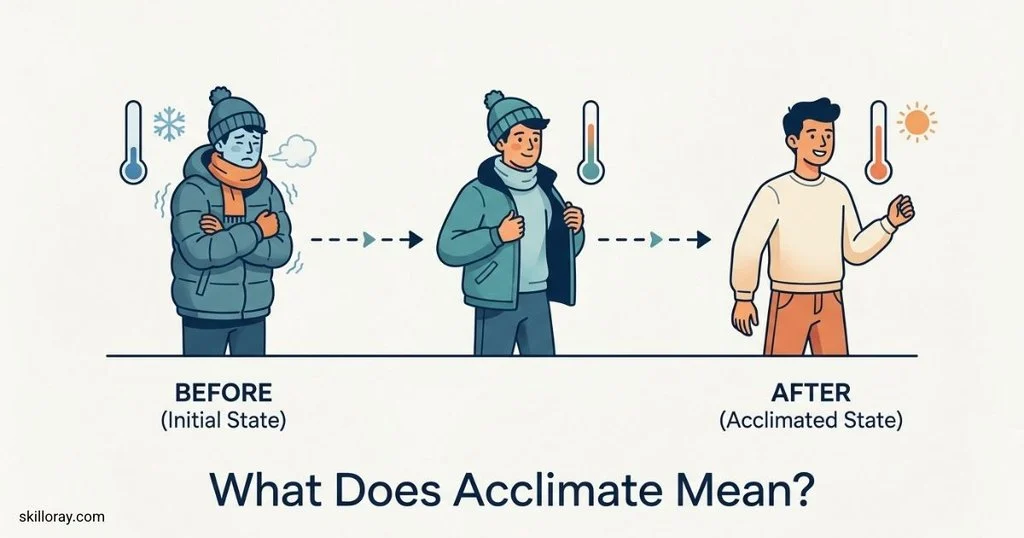
Acclimate means to become accustomed to a new environment, climate, temperature, or situation. It can describe physical adjustments, such as getting used to warmer weather, as well as everyday changes, such as settling into a new workplace.
The word is particularly common in American English. You might hear it when someone moves to another state, starts school, or spends time in an unfamiliar climate.
Examples of acclimate in a sentence:
- It took me a few days to acclimate to the hot, humid weather.
- New employees need time to acclimate to their team’s working style.
- The plants were moved outdoors gradually so they could acclimate to the changing conditions.
Notice that acclimate doesn’t always involve the weather. It can also describe adjusting to an unfamiliar routine or environment.
When Should You Use Acclimate?
Choose acclimate when it sounds natural for your audience, particularly in American English. It works well in everyday conversation, general writing, and discussions about environmental changes.
For instance, if your friend has just moved from a cool climate to a much warmer city, you could say:
“Give yourself a little time to acclimate to the heat.”
There’s no need to replace acclimate with acclimatize just to make the sentence sound more formal. Both can express the same basic idea.
What Does Acclimatize Mean?
Acclimatize means to adjust to a different climate or set of environmental conditions. It’s closely related to acclimation and can often replace it without changing the meaning.
The word frequently appears in discussions about travel, temperature, altitude, and changes in living conditions. It’s also used in scientific contexts involving plants and animals.
Examples of acclimatize in a sentence:
- The hikers spent time acclimatizing to the altitude before continuing their journey.
- It took the family several weeks to acclimatize to their new surroundings.
- The plants needed time to acclimatize to the different levels of sunlight.
When Should You Use Acclimatization?
Use acclimatize when discussing how people or other living things adjust to new environmental conditions. It’s a natural choice in travel writing, scientific discussions, and general English.
For example, travelers visiting a high-altitude destination may need time to adjust to the thinner air. In that context, acclimatize is an appropriate word.
However, it isn’t restricted to mountains or scientific writing. You can also use it to describe adjusting to a different climate or unfamiliar surroundings.
What Does Acclimatise Mean?
Acclimatise has the same meaning as acclimatize. The difference is spelling: British English commonly uses acclimatise, while American English generally favors acclimatization.
This is a familiar pattern in English spelling. For example, British English often uses organise, while American English typically uses organize.
Examples of acclimatise in a sentence:
- It took us a few days to acclimatise to the warmer weather.
- The visitors needed time to acclimatise to their new surroundings.
- The hikers paused to acclimatise before climbing to a higher elevation.
When Should You Use Acclimatise?
Use acclimatise when writing in British English or following a style guide that prefers this spelling.
If you’re writing for a British publication, consistency is important. Using acclimatise alongside words such as organise and realise helps maintain a consistent spelling style.
For an American audience, acclimatization is generally the safer choice. Both forms are correct, so the decision depends on your preferred variety of English.
Acclimatize vs Acclimatise: Which Spelling Is Correct?
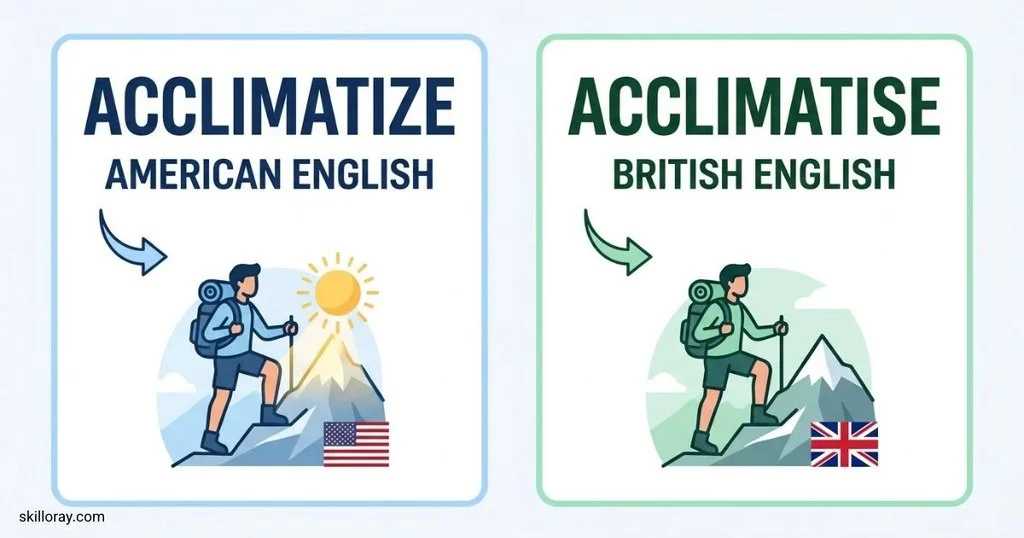
Both spellings are correct. Neither has a different meaning, and neither is grammatically superior to the other.
The distinction is mainly regional:
- American English: Acclimatize
- British English: Acclimatise is common, although acclimatize is also accepted.
The same distinction applies to their past-tense forms:
- American spelling: acclimatized
- British spelling: acclimatised
For example, an American writer might write, “The team acclimatized to the warmer conditions.” A British writer could write, “The team acclimatised to the warmer conditions.”
Both sentences communicate the same idea.
Acclimation vs Acclimatization vs Acclimatisation
The distinction also appears in the nouns related to these verbs.
Acclimation refers to the process of becoming accustomed to new environmental conditions. It’s particularly common in American English.
Acclimatization describes the same general process and is used in both American and British English.
Acclimatisation is the British spelling variant of acclimatization.
Here are examples of each word in context:
- The acclimation period helped the plants adjust to their new environment.
- The climbers allowed time for acclimatization before continuing their ascent.
- Proper acclimatisation can be important when adjusting to a different climate.
These nouns are closely related, but they aren’t verbs. Use acclimate, acclimatize, or acclimatise when describing the act of adjusting, and use acclimation or acclimatization when referring to the process itself.
Common Questions About Acclimate vs Acclimatize vs Acclimatise
Are Acclimate and Acclimatize Interchangeable?
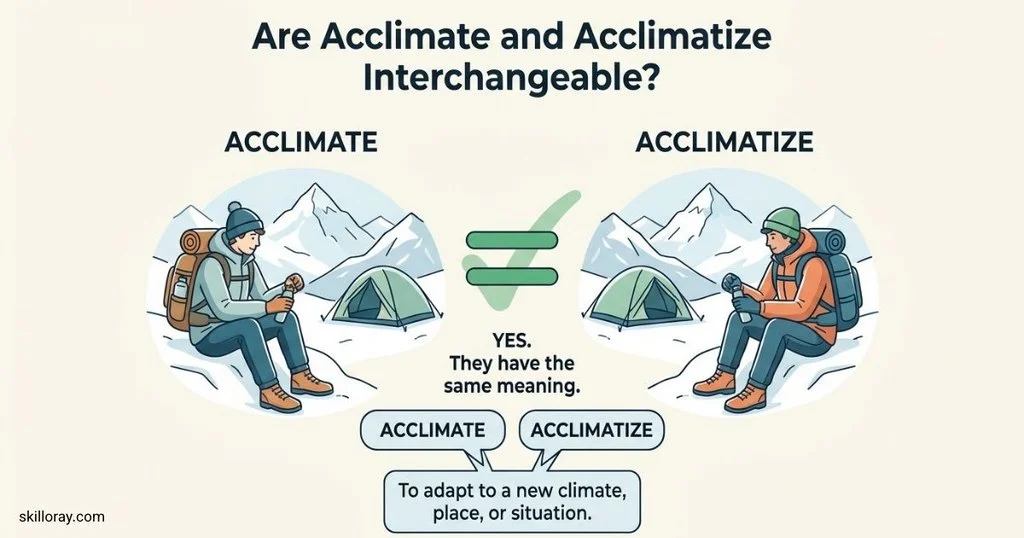
Yes. In most everyday contexts, acclimate and acclimatize are interchangeable because both mean adjusting to new conditions. The choice usually depends on regional preference, context, or personal style.
For example, “She needed time to acclimate to the heat” and “She needed time to acclimatize to the heat” are both correct.
Acclimatise British or American English?
Acclimatise is primarily associated with British English. American English generally prefers acclimatization, although the meaning remains the same in either spelling.
What Is the Past Tense of Acclimation?
The past tense of acclimate is acclimated. For example, “The plants acclimated to their new environment.”
For acclimatization, the past tense is acclimatized in American English. British English commonly uses acclimatization when following the -ise spelling.
Which Word Should I Use in Formal Writing?
Use the word that fits your audience and the style guide you’re following. Acclimate is especially common in American English, while acclimatize works in both American and British English. If you’re following British spelling conventions, acclimatise is also appropriate.
Final Takeaway
The difference between acclimate, acclimatize, and acclimatise is mainly a matter of spelling preference and regional usage.
Use acclimate for a natural choice in American English. Choose acclimatize when you prefer that established spelling, whether writing for an American or British audience. Use acclimatise when following British English conventions.
When in doubt, keep your spelling consistent throughout the article. That’s the simplest way to make your writing clear and professional.

I am Olivia Brown, a professional English editor and grammar writer who believes that great writing begins with a strong foundation in grammar. I have spent years creating educational resources that help students and professionals improve their writing, avoid common errors, and communicate more effectively. I strive to provide clear explanations and practical examples that make grammar easy to understand and apply.
Books: English Grammar Essentials and Modern Writing Success
 Daniel Carter
 James Walker