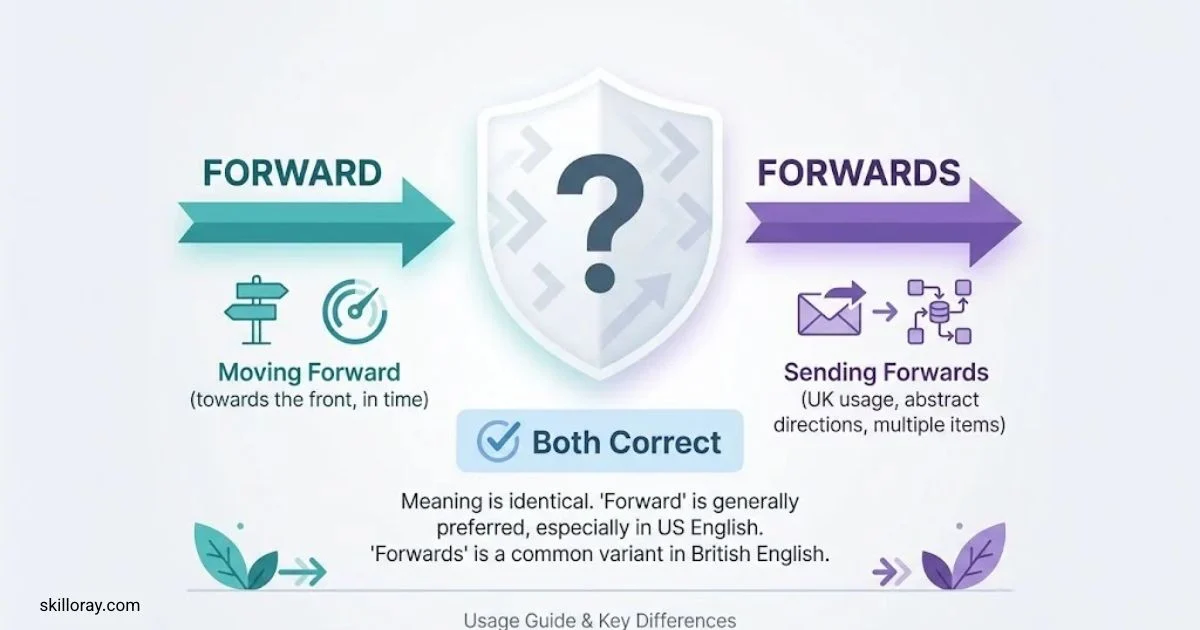
Have you ever stopped mid-sentence and wondered whether to write forward or forwards? You’re not alone. These two words look almost identical, so choosing the correct one can feel confusing when you want your English to sound natural.
I’m here to make this grammar question simple for you. Both forward and forwards can describe movement ahead, but their usage varies by region. In American English, forward is generally preferred, while forwards is more common in British English.
You’ll discover the key differences between forward and forwards, explore easy examples, and learn which word fits different situations. By the end, I want you to feel confident choosing the right word without second-guessing yourself.
Forward vs. Forwards: What’s the Difference?
When forward and forwards describe movement, they usually mean the same thing: toward the front or ahead.
| Word | Common usage | Example |
| Forward | Preferred in American English; also used in British English | She stepped forward to speak. |
| Forwards | Common in British English for movement or direction | She stepped forwards to speak. |
Both examples are grammatically correct. The difference is mainly regional, not a difference in meaning.
If you’re writing for an American audience, forward is generally the safest choice. British English also uses forward, so you don’t need to change every instance to forwards when writing for British readers.
When to Use Forward
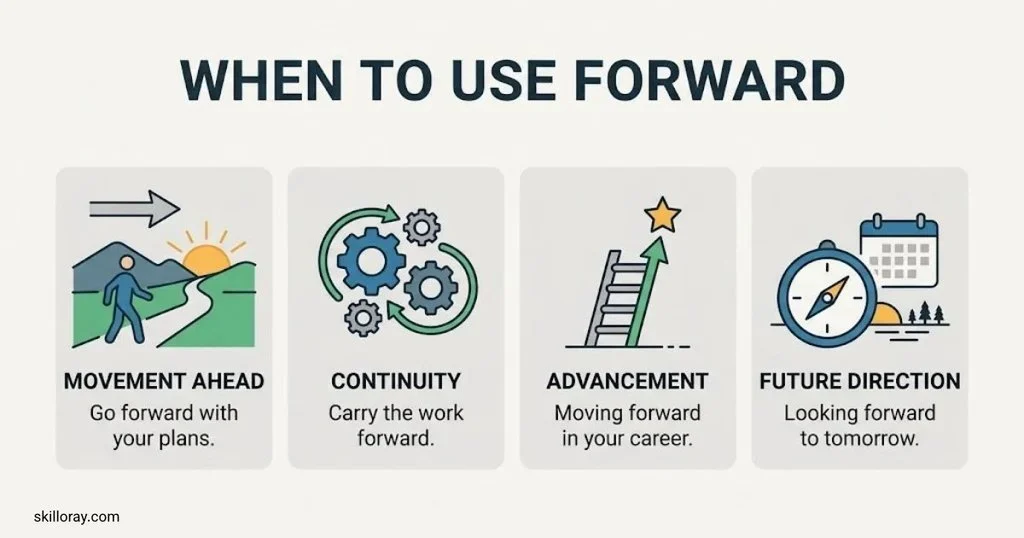
Forward can function as an adverb, adjective, verb, or noun. Its meaning changes with the context.
1. To Describe Movement or Progress
Use forward when someone or something moves ahead. It can also describe progress toward a goal.
Examples:
- The child took a step forward.
- Our team is moving forward with the project.
- She leaned forward to hear the announcement.
In these sentences, forward describes direction or progress.
2. To Send a Message or Document
Forward is also a verb meaning to send something you received to another person.
Examples:
- Please forward the email to your manager.
- I’ll forward the meeting details this afternoon.
- Could you forward the invitation to the rest of the team?
In this usage, forward is the correct base form after please, will, and could you. You wouldn’t write “Please forwards the email.”
3. In the Expression “Look Forward To”
The phrase look forward to means to anticipate something with pleasure or interest. It’s the established expression in both American and British English.
Examples:
- I look forward to hearing from you.
- We look forward to meeting the new teacher.
- She’s looking forward to the holidays.
Pay attention to the verb that follows to. Because to is a preposition in this expression, use a noun or the -ing form of a verb.
Correct: “I look forward to seeing you.”
Incorrect: “I look forward to see you.”
When to Use Forwards
Forwards is most commonly used as an adverb describing movement or direction. It’s especially familiar in British English.
Examples:
- The hikers moved forwards along the trail.
- He leaned forwards to pick up his bag.
- The bus rolled forwards slowly.
You can replace forwards with forward in these examples without changing the basic meaning.
In American English, however, forward is generally more common in such sentences. If you’re writing for a US audience, using forward consistently is a sensible choice.
American English vs. British English
Regional preference is the easiest way to understand the difference.
In American English: Writers generally use forward for direction, progress, and common expressions.
- We need to move forward with our plans.
- She stepped forward to collect her certificate.
- I look forward to your reply.
In British English: Both forms are used, but forwards is common when describing movement.
- The children ran forwards across the playground.
- He leaned forwards to read the sign.
- The car moved forwards after the light changed.
These examples illustrate common preferences, not absolute rules. British speakers also use forward for movement, and American speakers may encounter forwards in published writing.
Common Mistakes With Forward and Forwards
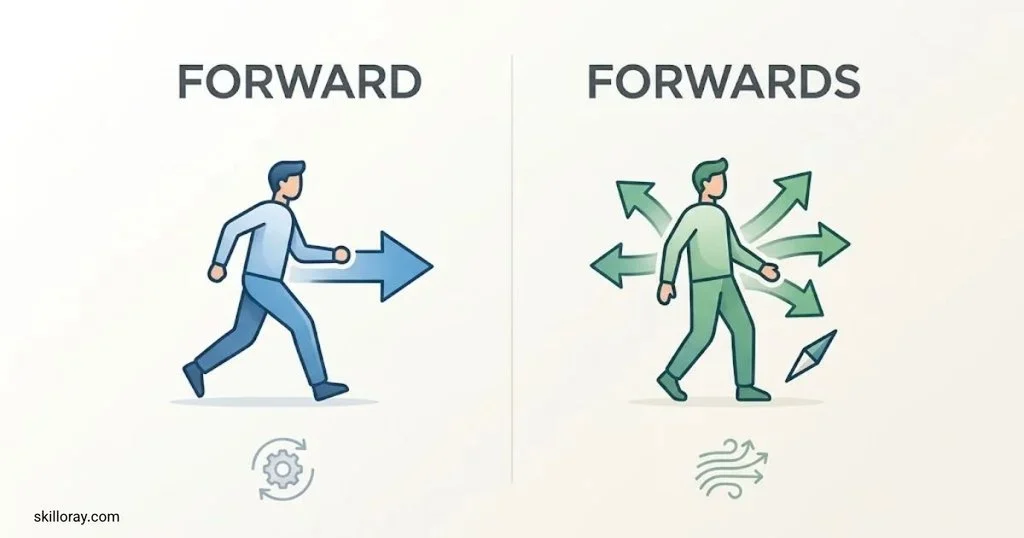
Most errors happen when writers confuse regional preferences with grammatical rules.
| Mistake | Better wording | Explanation |
| Please forwards the email. | Please forward the email. | Use the base verb after please. |
| I look forwards to hearing from you. | I look forward to hearing from you. | Look forward to is the established expression. |
| Forwards is always incorrect in American English. | Both forms exist, but forward is generally preferred in US usage. | Regional preference doesn’t make the alternative universally wrong. |
| Every British sentence must use forwards. | Choose the form that fits the sentence and style. | British English uses both spellings. |
The key is to consider the word’s function before deciding which form belongs in your sentence.
Frequently Asked Questions
Is forward or forwards correct?
Both are correct. Forward is generally preferred in American English, while forwards is common in British English when describing movement or direction.
Is forwards grammatically correct?
Yes. Forwards is a standard English adverb. For example, “The runner moved forwards” is grammatically correct, particularly in British English.
Is forward American or British English?
Both American and British English use forward. American English generally prefers it where British English often uses either forward or forwards.
Can I use forwards in American English?
Yes, but forward is the more usual choice in American English when describing movement or progress. For a US audience, forward is generally the more natural option.
Is it looking forward or looking forwards?
The established expression is looking forward in both American and British English.
Example: “I’m looking forward to the concert.”
Is it move forward or move forwards?
Both forms can be correct. Move forward is more common in American English, while move forwards is also widely used in British English.
Final Answer: Forward or Forwards?
Both forward and forwards are correct. American English generally favors forward, while British English commonly uses forwards for movement.
Use forward when sending a message and in the established phrase look forward to. For directional meaning, choose the form that suits your audience and use it consistently.

I am Daniel Carter, a grammar enthusiast and language educator with over 10 years of experience helping students and professionals improve their English writing and communication skills. I enjoy simplifying complex grammar rules into easy-to-understand lessons that anyone can follow. My goal is to help learners write with confidence, avoid common mistakes, and develop strong communication skills for academic and professional success. I regularly create practical grammar guides, writing tips, and language resources that make learning both enjoyable and effective.
Books: Mastering English Grammar and The Complete Guide to Better Writing
 James Walker
 Olivia Brown