Have you ever paused while writing a sentence and wondered whether to use saw or seen? You’re not alone. This small grammar question can confuse English learners, students, and even people who use English every day.
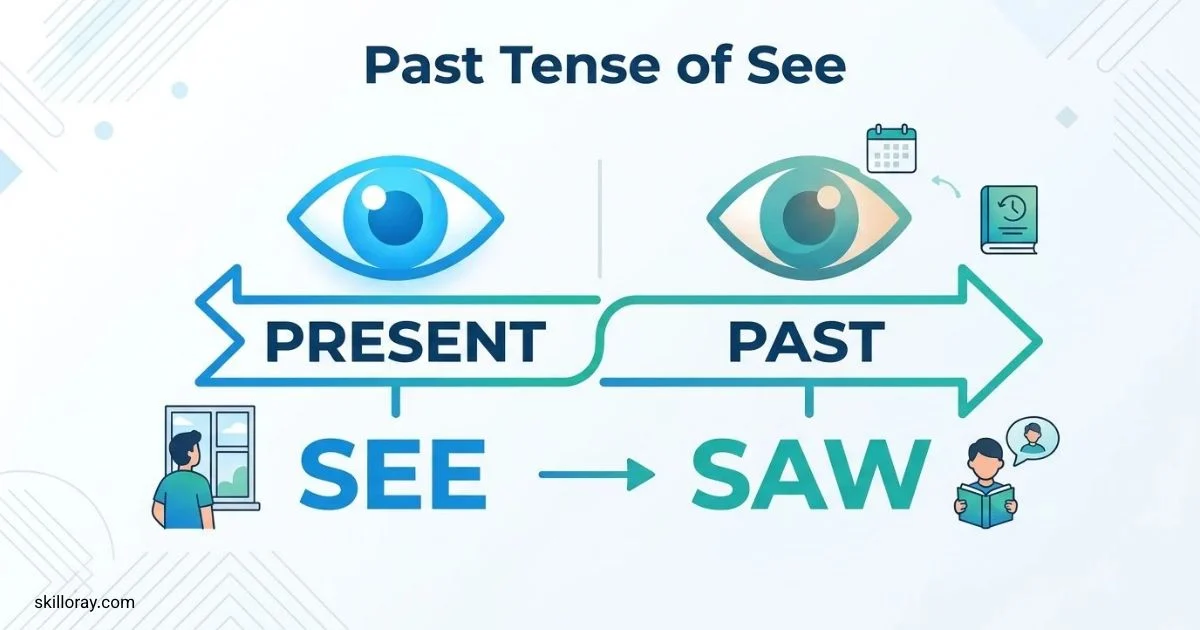
I want to make this easy for you. The past tense of see is saw, while seen is its past participle. Once you understand how these forms work, you’ll find it much easier to choose the right word when speaking or writing.
In this guide, you’ll learn the past tense of see, understand the difference between saw and seen, and explore simple examples you can use in everyday conversations. I’ll also explain common mistakes so you can write with greater confidence.
What Is the Past Tense of See?
The simple past tense of see is saw. Use it when describing something that happened in the past.
The three main forms of this irregular verb are:
| Verb form | Example |
| Present: see | I see a bird outside. |
| Simple past: saw | I saw a bird yesterday. |
| Past participle: seen | I have seen that bird before. |
Unlike regular verbs such as walk and play, see doesn’t form its past tense by adding -ed. Its forms change to saw and seen.
Remember the pattern: see → saw → seen.
Saw vs. Seen: What’s the Difference?
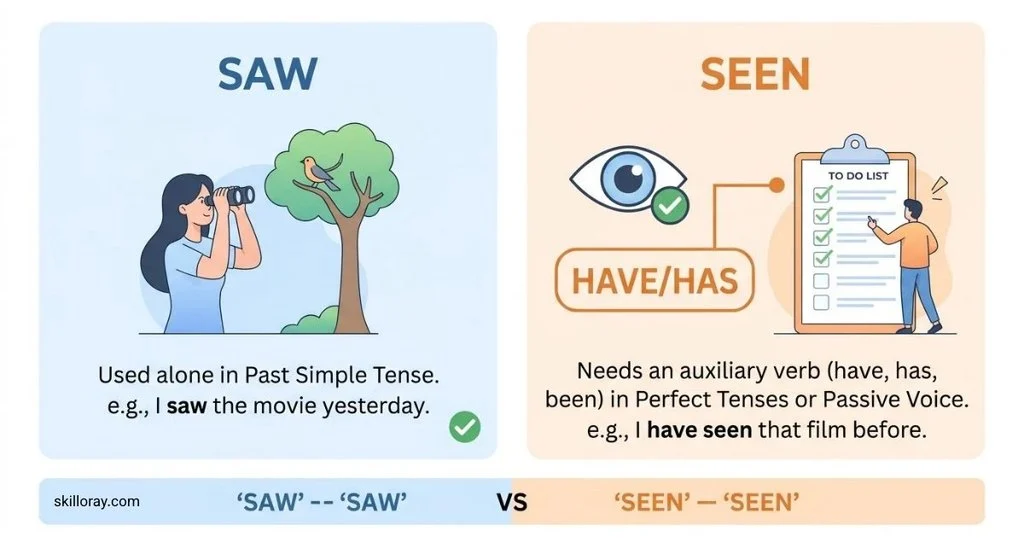
Although saw and seen come from the same verb, you can’t use them interchangeably in standard English.
Saw is the simple past tense. It describes a completed action or event.
Seen is the past participle. It usually appears with a helping verb to form a perfect tense.
| Sentence | Why it’s correct |
| I saw the movie last night. | Saw describes a completed past event. |
| I have seen that movie before. | Seen follows have. |
| She had seen the message earlier. | Seen follows had. |
| Have you seen my keys? | Seen follows have in a question. |
The helping verb also affects the tense. Have seen is present perfect, while had seen is past perfect.
When to Use Saw
Use saw when you’re describing something you witnessed or noticed in the past.
- I saw an old friend at the grocery store.
- We saw the ocean for the first time during our vacation.
- She saw the message but forgot to reply.
- The teacher saw that several students needed help.
- They saw the winning goal just before the match ended.
In each sentence, saw describes an event or observation that happened in the past.
When to Use Seen
Use seen with a suitable helping verb, such as have, has, or had, when forming perfect tenses.
- I have seen this problem before.
- She has seen every episode of the series.
- We had seen the warning before entering the building.
- He has never seen snow before.
- They had seen each other several times before becoming friends.
You can also use seen with modal constructions, as in “I would have seen the message if my phone had been working.”
Examples of See, Saw, and Seen in Sentences
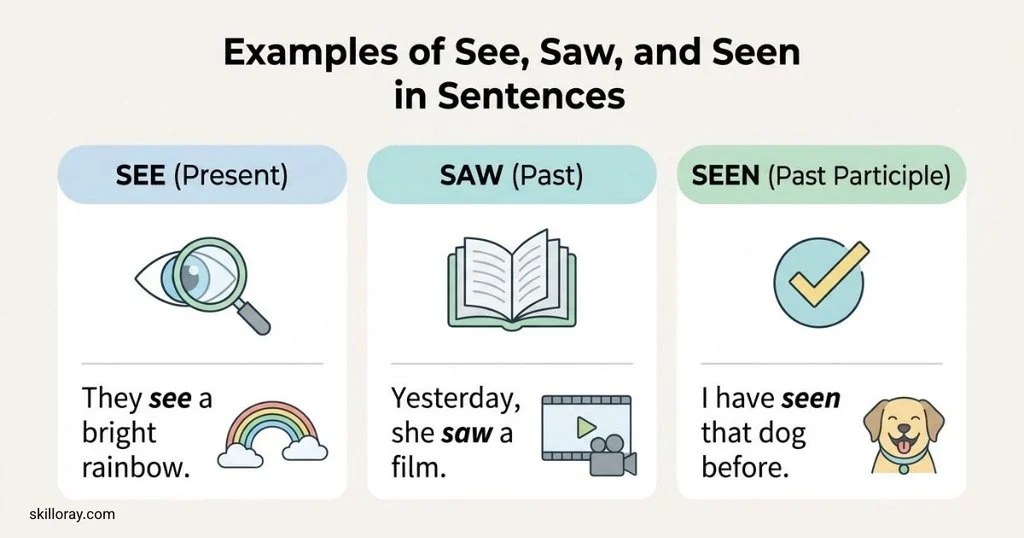
Here are some everyday examples showing how the verb changes with the sentence.
See — present tense
- I see what you mean.
- She can see the mountains from her window.
- We see our neighbors almost every day.
Saw — simple past tense
- I saw your email last night.
- He saw a deer while driving home.
- We saw the new house over the weekend.
Seen — past participle
- Have you seen my notebook?
- They have seen that show twice.
- I had seen the sign before I reached the entrance.
Notice that seen follows a helping verb in each example. That small detail is one of the easiest ways to choose the correct form.
Common Mistakes When Using the Past Tense of See
The most common errors involve using saw and seen in the wrong places.
| Incorrect | Correct |
| I seen him yesterday. | I saw him yesterday. |
| I have saw that movie. | I have seen that movie. |
| We had saw the building before. | We had seen the building before. |
Here’s why these corrections work:
- “I saw him yesterday.” Use saw because the sentence describes a past event without a helping verb.
- “I have seen that movie.” Use seen after have to form the present perfect tense.
- “We had seen the building before.” Use seen after had to form the past perfect tense.
You may hear “I seen it” in some dialects or informal speech. However, in standard written English, use “I saw it” or “I have seen it,” depending on what you mean.
Frequently Asked Questions
What is the past tense of see?
The past tense of see is saw. For example, “I saw a bird in the garden yesterday.”
Is it saw or seen?
Both words are correct, but they have different grammatical roles. Use saw for the simple past tense and seen as the past participle, usually with a helping verb.
What is the past participle of see?
The past participle is seen. You use it in constructions such as have seen, has seen, and had seen.
What is the past perfect tense of see?
The past perfect form is had seen. For example, “I had seen the movie before my friend recommended it.”
What is the future tense of see?
The simple future form is will see. For example, “We will see the results tomorrow.”
What are the three forms of see?
The three principal forms are see, saw, and seen.
- Present: I see the car.
- Past: I saw the car.
- Past participle: I have seen the car.
Final Answer: See, Saw, or Seen?
The simple past tense of see is saw, while seen is the past participle.
Use saw for a completed past event: “I saw the movie yesterday.”
Use seen with a helping verb: “I have seen the movie before.”
Once you remember see → saw → seen, you’ll find it much easier to use the correct form in everyday conversation and formal writing.

I am James Walker, an English language specialist with extensive experience in grammar, editing, and academic writing. I enjoy helping students, bloggers, and professionals strengthen their writing by explaining grammar concepts in a clear and engaging way. My focus is on providing accurate, practical, and easy-to-follow guidance that helps learners communicate more effectively in everyday and professional situations.
Books: Perfect English Grammar Handbook and Advanced Writing Techniques
 Daniel Carter
 Olivia Brown