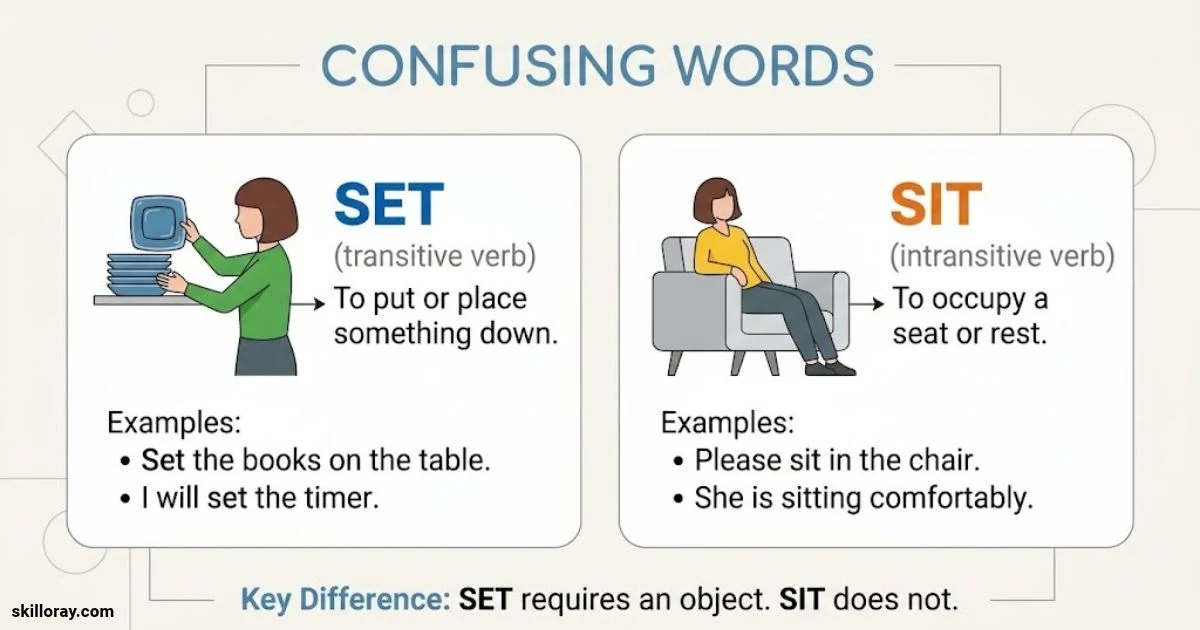
Have you ever stopped while writing because you weren’t sure whether to use set or sit? These two words look simple, but their meanings and uses can easily confuse English learners. I know how frustrating it can feel when two familiar words suddenly seem difficult to tell apart.
The good news is that set and sit have different meanings, and learning the difference is easier than you might think. Once you understand a few simple rules, you’ll know exactly which word to use in everyday conversations and writing.
In this guide, I’ll explain the difference between set and sit with clear definitions, practical examples, and easy grammar rules. Whether you’re learning English or improving your writing, you’ll find everything you need to use these words correctly.
Set vs. Sit: What’s the Difference?
Set and sit describe different actions, even though they sometimes appear in similar situations.
| Word | Main meaning | Example |
| Set | To place or arrange something | He set the books on the shelf. |
| Sit | To rest in a seated position | He sat beside the window. |
In their most common uses, set takes an object, while sit doesn’t need one.
Compare these sentences:
- She set the baby on the bed.
- She sat beside the baby.
In the first sentence, she places the baby somewhere. In the second, she takes a seat beside the baby.
When to Use Set
Use set when you mean to place, position, or arrange something. It can also describe establishing a time, adjusting a device, or reaching a particular result.
Here are some common uses.
1. Placing something somewhere
- Please set your keys beside the door.
- He set the glass carefully on the table.
2. Establishing a time or plan
- We set a date for the meeting.
- The school set a deadline for registration.
3. Adjusting or preparing something
- She set the alarm for 6 a.m.
- He set the oven temperature to 350 degrees.
4. Other meanings
The verb set appears in expressions that have nothing to do with placing objects.
- The sun sets in the west.
- The cement needs time to set.
- The coach set a new training record.
These examples show why the meaning of set depends on the context.
When to Use Sit
Use sit when someone or something occupies a seated position. The verb also appears in several expressions where it describes location, remaining unused, or taking an examination.
1. Taking a seat
- Please sit near the front.
- The children sat quietly during the lesson.
2. Describing a location
- Their house sits on top of a hill.
- The restaurant sits beside the river.
3. Remaining in one place
- The documents have been sitting on my desk all week.
- The unused equipment sat in storage for months.
4. Taking an examination
In British English, sit an exam is a common expression. In American English, take an exam is generally more familiar.
For example:
- British English: I have to sit my final exam tomorrow.
- American English: I have to take my final exam tomorrow.
Set vs. Sit: Past Tense and Verb Forms
Their past-tense forms are another common source of confusion. Set stays the same in its base, simple past, and past participle forms. Sit changes to sat.
| Verb form | Set | Sit |
| Base form | Set | Sit |
| Simple past | Set | Sat |
| Past participle | Set | Sat |
| Present participle | Setting | Sitting |
| Third-person singular | Sets | Sits |
Consider these examples:
- Present: I set the cup on the counter.
- Past: I set the cup on the counter yesterday.
- Present: I sit near the window.
- Past: I sat near the window yesterday.
Notice that set doesn’t become setted. Similarly, the correct past tense of sit is sat, not sitted.
Is It Set Down or Sit Down?
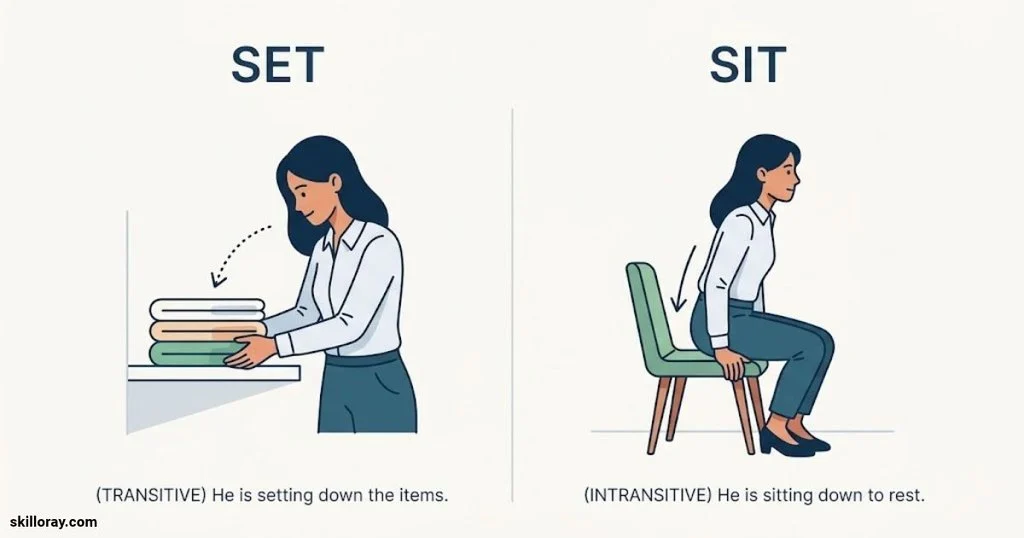
Both expressions are correct, but they describe different actions.
Set down means to put something on a surface.
Example: She set down her shopping bags near the entrance.
Sit down means to move into a seated position.
Example: Please sit down and make yourself comfortable.
You can also use set down figuratively to mean recording or establishing something in writing.
Example: The agreement sets down the responsibilities of each party.
The key is to identify what is being placed or who is taking a seat.
Common Mistakes With Set and Sit
These verbs can be confusing when a sentence involves both people and objects. The following comparisons show which form belongs in each situation.
| Incorrect | Correct | Why? |
| Sit the glass on the table. | Set the glass on the table. | You’re placing an object. |
| Set down on the chair. | Sit down on the chair. | You’re taking a seat. |
| I set there yesterday. | I sat there yesterday. | The past tense of sit is sat. |
| She sitted beside me. | She sat beside me. | Sat is the correct past form. |
| I set the baby down yesterday. | I set the baby down yesterday. | Set stays unchanged in the past tense. |
One additional point: sit can sometimes take an object when it means helping someone into a seated position.
For example:
The teacher sat the children in two rows.
This is correct, even though sit usually appears without a direct object in everyday sentences.
Frequently Asked Questions
1. What is the difference between set and sit?
Set usually means placing or arranging something, while sit usually means resting in a seated position. For example, you set a book on a desk and sit on a chair.
2. Is it set or sit on the chair?
Use sit on the chair when someone takes a seat. Use set the bag on the chair when placing an object there.
3. What is the past tense of set?
The past tense of set is also set. For example, “She set the table before dinner.”
4. What is the past tense of sit?
The past tense of sit is sat. For example, “He sat beside his friend.”
5. Is it sit down or set down?
Both are correct. Use sit down when a person takes a seat and set down when someone places an object somewhere.
6. Is set a regular or irregular verb?
Set is an irregular verb because it doesn’t form its past tense by adding -ed. Its base form, past tense, and past participle are all set.
7. Can sit be used with an object?
Yes. Although sit is usually intransitive when describing a seated position, it can take an object in certain sentences. For example, “She sat the child on the sofa.”
Final Thoughts
When choosing between set and sit, focus on the action rather than how the words sound. Use set for placing or arranging something, and use sit when describing a seated position. Remember that the past tense of sit is sat, while set stays unchanged. These simple distinctions will help you use both verbs correctly.

I am James Walker, an English language specialist with extensive experience in grammar, editing, and academic writing. I enjoy helping students, bloggers, and professionals strengthen their writing by explaining grammar concepts in a clear and engaging way. My focus is on providing accurate, practical, and easy-to-follow guidance that helps learners communicate more effectively in everyday and professional situations.
Books: Perfect English Grammar Handbook and Advanced Writing Techniques
 Daniel Carter
 Olivia Brown