
Have you ever stopped mid-sentence and wondered whether to say ran or run? You’re not alone! This small grammar question can confuse English learners, students, and even people who speak English every day.
I want to make this simple for you. The past tense of run is ran, but run also has an important role as the past participle. Once you understand the difference, you’ll find it much easier to use this verb correctly in everyday conversations and writing.
In this guide, you’ll learn the past tense of run, understand when to use ran and run, and explore clear examples of each form. I’ll also explain common mistakes so you can improve your grammar and speak English with greater confidence.
What Is the Past Tense of Run?
The simple past tense of run is ran. Use it when describing an action that happened and finished in the past.
Here are a few examples:
- I ran to the bus stop yesterday.
- She ran three miles before breakfast.
- The children ran outside when the rain stopped.
- We ran into an old friend at the store.
In each sentence, ran describes something that happened in the past. You don’t need a helping verb to form the simple past.
Run, Ran, and Run: What’s the Difference?
The three main forms of run serve different grammatical purposes.
| Verb form | Usage | Example |
| Run | Present tense | I run every morning. |
| Ran | Simple past tense | I ran yesterday morning. |
| Run | Past participle | I have run five miles today. |
| Running | Present participle | I am running right now. |
The most common confusion is between ran and run. Use ran for a completed past action, but use run after has, have, or had when forming perfect tenses.
Compare these sentences:
- Correct: He ran a marathon last year.
- Correct: He has run two marathons this year.
- Incorrect: He has ran two marathons this year.
The same rule applies to other perfect-tense sentences, including “She had run before breakfast.”
Is It Ran or Runned?

Ran is the correct standard past tense of run. Runned isn’t the standard form used in modern English.
Many regular verbs form their past tense by adding -ed. For example, walk becomes walked, and jump becomes jumped. However, run is irregular, so its form changes to ran.
Here are some common corrections:
| Incorrect | Correct |
| I runned to school. | I ran to school. |
| She runned around the park. | She ran around the park. |
| They have ran out of time. | They have run out of time. |
| We had ran five miles. | We had run five miles. |
Remember the difference: ran works as the simple past, while run follows have, has, and had in perfect tenses.
Examples of Ran in Sentences
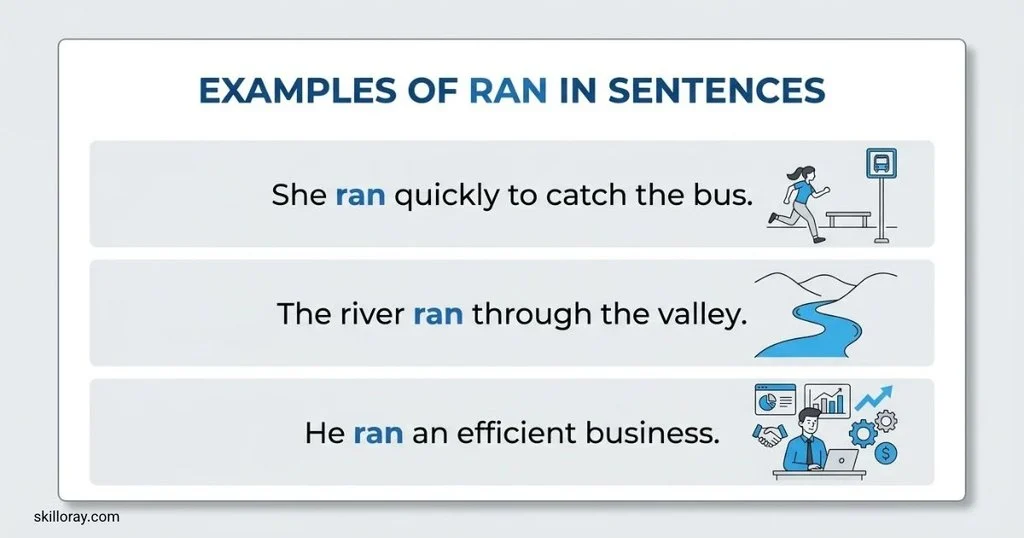
The verb ran can describe physical movement, but it also appears in expressions with other meanings.
- Physical movement: She ran to catch the train.
- Exercise: He ran two miles before work.
- Business: They ran a family-owned restaurant for ten years.
- Flowing water: Water ran across the kitchen floor.
- Time: We ran out of time before finishing the project.
- Meeting someone: I ran into my teacher at the library.
These examples show why context matters. Although the meaning changes, ran remains the correct simple past form.
How to Use Run in Different Tenses
The correct form depends on when the action happens and how the sentence is constructed.
| Tense | Example |
| Simple present | She runs every morning. |
| Simple past | She ran yesterday. |
| Simple future | She will run tomorrow. |
| Present perfect | She has run five miles today. |
| Past perfect | She had run before breakfast. |
| Present continuous | She is running now. |
| Past continuous | She was running when it started raining. |
Notice that the simple past uses ran, while perfect tenses use run after a helping verb. Continuous tenses use running with the appropriate form of be.
Frequently Asked Questions
What is the simple past tense of run?
The simple past tense is ran. For example, “We ran around the park yesterday.”
Is runned a word?
You may encounter runned in nonstandard speech or writing, but it isn’t the standard past-tense form. Use ran instead.
Is it “I ran” or “I have ran”?
The correct forms are “I ran” and “I have run.” Use ran for the simple past and run after have.
What is the past participle of run?
The past participle is run. Examples include “She has run a marathon” and “They had run out of supplies.”
Is run an irregular verb?
Yes. Run is irregular because its simple past form is ran, rather than runned. Its past participle remains run.
Can ran be used without a helping verb?
Yes. In the simple past, ran usually stands on its own. For example, “He ran home after school.”
Final Answer: Ran or Runned?
The correct past tense of run is ran. Use ran for actions that happened in the past and run as the past participle.
Remember these three forms:
- Present: run
- Simple past: ran
- Past participle: run
Say “I ran yesterday” but “I have run today.” Once you understand this distinction, you’ll know which form to use in most everyday sentences.

I am Daniel Carter, a grammar enthusiast and language educator with over 10 years of experience helping students and professionals improve their English writing and communication skills. I enjoy simplifying complex grammar rules into easy-to-understand lessons that anyone can follow. My goal is to help learners write with confidence, avoid common mistakes, and develop strong communication skills for academic and professional success. I regularly create practical grammar guides, writing tips, and language resources that make learning both enjoyable and effective.
Books: Mastering English Grammar and The Complete Guide to Better Writing
 Olivia Brown
 James Walker