
The words follow-up and follow up look almost identical, but the small hyphen makes a big difference in how they function in a sentence. If you’ve ever paused while writing an email, report, or professional message to wonder which version to use, you’re not alone.
The good news is that both “follow-up” and “follow up” are correct, but they serve different grammatical purposes. Once you understand when to use each form, you’ll find it much easier to write clearly and confidently.
In this guide, I’ll explain the difference between follow-up and follow up with simple grammar rules, practical examples, and common mistakes to avoid. Whether you’re writing at work, communicating online, or improving your everyday English, you’ll know exactly which form to choose.
Follow-Up or Follow Up: Quick Answer
The correct spelling depends on the role the phrase plays in a sentence.
| Form | Grammar | Example |
| Follow-up | Noun | I sent a follow-up. |
| Follow-up | Adjective | She received a follow-up email. |
| Follow up | Verb | I’ll follow up tomorrow. |
Remember: Use follow-up to name or describe something. Use follow up when someone performs the action.
When to Use Follow-Up With a Hyphen
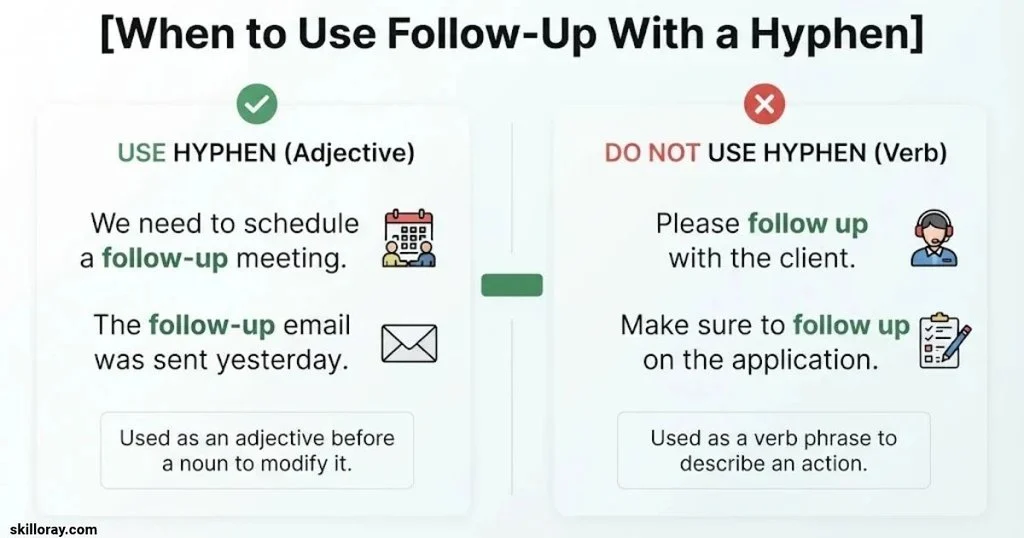
Use follow-up as a noun or adjective. The hyphen connects the two words when they work together to express one idea.
Follow-Up as a Noun
As a noun, follow-up means an additional action, conversation, message, or meeting that happens after an earlier event.
For example, after a job interview, you might contact the recruiter to thank them and ask about the next steps. That communication is a follow-up.
Here are some examples:
- I sent a follow-up after the job interview.
- The doctor scheduled a follow-up for next month.
- We need a follow-up to discuss the customer’s concerns.
- Her follow-up helped resolve the problem.
- The manager requested a follow-up after the presentation.
In each sentence, follow-up names an additional action or event.
Follow-Up as an Adjective
Use follow-up as an adjective when it describes a noun. It usually refers to something that happens after an earlier conversation, meeting, or activity.
Examples:
- I received a follow-up email from the recruiter.
- The doctor recommended a follow-up appointment.
- We arranged a follow-up meeting with the client.
- She prepared a follow-up report after the presentation.
- The company sent a follow-up message to its customers.
Some common combinations include:
- Follow-up email
- Follow-up meeting
- Follow-up appointment
- Follow-up question
- Follow-up call
- Follow-up report
- Follow-up interview
The hyphen makes it clear that the two words work together to describe the noun that follows.
When to Use Follow Up Without a Hyphen
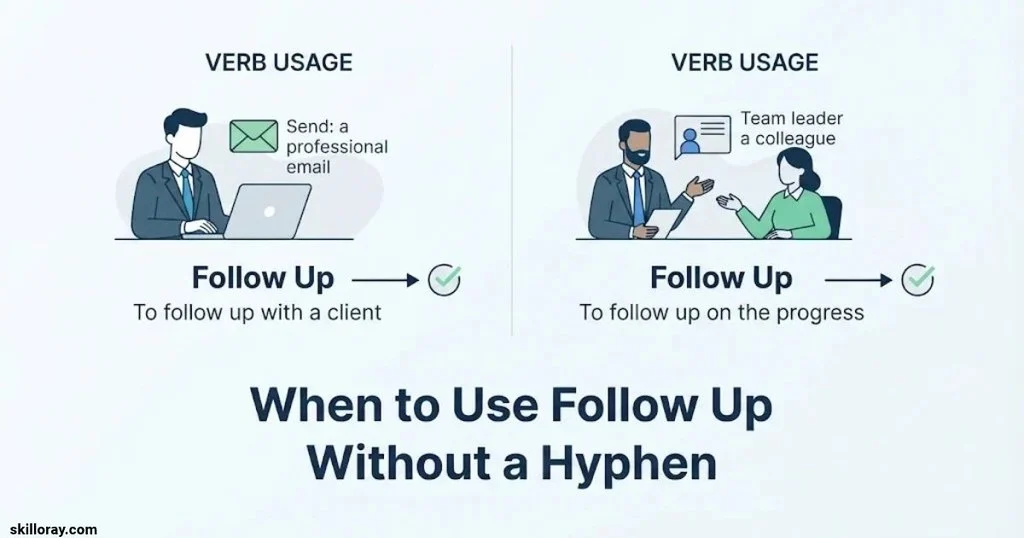
Use follow up as a verb when describing the action of contacting someone again, checking on a situation, or taking the next step.
For example, after sending a job application, you might follow up with the hiring manager to ask whether there is an update.
More examples:
- I’ll follow up with the customer tomorrow.
- She plans to follow up after the interview.
- Please follow up on your application next week.
- The manager asked me to follow up with the supplier.
- We should follow up on the complaint before Friday.
- He forgot to follow up about the payment.
In these sentences, follow up describes an action rather than naming an event or describing a noun.
Can You Separate the Words in Follow Up?
Yes. Follow up is a separable phrasal verb, which means an object can sometimes come between the two words.
For example:
- I’ll follow up the application tomorrow.
- I’ll follow the application up tomorrow.
- I’ll follow it up tomorrow.
All three sentences use follow up as a verb. Notice that when the object is a pronoun, such as it, it goes between follow and up.
This is an important difference between the verb and the hyphenated noun or adjective.
Follow Up With vs. Follow Up On
Both expressions are correct, but they usually emphasize different things.
Follow up with commonly identifies the person or organization you contact again.
Examples:
- I’ll follow up with the hiring manager.
- She followed up with the customer about the order.
- Please follow up with the supplier this afternoon.
Follow up on usually identifies the subject, request, or issue that needs further attention.
Examples:
- I need to follow up on my job application.
- The team will follow up on the customer’s complaint.
- We should follow up on the changes discussed yesterday.
You can also use both expressions together:
I’ll follow up with the hiring manager on my application next week.
Here, with the hiring manager identifies the person being contacted, while on my application explains the reason for the contact.
Follow-Up or Follow Up in an Email?
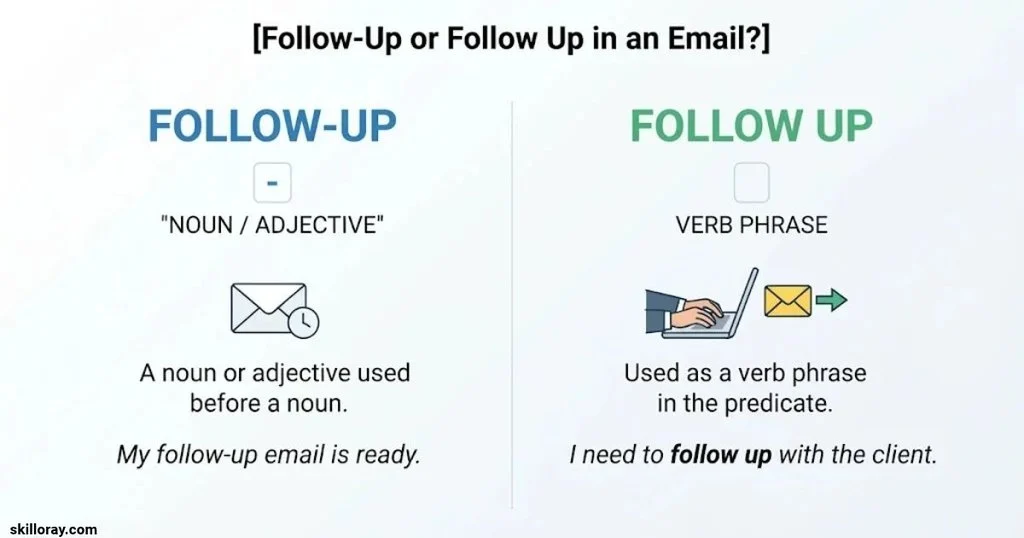
Both forms are common in professional emails. Choose the spelling according to how you use the phrase.
Use follow-up when naming an email or describing a message:
- Subject: Follow-Up on Our Recent Meeting
- Subject: Follow-Up Regarding Your Application
- Subject: Quick Follow-Up About the Proposal
Use follow up when describing the action of contacting someone again:
- I’ll follow up with you later this week.
- I wanted to follow up on my previous email.
- Our team will follow up once we review your request.
Here’s how both forms can appear naturally in the same email:
Subject: Follow-Up on the Project Proposal
Hello Sarah,
I wanted to follow up on the proposal I sent last Thursday. Have you had a chance to review it?
I’ll be happy to answer any questions or provide additional information.
Best regards,
Alex
The subject line uses follow-up as a noun, while the email body uses follow up as a verb.
Is It Followup, Follow-Up, or Follow Up?
You may encounter three different spellings, but they are not equally preferred in standard writing.
| Spelling | Usage |
| Follow-up | Standard noun and adjective form |
| Follow up | Standard verb form |
| Followup | Closed form; generally less preferred in standard edited writing |
For most professional and academic writing, use follow-up as a noun or adjective and follow up as a verb.
For example:
- Correct: I sent a follow-up email.
- Correct: I’ll follow up tomorrow.
- Generally less preferred: I sent a followup email.
Following this distinction keeps your writing clear and consistent.
Common Follow-Up and Follow Up Mistakes
These examples show some common spelling errors and how to correct them.
| Incorrect | Correct | Why? |
| I will follow-up tomorrow. | I will follow up tomorrow. | The phrase is a verb. |
| I sent a follow up email. | I sent a follow-up email. | It describes the email. |
| Please send me a follow up. | Please send me a follow-up. | It is used as a noun. |
| She will follow-up with the client. | She will follow up with the client. | It describes an action. |
| We scheduled a follow up meeting. | We scheduled a follow-up meeting. | It describes the meeting. |
The most common mistake is adding a hyphen when follow up functions as a verb.
Frequently Asked Questions
Is follow-up one word or two?
Follow-up is written with a hyphen when used as a noun or adjective. Follow up is written as two separate words when used as a verb. The closed form followup is generally less preferred in standard writing.
Is follow-up grammatically correct?
Yes. Follow-up is grammatically correct as a noun and adjective.
Examples:
- I received a follow-up email.
- We scheduled a follow-up meeting.
Is follow up a phrasal verb?
Yes. Follow up is a phrasal verb that means to take additional action, contact someone again, or check on something.
Example: “I’ll follow up with the manager tomorrow.”
Should I write follow-up email or follow up email?
Write follow-up email. The phrase describes the type of email, so the hyphenated adjective form is appropriate.
Is it follow up with or follow up on?
Both are correct. Use follow up with when identifying the person you contact again and follow up on when identifying the subject or issue that needs attention. You can also use both in one sentence.
What is the past tense of follow up?
The past tense is followed up.
Examples:
- I followed up with the customer yesterday.
- She followed up on the application last week.
- We followed up after the meeting.
Is follow-up formal or informal?
Both follow-up and follow up are appropriate in formal and informal writing. You can use them in business emails, reports, academic work, and everyday conversations.
Final Thoughts
The difference between follow-up and follow up comes down to grammar. Use the hyphenated form when you’re naming an additional action or describing something, such as a follow-up email. Use the two-word form when someone performs the action, such as when you follow up with a customer.
Once you recognize If the phrase is a noun, adjective, or verb, choosing the correct spelling becomes much easier.

I am Olivia Brown, a professional English editor and grammar writer who believes that great writing begins with a strong foundation in grammar. I have spent years creating educational resources that help students and professionals improve their writing, avoid common errors, and communicate more effectively. I strive to provide clear explanations and practical examples that make grammar easy to understand and apply.
Books: English Grammar Essentials and Modern Writing Success
 Daniel Carter
 James Walker