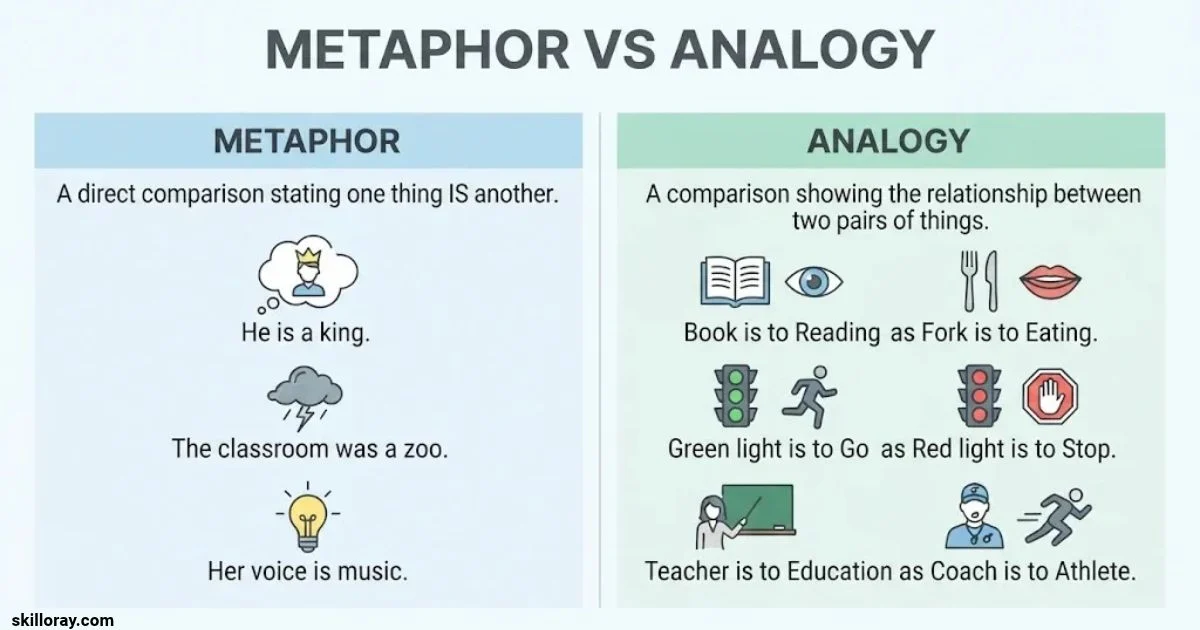
Metaphors and analogies are two powerful ways to make ideas easier to understand, but they don’t work in exactly the same way. You may have come across both in books, conversations, or everyday writing without realizing the difference. I find these comparisons interesting because a small change in wording can completely change how a message is understood.
A metaphor describes something by saying it is something else, while an analogy explains an idea by showing how two things are alike. If you’ve ever wondered whether a metaphor and an analogy mean the same thing, you’re not alone. Understanding the difference can make your writing clearer and more expressive.
In this guide, you’ll learn what metaphor and analogy mean, how they differ, and how to recognize them through simple examples. I’ll also explain when to use each one so you can choose the right comparison and communicate your ideas with confidence.
Metaphor vs Analogy: Quick Answer
The main difference between a metaphor and an analogy is their purpose.
- Metaphor: Makes a figurative comparison to express an idea or create a vivid image.
- Analogy: Explains a similarity or relationship between two things to make an idea easier to understand.
| Feature | Metaphor | Analogy |
| Main purpose | Create an image or express meaning | Explain an idea through comparison |
| Structure | Often direct and figurative | Often explains several similarities |
| Common use | Poetry, stories, speeches, everyday language | Teaching, explanations, reasoning |
| Example | Time is money. | Managing time is like managing money because both require careful planning. |
A metaphor can be part of an analogy, but the two terms are not interchangeable. The length of a comparison doesn’t determine whether it’s a metaphor or an analogy. Its purpose and structure matter more.
What Is a Metaphor?
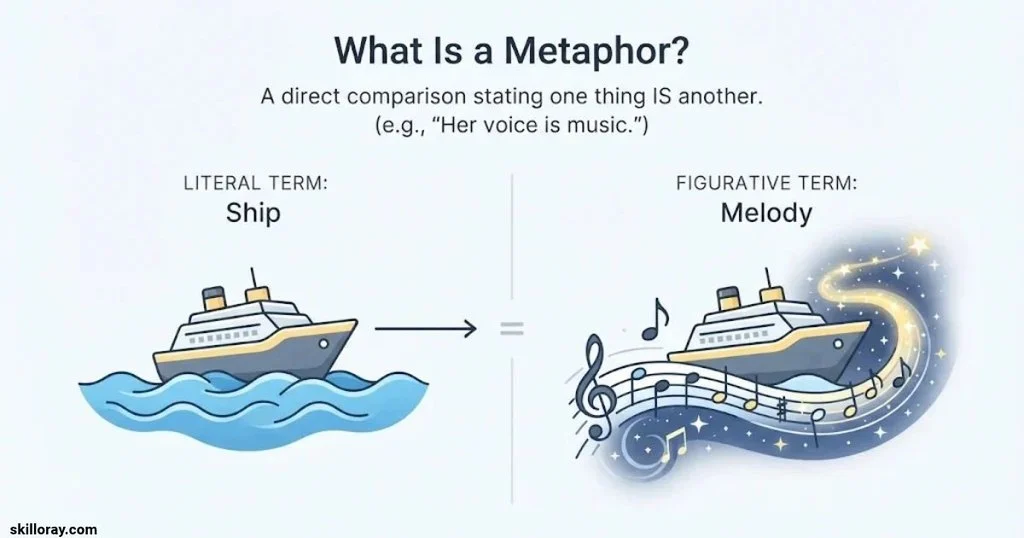
A metaphor is a figure of speech that describes one thing as another to suggest a similarity between them. The two things aren’t literally the same. Instead, the comparison helps communicate an idea, feeling, or quality in a more memorable way.
For example:
Life is a journey.
Life isn’t an actual road trip. The metaphor compares life to a journey because both involve different stages, unexpected challenges, and destinations.
Metaphors are useful because they let writers express complicated feelings or ideas through familiar images. Instead of explaining everything directly, a writer can choose a comparison that helps readers picture the meaning.
Examples of Metaphors
Here are some common metaphors and what they communicate:
| Metaphor | Meaning |
| Time is money. | Time is valuable and should be used wisely. |
| He has a heart of stone. | He seems emotionally cold or unkind. |
| The classroom was a zoo. | The classroom was noisy and chaotic. |
| Her words were sunshine. | Her words brought comfort or happiness. |
| Knowledge is power. | Having knowledge can give someone an advantage. |
| The world is a stage. | People take on different roles throughout life. |
These statements aren’t meant to be understood literally. Their comparisons help readers understand the intended meaning.
What Is an Extended Metaphor?
An extended metaphor is a metaphor that continues across several sentences, a paragraph, or even an entire poem or story.
For example:
Life is a journey. Some roads are smooth, while others are full of obstacles. We sometimes take wrong turns, meet unexpected travelers, and discover new paths along the way.
The comparison between life and a journey continues throughout the passage. Each detail develops the original image.
An extended metaphor is useful when a writer wants to explore an idea in depth rather than make a single comparison.
When Should You Use a Metaphor?
Use a metaphor when you want your writing to feel more expressive, emotional, or memorable.
Metaphors work especially well in:
- Creative writing: They make descriptions more vivid.
- Poetry: They express feelings through imagery.
- Speeches: They help audiences remember important messages.
- Storytelling: They add depth to characters and situations.
- Everyday conversation: They make ordinary explanations more interesting.
For example, instead of writing, “She felt nervous before the presentation,” you could say:
Her stomach was a knot of nerves.
The metaphor gives readers a stronger picture of her anxiety.
What Is an Analogy?
An analogy is a comparison between two different things that share a relevant similarity or relationship. Its purpose is to explain something unfamiliar by connecting it to something readers already understand.
Consider this example:
Learning a language is like building a house. You need a strong foundation of basic vocabulary and grammar before you can develop more advanced skills.
The comparison makes the learning process easier to understand. Just as a house needs a foundation before additional rooms can be built, language learners need basic knowledge before moving on to more difficult concepts.
An analogy can explain how something works, show a relationship, or support an argument. It is useful in both everyday communication and more formal discussions.
Examples of Analogies
1. Learning fractions is like sharing a pizza
Imagine dividing a pizza among four friends. Each person receives one of four equal pieces. This makes the idea of fractions easier to picture because each slice represents part of a whole.
2. A teacher is like a guide
A teacher helps students understand unfamiliar subjects and find their way through difficult lessons. Like a guide, a teacher provides direction, but students still need to make progress themselves.
3. Managing money is like maintaining a garden
A garden needs regular attention to grow. In the same way, savings need planning and consistent care. Unnecessary expenses are like weeds that can slow down financial progress.
4. Building trust is like building a house
A strong house needs a stable foundation. Similarly, a trusting relationship depends on honesty, respect, and consistency. Without these qualities, the relationship can become unstable.
5. Learning an instrument is like learning a sport
Both require regular practice, patience, and gradual improvement. A beginner doesn’t become an expert overnight. Progress comes from learning basic techniques and correcting mistakes over time.
When Should You Use an Analogy?
An analogy is especially helpful when an explanation feels too complicated or abstract.
You can use analogies in:
- Education: Explain difficult subjects through familiar situations.
- Science: Introduce complex processes using simpler comparisons.
- Business: Make strategies and systems easier to understand.
- Arguments: Show how two situations share a relevant relationship.
- Everyday conversations: Help someone understand an unfamiliar idea.
For example, explaining how a computer’s temporary memory works may be difficult for a beginner. Comparing it to a desk where information is kept while someone works can provide a useful starting point.
However, an analogy is not a perfect description. A computer and a desk are different things, just as human memory and computer memory work differently. A good analogy highlights the relevant similarity without pretending everything is identical.
Metaphor vs Analogy: Key Differences
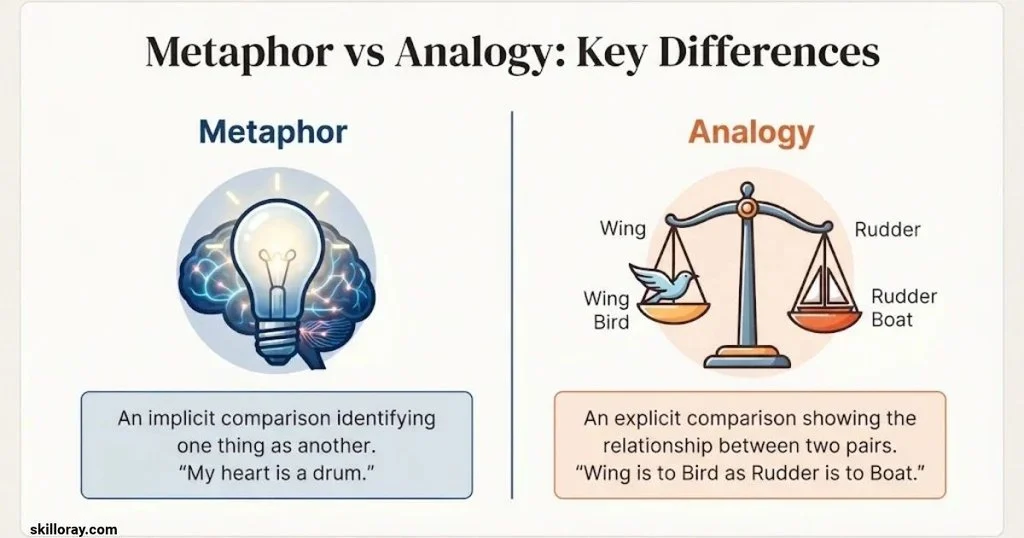
Both devices use comparisons, but they communicate ideas in different ways.
Purpose of the Comparison
A metaphor creates a figurative image.
Example:
Her voice is music.
This doesn’t mean her voice literally produces music. It suggests that her voice sounds pleasant or beautiful.
An analogy explains why two things are similar.
Example:
Her voice is like music because its rhythm and tone create a pleasant listening experience.
The analogy develops the comparison by explaining the shared qualities.
How the Comparison Works
A metaphor often presents a direct comparison without explaining every detail.
For example:
The city is a jungle.
This suggests that the city is crowded, competitive, or difficult to navigate.
An analogy makes the connection clearer:
Living in a busy city can be like surviving in a jungle because people must compete for space, deal with unexpected problems, and find their way through crowded surroundings.
The second example explains the similarities rather than leaving the reader to interpret the image alone.
Where Each One Is Used
Metaphors are common in poetry, fiction, songs, speeches, and everyday conversation. They make language more expressive.
Analogies are often used in education, explanations, discussions, and arguments. They help people understand relationships between unfamiliar and familiar things.
These uses can overlap. A metaphor can appear in an explanation, and an analogy can be used in creative writing.
Can a Metaphor Be an Analogy?
Yes. A metaphor can form the starting point of an analogy, but the two terms describe different aspects of the comparison.
Consider this example:
Metaphor:
The brain is a command center.
This describes the brain as a command center to suggest that it coordinates many activities.
Analogy:
The brain is like a command center because it receives information, processes signals, and coordinates responses throughout the body. A command center also receives information and helps coordinate different operations.
The analogy develops the original comparison by explaining the similarities.
Another example:
Metaphor:
Knowledge is a key.
Analogy:
Knowledge is like a key because it can open opportunities that would otherwise remain out of reach.
The metaphor creates a memorable image. The analogy explains what the image represents.
Metaphor vs Analogy vs Simile
A simile is another type of comparison. It usually uses the words like or as to show that two things share a quality.
Although metaphors, analogies, and similes are related, they have different structures.
| Figure of Speech | Definition | Example |
| Metaphor | Describes one thing as another | Her voice is music. |
| Simile | Compares two things using like or as | Her voice is like music. |
| Analogy | Develops a comparison to explain a similarity | Her voice is like music because its rhythm and tone make it pleasant to hear. |
Here is another example:
- Metaphor: My brother is a rock.
- Simile: My brother is like a rock.
- Analogy: My brother is like a rock because he stays strong and supports our family during difficult times.
A metaphor makes a direct figurative comparison. A simile makes an explicit comparison using like or as. An analogy explains the relationship between the things being compared.
Common Mistakes When Using Metaphors and Analogies
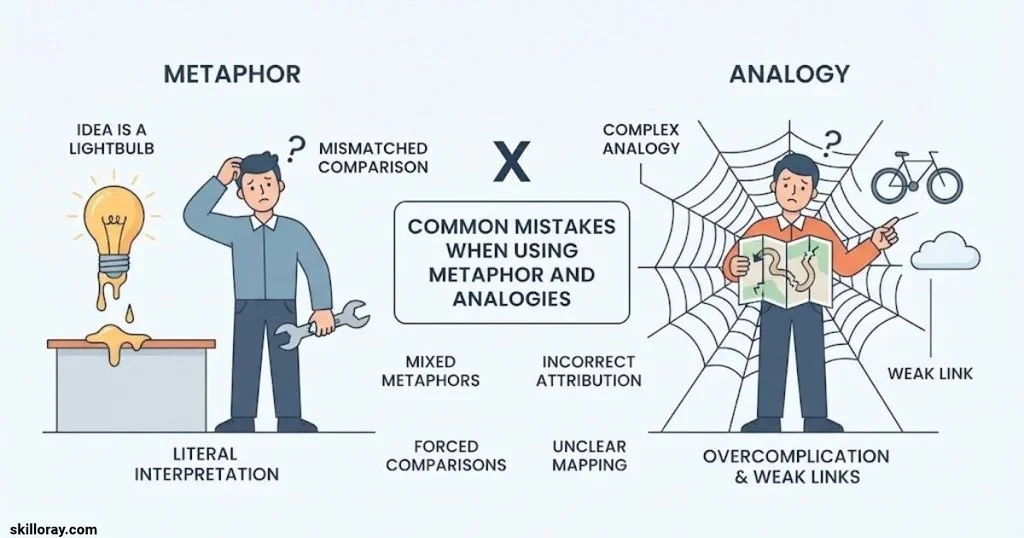
Because both devices involve comparisons, it’s easy to confuse them. These mistakes can also make writing less clear.
Assuming Every Comparison Is a Metaphor
Not every comparison is a metaphor. An analogy can explain a relationship between two systems or situations without using a direct figurative statement.
For example, comparing the human heart to a mechanical pump to explain how both move fluid develops an analogy. Saying “The heart is a pump” is a metaphorical description.
Thinking Analogies Must Be Long
An analogy doesn’t have to contain several sentences. A short comparison can still be an analogy if it explains a relevant similarity.
The important question is whether the comparison helps explain a relationship, not how many words it contains.
Using Misleading Analogies
An analogy can make an explanation easier, but it can also cause confusion when the similarities are exaggerated.
For example, comparing the brain to a computer can help explain information processing. However, human thinking, emotions, and memory are much more complex than computer operations.
A useful analogy should explain a specific point without suggesting that the two things are identical.
Confusing Metaphors With Similes
Metaphors and similes both create comparisons, but their wording differs.
- Metaphor: The classroom was a zoo.
- Simile: The classroom was like a zoo.
The first describes the classroom as a zoo figuratively. The second makes the comparison using the word like.
Frequently Asked Questions
Is a metaphor the same as an analogy?
No. Both use comparisons, but a metaphor describes one thing as another to create an image or express an idea. An analogy explains a similarity or relationship to make something easier to understand.
What is the main difference between metaphor and analogy?
The main difference is their purpose. A metaphor creates a figurative comparison, while an analogy develops a comparison to explain how two things are similar.
Can an analogy contain a metaphor?
Yes. A metaphor can form part of an analogy. For example, “The brain is a command center” is a metaphor. Explaining how the brain and a command center both coordinate activities develops that comparison into an analogy.
What is an example of a metaphor and an analogy?
A metaphor is “Time is money.” It suggests that time is valuable.
An analogy is “Managing time is like managing money because both require planning and careful decisions.” It explains the similarity between the two activities.
Is an analogy a figure of speech?
An analogy is a comparison used to explain a relationship between two things. It is commonly used as a rhetorical and explanatory device. It can involve figures of speech such as metaphors and similes, but it is broader than either one.
What is the difference between an analogy and a simile?
A simile compares two things using like or as. For example, “He is as brave as a lion.” An analogy develops a comparison to explain why two things are similar or how their relationships work.
Why do writers use metaphors and analogies?
Writers use metaphors to make descriptions more expressive and memorable. They use analogies to explain unfamiliar ideas, clarify relationships, and make complicated subjects easier to understand.
Final Thoughts
Metaphors and analogies both make comparisons, but they do different jobs. A metaphor creates an image by describing one thing as another, while an analogy explains a similarity between two things.
Remember the difference: “Life is a journey” is a metaphor. Explaining how life’s challenges resemble the different stages of a journey develops that idea into an analogy.
Use metaphors when you want to make your writing more expressive. Choose analogies when you want readers to understand an idea through a familiar comparison.

I am Daniel Carter, a grammar enthusiast and language educator with over 10 years of experience helping students and professionals improve their English writing and communication skills. I enjoy simplifying complex grammar rules into easy-to-understand lessons that anyone can follow. My goal is to help learners write with confidence, avoid common mistakes, and develop strong communication skills for academic and professional success. I regularly create practical grammar guides, writing tips, and language resources that make learning both enjoyable and effective.
Books: Mastering English Grammar and The Complete Guide to Better Writing
 Olivia Brown
 James Walker