Have you ever paused while writing because you weren’t sure how to make iris plural? You’re not alone. Some English words have unusual plural forms, and iris can leave even confident writers wondering which spelling is correct.
I want to make this grammar question simple for you. Whether you’re writing about the colorful flowers in a garden or the colored part of the human eye, understanding the plural of iris will help you communicate clearly and avoid common mistakes.
In this guide, you’ll learn the correct plural forms of iris, what they mean, and how to use them in everyday sentences. I’ll also share practical examples so you can choose the right form with confidence.
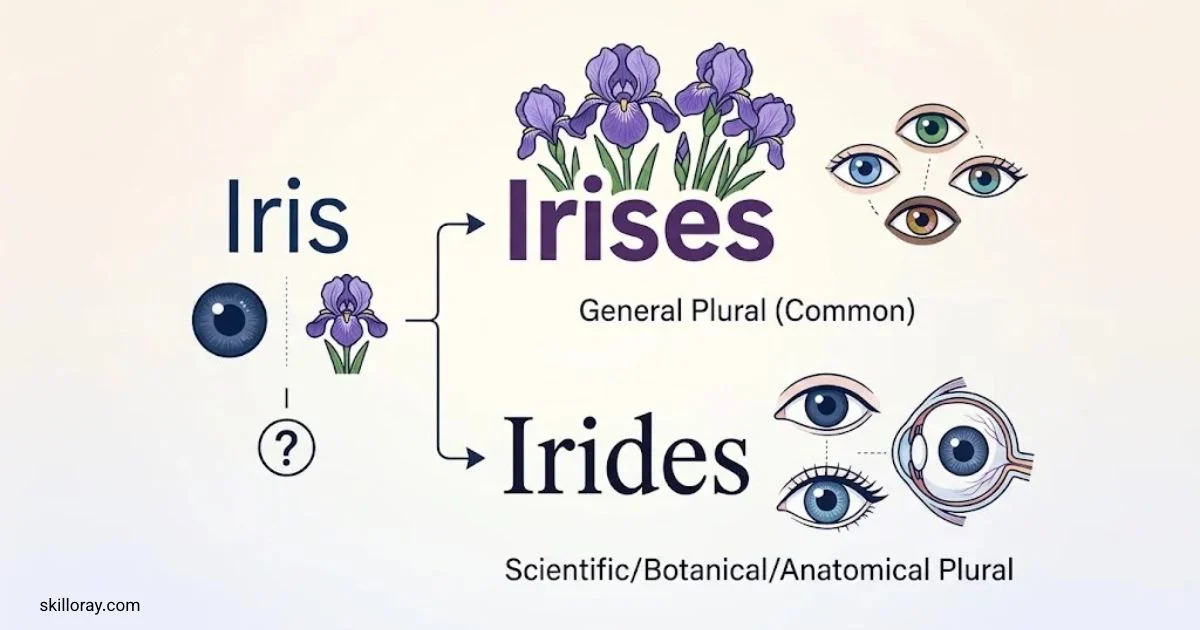
Iris vs. Irises vs. Irides
The correct form depends on whether you’re describing one thing or several.
| Word | Usage | Example |
| Iris | Singular | A purple iris grew beside the fence. |
| Irises | Standard plural | The garden is full of irises. |
| Irides | Less common alternative plural | The specialist examined the bird’s irides. |
Most writers should choose irises. Dictionaries recognize irides as an alternative, particularly for the colored parts of the eye and certain other meanings of iris. It is less common in everyday English. <Cite refs={[“turn446097search1″,”turn446097search5”]}/>
Examples of Irises in a Sentence
Here are a few examples showing how to use the plural naturally:
- The garden was filled with purple and yellow irises.
- My mother planted several irises along the walkway.
- The doctor examined both irises during the eye examination.
- The photograph captured the intricate patterns in the person’s irises.
- The camera’s irises control the amount of light entering the optical system.
An iris can refer to a flowering plant, the colored ring around the pupil, or an adjustable optical mechanism. The plural irises works for these common meanings.
Common Mistake: Iris’s or Irises?
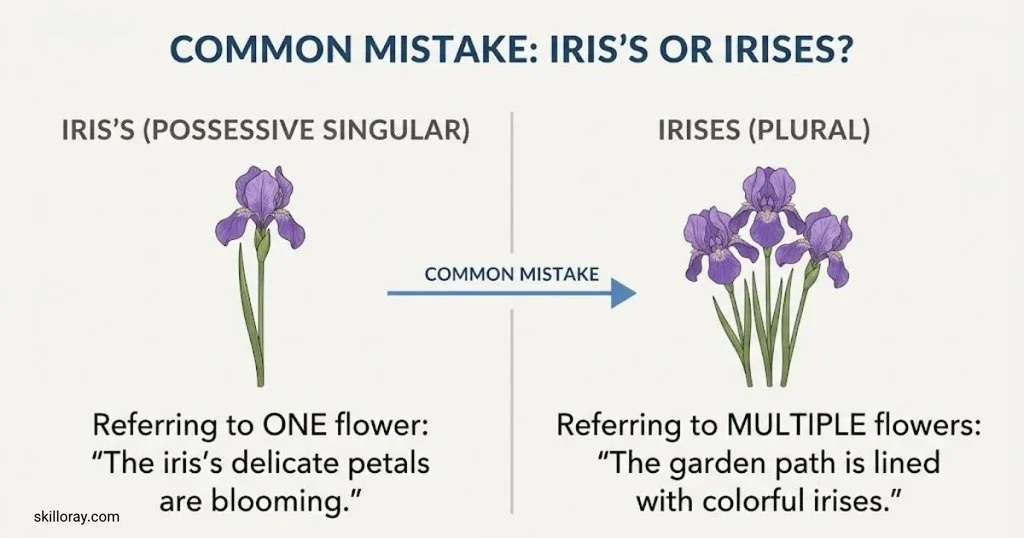
Irises is the plural, while iris’s is generally a possessive form referring to something belonging to one iris or to a person named Iris.
Compare these examples:
- Plural: The irises need more sunlight.
- Possessive: The iris’s petals were damaged by the frost.
Don’t add an apostrophe just because you’re referring to more than one flower. For ordinary plurals, use irises.
Frequently Asked Questions
What is the plural of iris flower?
The plural is irises. For example, “The florist arranged white irises in a vase.”
Is irides a correct plural of iris?
Yes. Irides is a recognized alternative plural, although irises is the more familiar choice for general writing. <Cite refs={[“turn446097search1″,”turn446097search5”]}/>
What is the plural of iris when referring to eyes?
The usual plural is irises. For example, “The doctor examined the patient’s irises.”
Why does iris become irises?
English commonly adds -es to nouns ending in -s to form the plural. That’s why the standard plural is irises.
Final Answer
The plural of iris is irises in standard everyday English. Use it for flowers, eyes, and optical mechanisms. Irides is also correct in certain contexts, but irises is the safest choice for most writing.

I am Olivia Brown, a professional English editor and grammar writer who believes that great writing begins with a strong foundation in grammar. I have spent years creating educational resources that help students and professionals improve their writing, avoid common errors, and communicate more effectively. I strive to provide clear explanations and practical examples that make grammar easy to understand and apply.
Books: English Grammar Essentials and Modern Writing Success
 Daniel Carter
 James Walker