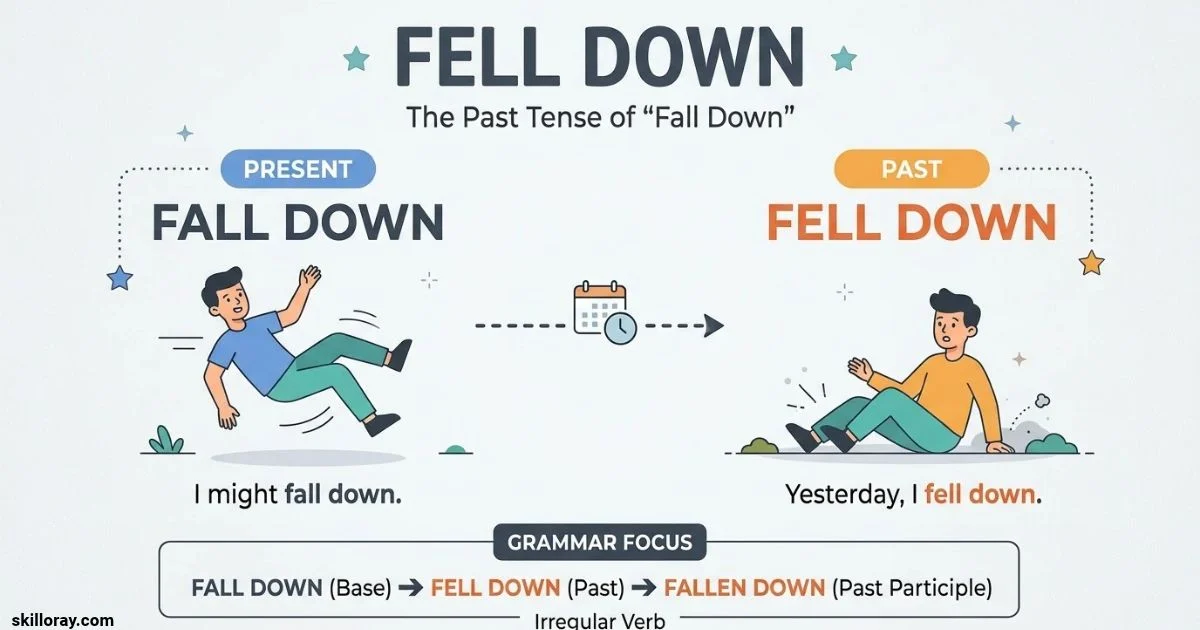
The phrase “fall down” is commonly used when someone loses their balance and drops to the ground. But what happens when you want to describe this action in the past? Choosing the correct verb form can make your sentences clearer and more natural.
The past tense of “fall down” is “fell down,” not “falled down.”If you want to use this phrase correctly in everyday English, understanding its verb forms is essential.
In this guide, I’ll explain the past tense of fall down, its meaning, and how to use it in different sentences. You’ll also discover practical examples, common mistakes, and the difference between “fall down” and “fell down” to help you improve your English grammar.
What Is the Past Tense of Fall Down?
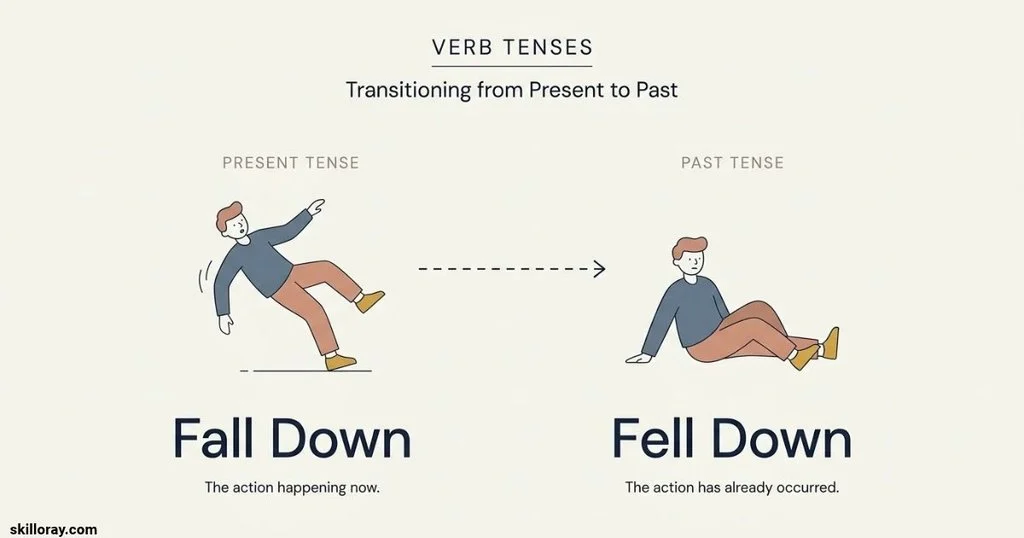
Fell down is the simple past tense of fall down. It describes an action that happened and finished in the past.
Here are some natural examples:
- I fell down while running in the park.
- She fell down on the wet floor.
- The little boy fell down while chasing his dog.
- A branch fell down during the storm.
- He fell down the stairs but wasn’t seriously hurt.
You can use fell down for people, animals, and objects that drop to the ground from their normal positions.
One important point: fall down doesn’t fit every situation involving downward movement. For example, prices fall, and a book can fall off a shelf. The choice depends on what is happening.
What Are the Three Forms of Fall?
The verb fall has three main forms. Each one has a different grammatical use.
| Verb Form | Word | Example |
| V1 – Base form | Fall | Be careful not to fall. |
| V2 – Simple past | Fell | I fell down yesterday. |
| V3 – Past participle | Fallen | I have fallen down before. |
The present participle is falling.
Remember this pattern:
Fall → Fell → Fallen
Don’t add -ed to make the past tense. Falled is not the standard English form.
Fell Down vs. Fallen Down: What’s the Difference?
Both expressions describe a fall, but they have different grammatical uses.
- Fell down is the simple past tense.
- Fallen down is the past participle, usually used with a helping verb such as has, have, or had.
Compare these sentences:
| Fell Down | Fallen Down |
| He fell down yesterday. | He has fallen down before. |
| The tree fell down last night. | The tree had fallen down before we arrived. |
| She fell down while running. | She has fallen down several times. |
| The old wall fell down during the storm. | Part of the wall has fallen down. |
Use fell down when you’re simply describing a completed past action.
Use fallen down when forming a perfect tense:
- She has fallen down.
- They have fallen down.
- He had fallen down before anyone noticed.
A useful rule is to remember that has, have, and had take the past participle fallen, not fell.
Fall Down vs. Fall Off vs. Fall Over
These three expressions are related, but they describe slightly different situations. Choosing the right one makes your sentence clearer.
| Expression | Meaning | Example |
| Fall down | Drop to the ground from a normal position | He fell down on the pavement. |
| Fall off | Become separated from or drop off a surface or object | She fell off her bicycle. |
| Fall over | Lose balance or topple onto the ground or another surface | The chair fell over. |
Fall Down
Use fall down when someone or something drops to the ground.
Examples:
- The child fell down while playing.
- I slipped and fell down on the sidewalk.
- The old building fell down after the earthquake.
Fall Off
Use fall off when someone or something drops from a surface, vehicle, or object.
Examples:
- He fell off his bicycle.
- My phone fell off the table.
- A leaf fell off the tree.
Fall Over
Use fall over when someone loses balance or an object topples.
Examples:
- The little girl fell over while learning to skate.
- The strong wind made the fence fall over.
- I almost fell over when I tripped on the rug.
These expressions can overlap in some situations. For example, someone who loses balance may fall over and fall down. The important difference is the emphasis: fall off highlights the surface or object someone leaves, while fall over often highlights losing balance or toppling.
How to Use Fell Down in Negative Sentences and Questions
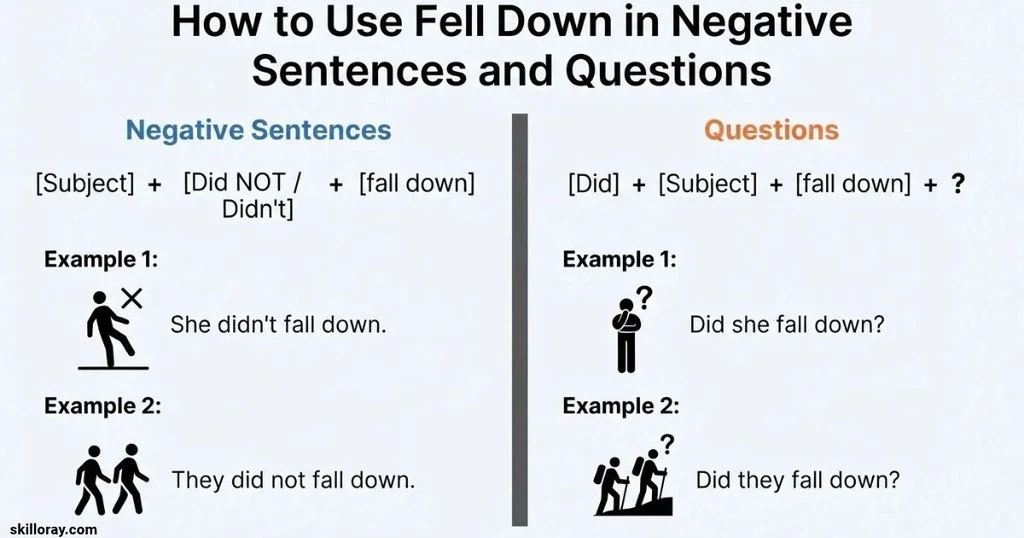
When you make a negative sentence or question using did, the main verb returns to its base form: fall.
This is a common mistake for English learners.
Negative Sentences
Use did not or didn’t followed by fall down.
Examples:
- I didn’t fall down during the race.
- She didn’t fall down the stairs.
- The tree did not fall down during the storm.
Remember:
- Correct: He didn’t fall down.
- Incorrect: He didn’t fell down.
The helping verb did already shows the past tense, so you don’t need to change fall to fell.
Questions
Use did before the subject, followed by the base form fall down.
Examples:
- Did you fall down yesterday?
- Did the child fall down while playing?
- Why did she fall down?
- Did anyone fall down during the match?
Don’t write Did you fell down? The correct question is Did you fall down?
Examples of Fell Down in Sentences
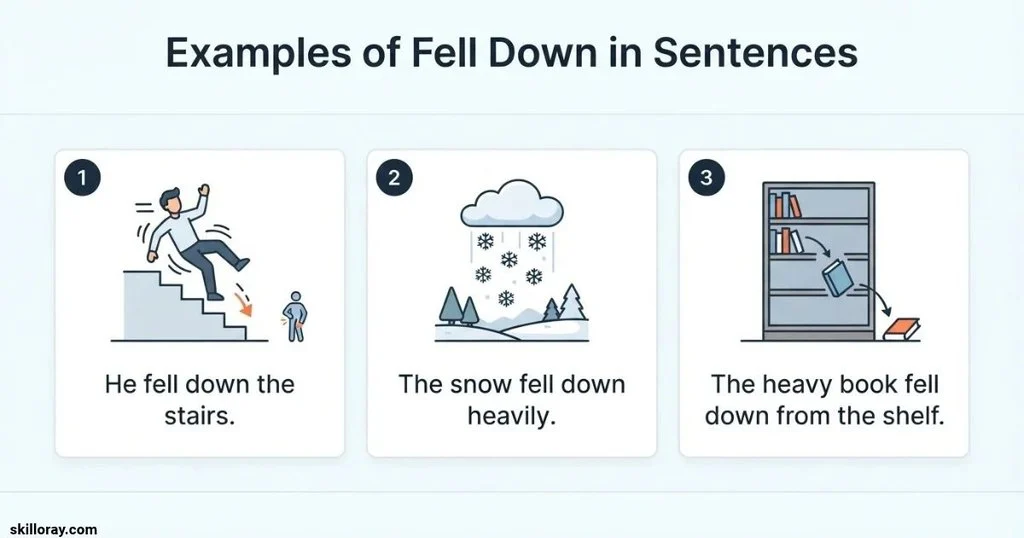
Here are more examples showing how people use fell down in everyday situations.
- I fell down while walking on the icy road.
- The boy fell down but quickly got back up.
- She fell down while playing basketball with her friends.
- The old tree fell down during last night’s storm.
- My little brother fell down while running through the garden.
- The sign fell down after several days of heavy rain.
- He fell down the stairs when he missed a step.
- The glass fell down and broke into small pieces.
Each sentence describes a past event. The form fell tells the reader that the action has already happened.
Common Mistakes When Using Fall Down
Some mistakes happen because English learners apply regular verb rules to irregular verbs. Others happen when they use the past participle without a helping verb.
| Incorrect Sentence | Correct Sentence |
| I falled down yesterday. | I fell down yesterday. |
| She has fell down. | She has fallen down. |
| He didn’t fell down. | He didn’t fall down. |
| Did you fell down? | Did you fall down? |
| They had fell down. | They had fallen down. |
Keep these three rules in mind:
- Use fell for the simple past.
- Use fallen after has, have, or had.
- Use fall after did or didn’t.
These patterns also apply when you use fall without down.
Quick Practice: Choose the Correct Form
Test what you’ve learned by choosing the correct word in each sentence.
1. The little boy ___ down while playing yesterday.
- A. Fall
- B. Fell
- C. Fallen
2. She has ___ down twice this week.
- A. Fell
- B. Fallen
- C. Falling
3. Did he ___ down during the game?
- A. Fell
- B. Fallen
- C. Fall
Answers:
- B — Fell
- B — Fallen
- C — Fall
The key is to look at the helping verb and the time of the action before choosing a form.
Frequently Asked Questions
What is the past tense of fall down?
The past tense of fall down is fell down. For example: “I fell down while playing basketball yesterday.”
Is it fell down or fallen down?
Both are correct, but they have different grammatical uses. Fell down is the simple past, while fallen down is the past participle.
- She fell down yesterday.
- She has fallen down before.
Is falled down correct?
No. Falled down is not correct in standard English. Fall is an irregular verb, and its simple past form is fell. The correct expression is fell down.
What is the past participle of fall down?
The past participle is fallen down. Use it with helping verbs such as has, have, and had.
For example: “The old tree has fallen down.”
What is the difference between fall and fell?
Fall is the base form, while fell is the simple past form.
- Present: I sometimes fall when I lose my balance.
- Past: I fell yesterday while walking.
How do you use fall down in a negative sentence?
Use didn’t or did not followed by fall down.
Example: “I didn’t fall down during the match.”
Don’t use fell after didn’t because the helping verb already indicates the past tense.
What is the past tense of fall off?
The past tense of fall off is fell off.
Example: “He fell off his bicycle while riding to school.”
What is the past tense of fall over?
The past tense of fall over is fell over.
Example: “The chair fell over when someone bumped into it.”
Final Thoughts
The past tense of fall down is fell down, not falled down. The complete verb pattern is fall, fell, fallen.
Remember to use fell for a completed action in the past, fallen after has, have, or had, and the base form fall after did or didn’t. Once you learn these patterns, you’ll be able to use the phrase confidently in everyday English.

I am Olivia Brown, a professional English editor and grammar writer who believes that great writing begins with a strong foundation in grammar. I have spent years creating educational resources that help students and professionals improve their writing, avoid common errors, and communicate more effectively. I strive to provide clear explanations and practical examples that make grammar easy to understand and apply.
Books: English Grammar Essentials and Modern Writing Success
 Daniel Carter
 James Walker