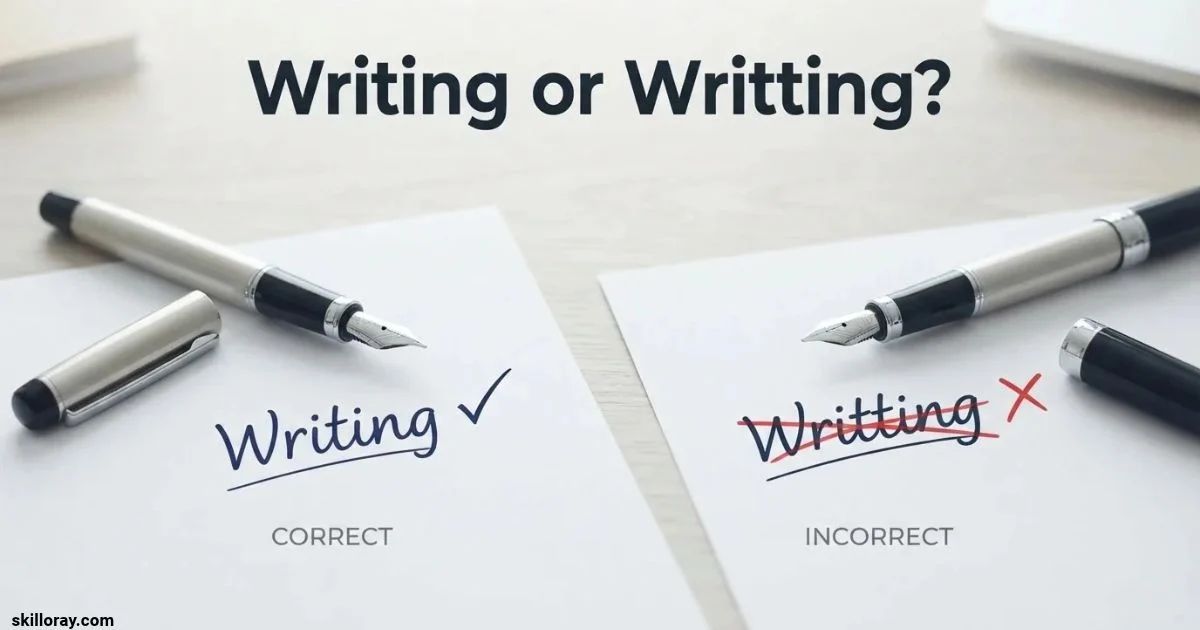
Have you ever stopped while typing and wondered whether writing or writting is the correct spelling? You’re not alone! These two words look almost identical, so it’s easy to get confused. I’ll help you understand the difference and choose the correct spelling with confidence.
The correct spelling is “writing,” with only one T. “Writting” is a common misspelling and isn’t accepted in standard English. If you want to know why one T is correct and how to remember the spelling, you’re in the right place!
In this guide, you’ll learn the meaning of writing, understand why writting is incorrect, and explore simple examples that show how to use the word in everyday sentences. By the end, you’ll never have to second-guess this spelling again.
Is It Writing or Writting?
The correct spelling is writing, with one t. The spelling writting, with two t’s, is incorrect.
Here are a few examples of the correct form:
- I’m writing down the address before I forget it.
- Maya enjoys writing short stories in her free time.
- The teacher asked us to write a paragraph about our hometown.
- He is writing an email to his manager.
- Her writing has become clearer with practice.
Whether you’re creating a story, taking notes, or sending a message, always use writing.
Why Is Writing Spelled With One T?
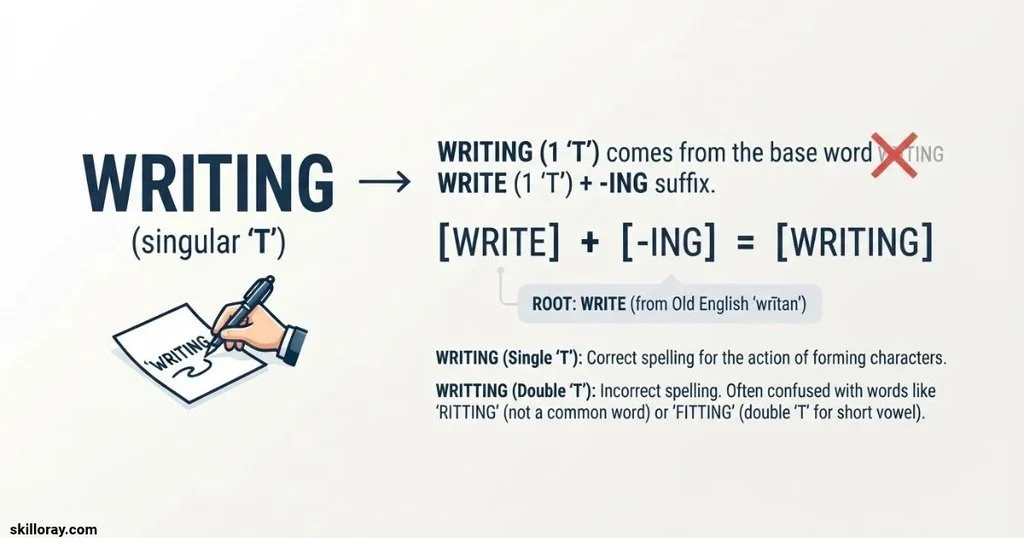
The spelling of writing follows a common English rule for verbs ending in a silent e.
When you add -ing to a verb that ends in a silent e, you usually remove the final e first. You then add the suffix without doubling the last consonant.
The change looks like this:
Write − e + ing = Writing
That’s why writing has one t, not two.
Compare it with these verbs:
| Base Verb | Correct -ing Form | Spelling Rule |
| Write | Writing | Remove silent e |
| Make | Making | Remove silent e |
| Drive | Driving | Remove silent e |
| Take | Taking | Remove silent e |
| Run | Running | Double final consonant |
| Sit | Sitting | Double final consonant |
| Swim | Swimming | Double final consonant |
| Stop | Stopping | Double final consonant |
The difference explains why running and sitting have double consonants, while writing does not.
Writing in Sentences
Writing is the -ing form of write. It can describe an action in progress or an activity someone enjoys doing.
Here are some everyday examples:
- I’m writing a shopping list for tomorrow.
- She was writing in her journal when the phone rang.
- My brother spends his weekends writing song reviews.
- The students are writing their answers in notebooks.
- He enjoys writing about his travel experiences.
- I started writing a new article this morning.
You can also use writing after certain verbs and prepositions:
- She enjoys writing poems.
- He is interested in writing fiction.
- They finished writing the report.
- I’m thinking about writing a book.
In each sentence, the spelling remains the same: writing.
What Does Writing Mean?
The word writing has two common uses. It can refer to the activity of creating written content or to the written work itself.
1. Writing as a verb form
When used as a verb form, writing describes the action of putting words together to communicate an idea.
Examples:
- She is writing a letter to her grandmother.
- I’m writing an article about English spelling.
- They were writing notes during the lesson.
2. Writing as a noun
As a noun, writing can refer to the skill, style, or finished work of putting words into written form.
Examples:
- His writing is clear and easy to follow.
- Good writing takes practice.
- Her academic writing has improved.
- I couldn’t read the writing on the old document.
Although the word has different uses, its spelling never changes to writting.
Writing vs. Righting: What’s the Difference?
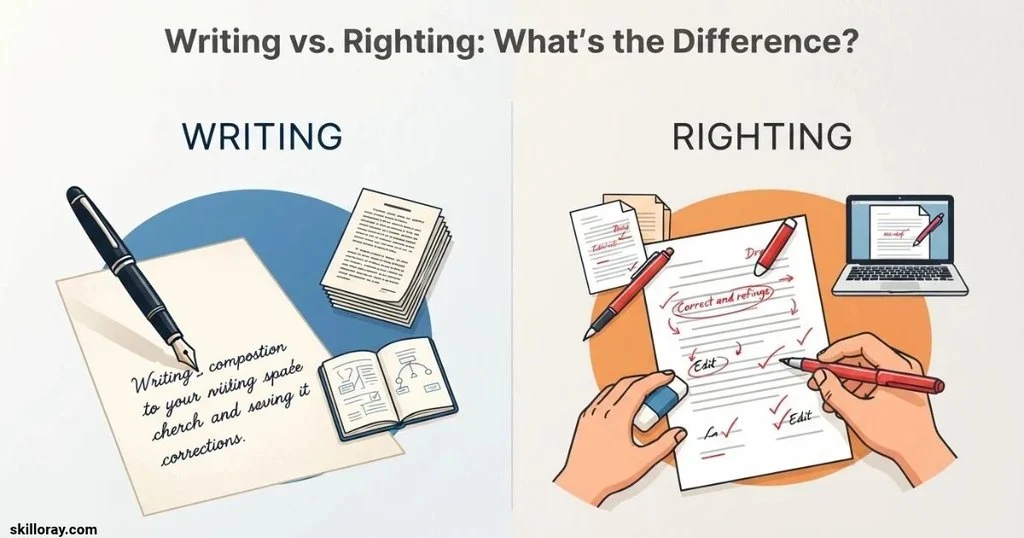
Writing and righting sound the same in standard English, but they have different meanings.
Writing comes from the verb write. It means creating words, sentences, or other written material.
Example: She is writing a message to her friend.
Righting comes from the verb right. It means correcting something wrong or putting something back into an upright position.
Example: The company is righting its previous mistakes.
Both words are correctly spelled, but they aren’t interchangeable. Also, writting is not an alternative spelling of writing or righting.
What Are the Different Forms of Write?
Write is an irregular verb, so its past forms don’t follow the usual pattern of simply adding -ed.
Here are its main forms:
| Verb Form | Correct Word | Example |
| Base form | Write | I write in my journal. |
| Third-person singular | Writes | She writes short stories. |
| Simple past | Wrote | He wrote a letter yesterday. |
| Past participle | Written | I have written three articles. |
| -ing form | Writing | They are writing a report. |
Pay attention to the difference between wrote and written. Use wrote for the simple past and written with helping verbs such as has, have, and had.
For example:
- I wrote an email yesterday.
- I have written an email today.
- I am writing another email now.
Common Spelling Mistakes to Avoid
Some English verbs double their final consonants before adding -ing, while others don’t. Mixing up these patterns can lead to spelling mistakes.
Here are a few examples:
| Incorrect | Correct |
| Writting | Writing |
| Makeing | Making |
| Takeing | Taking |
| Runing | Running |
| Sittting | Sitting |
| Swimmming | Swimming |
A simple way to check writing is to return to its base form, write. Remove the silent e, add -ing, and keep the final t single.
Frequently Asked Questions
Is writing or writting correct?
Writing is correct. It is the -ing form of write. Writting is a spelling mistake and isn’t accepted in standard English.
Why does writing have only one t?
The base verb write ends in a silent e. You remove that letter before adding -ing, which gives you writing. The final t doesn’t need to be doubled.
Is writting ever correct in English?
No. Writting is not a standard English spelling. Use writing in everyday communication, academic work, and professional documents.
What is the difference between write and writing?
Write is the base form of the verb, while writing is its -ing form. For example, “I write every day” describes a regular activity, while “I am writing now” describes an action in progress.
What is the past tense of write?
The simple past tense of write is wrote. For example, “She wrote a letter yesterday.” The past participle is written, as in “She has written a letter.”
Is writing a noun or a verb?
Writing can be both. It is a verb form in “He is writing a report” and a noun in “His writing is excellent.”
Final Thoughts
If you’re unsure whether to write writing or writting, go back to the original verb: write. Remove its silent e and add -ing to get writing.
Remember, the correct spelling has just one t. If you’re preparing an assignment, sending an email, or working on a story, writing is the form to use.

I am Daniel Carter, a grammar enthusiast and language educator with over 10 years of experience helping students and professionals improve their English writing and communication skills. I enjoy simplifying complex grammar rules into easy-to-understand lessons that anyone can follow. My goal is to help learners write with confidence, avoid common mistakes, and develop strong communication skills for academic and professional success. I regularly create practical grammar guides, writing tips, and language resources that make learning both enjoyable and effective.
Books: Mastering English Grammar and The Complete Guide to Better Writing
 Olivia Brown
 James Walker