Hair is one of those everyday words that can be surprisingly confusing when it comes to grammar. You probably use it regularly, but have you ever wondered whether the plural of hair is hair or hairs? The answer depends on how you’re using the word.
In most situations, the plural of hair is hair because it is an uncountable noun when referring to the hair on someone’s head or body. However, hairs is also correct when you’re talking about individual strands. Understanding this small difference can help you avoid common grammar mistakes.
In this guide, I’ll explain when to use hair and hairs, with simple examples that make the difference easy to remember. Whether you’re improving your English or checking a sentence, you’ll find everything you need to use the word correctly.
What Is the Plural of Hair?
Hairs is the plural form of hair when you refer to individual strands. However, hair usually remains unchanged when you describe all the hair on someone’s head or body.
Here are the three forms you’ll commonly encounter:
| Form | Meaning | Example |
| Hair | Hair as a whole; uncountable noun | Her hair is naturally curly. |
| A hair | One individual strand | I found a hair on my jacket. |
| Hairs | Two or more individual strands | Three hairs were stuck to the brush. |
So, if someone asks, “What is the plural of hair?” the answer is hairs when individual strands are being counted. In general descriptions, however, hair is the natural choice.
Hair vs. Hairs: What’s the Difference?
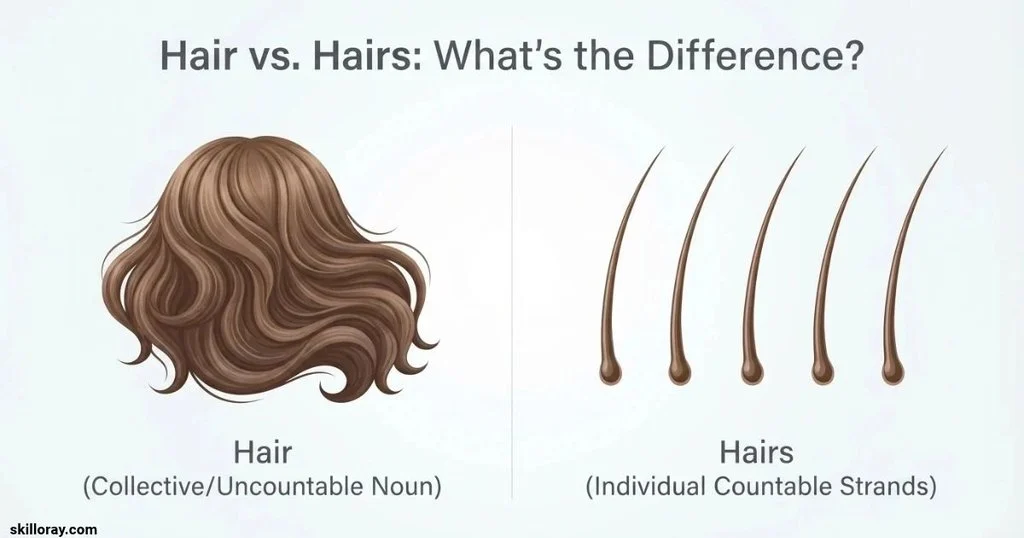
The difference between hair and hairs depends on how you’re using the word.
Hair is generally uncountable when it refers to the hair covering someone’s head or body. You use it to describe its length, color, texture, or overall appearance.
Examples:
- She has thick, curly hair.
- My hair gets tangled in windy weather.
- His hair is turning gray.
- The dog has short, soft hair.
- I need to wash my hair tonight.
Hairs is countable because it refers to separate strands that you can identify or count.
Examples:
- I found two hairs on my black shirt.
- A few gray hairs appeared near his temples.
- The lint roller picked up several dog hairs.
- She noticed three loose hairs on the pillow.
- There were white hairs around the cat’s face.
Oxford and Cambridge both recognize these countable and uncountable uses of hair. The dictionaries also give examples of individual strands being described as a hair or hairs.
What About “A Hair” and “A Strand of Hair”?
Both expressions refer to one individual strand, but they fit slightly different situations.
A hair is the shorter, everyday expression. It’s useful when you notice or identify one strand.
- There’s a hair in my soup.
- I found a hair on the bathroom floor.
- A hair was stuck to the back of his shirt.
A strand of hair makes the meaning more specific. It can sound more descriptive when you’re talking about one particular strand.
- A strand of hair fell across her face.
- He noticed a strand of hair caught in the zipper.
- She gently removed a strand of hair from the baby’s cheek.
You can also use strands of hair when referring to several strands without counting them individually.
For example: “Several strands of hair were caught in the comb.”
Is Hair Singular or Plural?
In everyday descriptions, hair is usually an uncountable noun. Uncountable nouns generally take singular verbs, which is why you say “My hair is” rather than “My hair are.”
Consider these examples:
| Correct sentence | Why it is correct |
| My hair is getting longer. | Hair is uncountable here. |
| Her hair looks healthy. | The sentence describes hair as a whole. |
| His hair was wet after the rain. | Hair takes the singular verb was. |
| The hairs are on the floor. | Hairs refers to multiple strands. |
| Two hairs were on my sleeve. | The plural noun takes were. |
The same rule applies to pronouns. When hair refers to someone’s hair as a whole, use it. When you’re talking about individual hairs, use they.
- Her hair looks nice. I love it.
- I found two hairs on my coat. They were difficult to remove.
Common Mistakes When Using Hair and Hairs
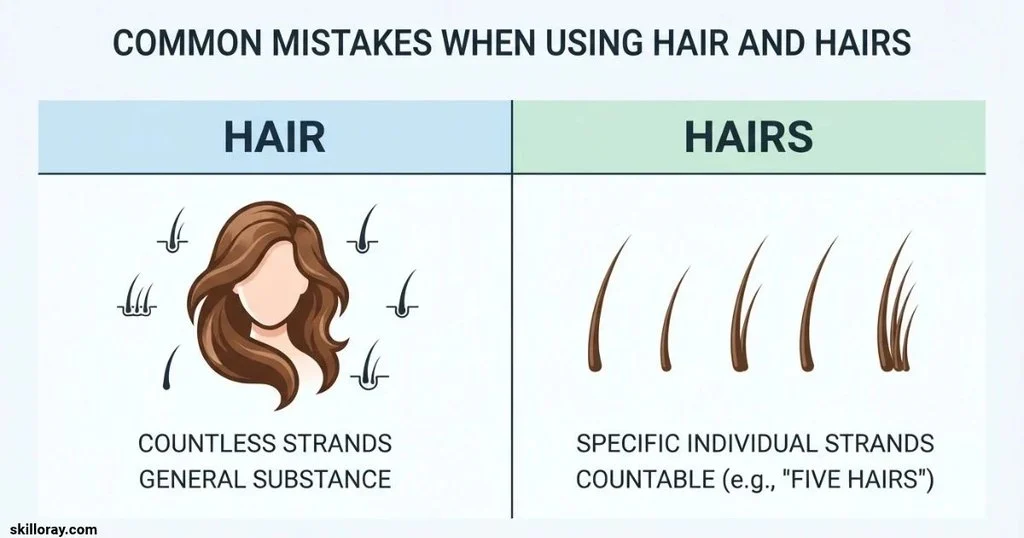
These mistakes often happen when writers treat hair as a regular countable noun in every situation.
| Incorrect | Correct |
| She has beautiful hairs. | She has beautiful hair. |
| My hair are black. | My hair is black. |
| I found three hair on my shirt. | I found three hairs on my shirt. |
| He has a long hairs. | He has long hair. |
| There is many hairs on the brush. | There are many hairs on the brush. |
Remember these two practical rules:
- Use hair with singular verbs when describing someone’s overall hair.
- Use hairs with plural verbs when counting individual strands.
Also, avoid using many directly with uncountable hair. Say “She has a lot of hair,” not “She has many hair.”
Frequently Asked Questions
What is the plural of hair?
The plural of hair is hairs when referring to two or more individual strands. When describing someone’s hair as a whole, the word usually remains hair.
Is hairs a correct word?
Yes, hairs is a correct plural noun. It refers to individual strands, as in “There are several hairs on the pillow.”
Is hair countable or uncountable?
Hair can be both countable and uncountable. It’s usually uncountable when referring to hair as a whole, but countable when referring to individual strands.
Should I say “my hair is” or “my hair are”?
Say “my hair is” because hair is normally uncountable when referring to the hair on your head. For example, “My hair is naturally dark.”
Can I say “a few hairs”?
Yes. A few hairs is correct when you mean a small number of individual strands. For example, “I noticed a few gray hairs near my forehead.”
What is the difference between hair and a strand of hair?
Hair can describe the overall mass of hair or an individual strand, depending on context. A strand of hair specifically means one individual piece.
Final Thoughts
Use hair when describing someone’s overall hair, such as its color, length, or texture. Use hairs when you’re counting separate strands. If you remember the difference between the whole and the individual strands, you’ll find it much easier to choose the correct form.

I am Olivia Brown, a professional English editor and grammar writer who believes that great writing begins with a strong foundation in grammar. I have spent years creating educational resources that help students and professionals improve their writing, avoid common errors, and communicate more effectively. I strive to provide clear explanations and practical examples that make grammar easy to understand and apply.
Books: English Grammar Essentials and Modern Writing Success
 Daniel Carter
 James Walker