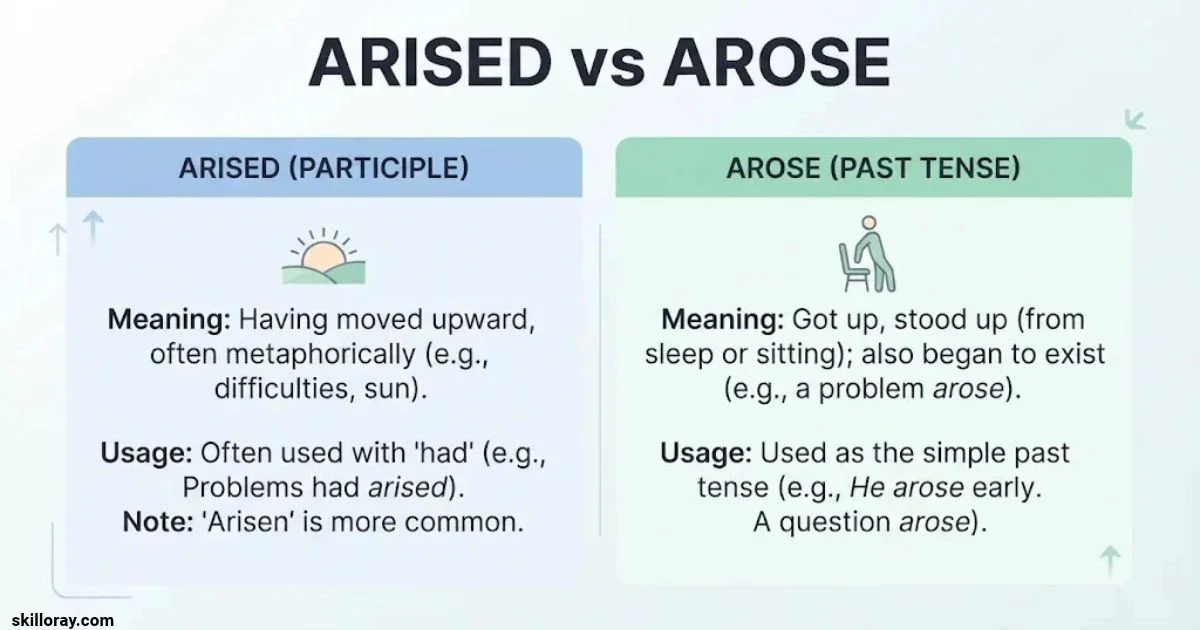
Have you ever paused while writing and wondered whether to use arised or arose? You’re not alone. These two forms look similar, but only one is accepted as the standard past tense of arise. Choosing the right word can make a noticeable difference in your writing.
Arose is the correct simple past tense of arise, while arised is a nonstandard form. If you want to write naturally and avoid this common grammar mistake, understanding the difference is easier than you might think.
In this guide, I’ll explain the difference between arised and arose, show you how to use arose in everyday sentences, and share practical examples to help you remember the correct form. By the end, you’ll know exactly which word to choose whenever you use the verb arise.
Arised vs Arose: Quick Answer
Use arose when describing something that happened or began in the past. Avoid arised in standard writing.
| Word | Correct? | Usage |
| Arise | Yes | Base form |
| Arose | Yes | Simple past tense |
| Arisen | Yes | Past participle |
| Arised | No | Nonstandard form |
Examples:
- Correct: A technical problem arose during the update.
- Incorrect: A technical problem arised during the update.
- Correct: Several questions have arisen since the announcement.
The easiest way to remember the correct forms is to learn them together: arise → arose → arisen.
Why Is Arose Correct Instead of Arised?
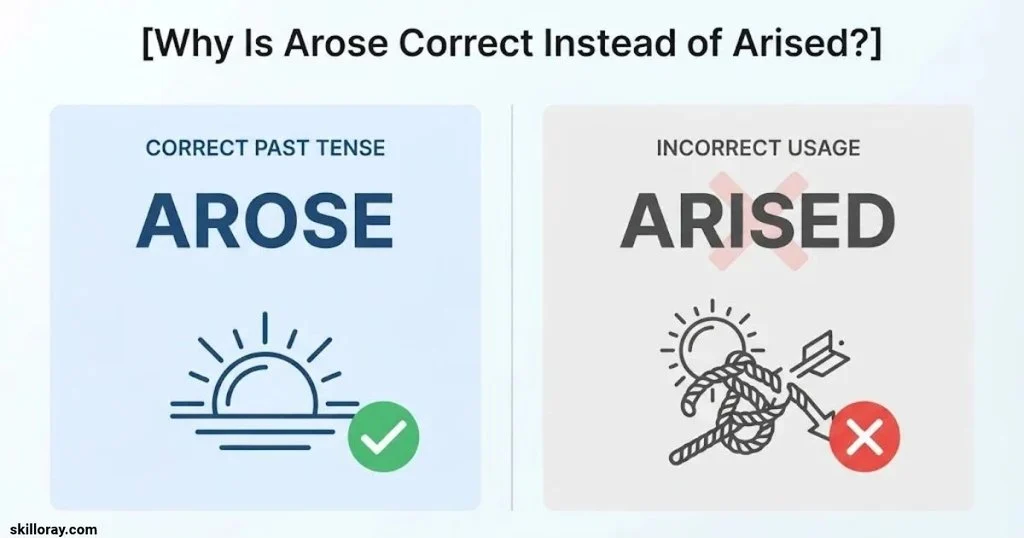
The confusion comes from treating arise like a regular verb. Most regular verbs form their past tense by adding -ed, as in work → worked or clean → cleaned. However, arise is an irregular verb, so its spelling changes.
Compare these irregular verbs:
| Base form | Simple past | Past participle |
| Arise | Arose | Arisen |
| Write | Wrote | Written |
| Speak | Spoke | Spoken |
| Drive | Drove | Driven |
| Break | Broke | Broken |
Just as you write wrote instead of writed, you write arose instead of arised.
What Are the Three Forms of Arise?
The verb arise has three main forms: arise, arose, and arisen. Each form has a different role in a sentence.
| Verb form | Word | Example |
| Base form | Arise | Problems can arise unexpectedly. |
| Third-person singular | Arises | A new question arises every week. |
| Present participle | Arising | New concerns are arising. |
| Simple past | Arose | A problem arose yesterday. |
| Past participle | Arisen | A problem has arisen. |
You can use arise in several situations. It often describes problems, questions, disagreements, opportunities, or other events that happen or come into existence.
For example:
- A disagreement arose from a misunderstanding.
- An opportunity arose when the company opened a new branch.
- Questions arose about the new attendance policy.
- A technical issue arose while we were updating the website.
In each sentence, something happened in the past, so arose is the appropriate form.
Arose vs Arisen: What’s the Difference?
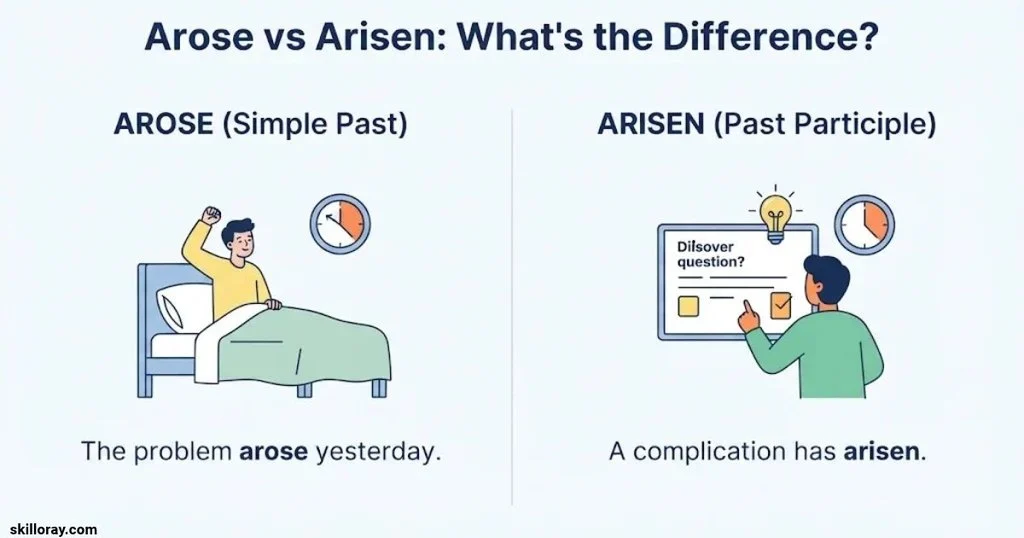
Although arose and arisen come from the same verb, they aren’t interchangeable.
Arose is the simple past tense. Use it to describe an event that happened in the past.
Arisen is the past participle. It usually appears with a helping verb such as has, have, or had.
Compare the sentences:
| Arose | Arisen |
| A problem arose yesterday. | A problem has arisen today. |
| An opportunity arose last year. | An opportunity has arisen recently. |
| Several questions arose during class. | Several questions have arisen since class. |
| A disagreement arose before the meeting. | A disagreement had arisen before the meeting. |
The difference is easier to remember when you look at the helping verbs:
- Simple past: A problem arose.
- Present perfect: A problem has arisen.
- Past perfect: A problem had arisen.
Is It Had Arised or Had Arisen?
Had arisen is correct. The past perfect tense uses had followed by the past participle, which is arisen.
Incorrect: Several issues had arised before the deadline.
Correct: Several issues had arisen before the deadline.
The same rule applies to has and have:
- Incorrect: A new problem has arised.
- Correct: A new problem has arisen.
- Incorrect: Many questions have arised.
- Correct: Many questions have arisen.
Arise vs Rise: What’s the Difference?

Arise and rise have related meanings, but they aren’t interchangeable in every sentence.
Arise often means to happen, occur, or come into existence. It’s commonly used with words such as problem, question, opportunity, and difficulty.
Rise usually means to move upward, increase, or get out of bed.
| Verb | Simple past | Past participle | Example |
| Arise | Arose | Arisen | A problem arose during the meeting. |
| Rise | Rose | Risen | The sun rose over the hills. |
More examples:
- A new issue arose during the discussion.
- The temperature rose overnight.
- Questions may arise when instructions aren’t clear.
- Food prices rose last month.
A simple way to remember the difference: problems arise, while temperatures and prices often rise.
Common Mistakes to Avoid
These are some common errors involving arise and its past forms.
| Incorrect | Correct |
| A problem arised yesterday. | A problem arose yesterday. |
| Several issues have arised. | Several issues have arisen. |
| A question has arose. | A question has arisen. |
| The sun arose at six. | The sun rose at six. |
The last example uses rose because it describes the sun appearing above the horizon. That’s the past tense of rise, not arise.
Frequently Asked Questions
Is arised a real word?
Arised is a nonstandard form that some writers may produce by adding -ed to arise. It isn’t the accepted standard past tense. Use arose instead.
Is arose the past tense of arise?
Yes. Arose is the simple past tense of arise. For example: “A disagreement arose during the discussion.”
Should I use arised or arose?
Use arose. It’s the correct simple past form of arise. For example, “An unexpected opportunity arose last week.”
Is it had arised or had arisen?
Had arisen is correct because arisen is the past participle of arise. The past perfect tense uses had followed by the past participle.
What is the past participle of arise?
The past participle is arisen. Use it with helping verbs such as has, have, and had.
What is the difference between arose and rose?
Arose is the past tense of arise, while rose is the past tense of rise. A problem arose during a meeting, but the sun rose in the morning.
Final Thoughts
When choosing between arised and arose, use arose for the simple past tense of arise. The word doesn’t follow the regular -ed pattern.
Keep the three forms together: arise → arose → arisen. Use arose for something that happened in the past and arisen after helping verbs such as has, have, and had. Once you learn this pattern, you’ll avoid one of the most common mistakes with this irregular verb.

I am James Walker, an English language specialist with extensive experience in grammar, editing, and academic writing. I enjoy helping students, bloggers, and professionals strengthen their writing by explaining grammar concepts in a clear and engaging way. My focus is on providing accurate, practical, and easy-to-follow guidance that helps learners communicate more effectively in everyday and professional situations.
Books: Perfect English Grammar Handbook and Advanced Writing Techniques
 Daniel Carter
 Olivia Brown