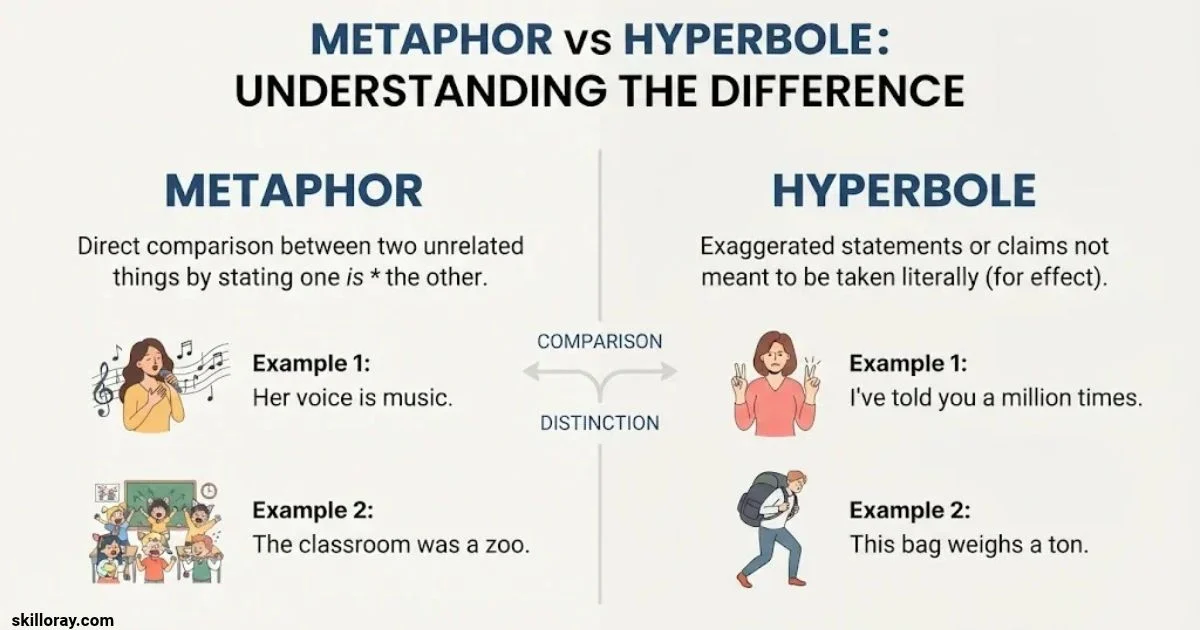
Have you ever described someone as having a heart of gold or said you were so hungry you could eat a horse? These expressions make everyday language more colorful, but they use different literary devices. Understanding metaphor vs hyperbole can help you recognize how writers make their words more powerful and interesting.
A metaphor compares two different things by suggesting they are alike, while hyperbole uses extreme exaggeration to emphasize an idea. Although both make language more expressive, they serve different purposes and create different effects.
In this guide, I’ll explain the difference between metaphor and hyperbole with simple definitions, clear examples, and practical explanations. Whether you’re a student, writer, or simply curious about English, you’ll discover how to identify and use both literary devices with confidence.
Metaphor vs Hyperbole: Quick Answer
The easiest way to distinguish these figures of speech is to look at how they communicate an idea.
- Metaphor: Makes a figurative comparison between two different things.
- Hyperbole: Uses deliberate exaggeration to emphasize a feeling, quality, or situation.
| Feature | Metaphor | Hyperbole |
| Main purpose | Create a comparison or image | Emphasize something through exaggeration |
| How it works | Describes one thing as another | Makes something sound more extreme |
| Literal meaning | Not usually intended literally | Not intended literally |
| Common uses | Poetry, stories, speeches, conversations | Humor, emotional expression, everyday speech |
| Example | My father is my rock. | My father can move mountains. |
Both are figures of speech, but a metaphor depends on comparison, whereas hyperbole depends on exaggeration.
What Is a Metaphor?
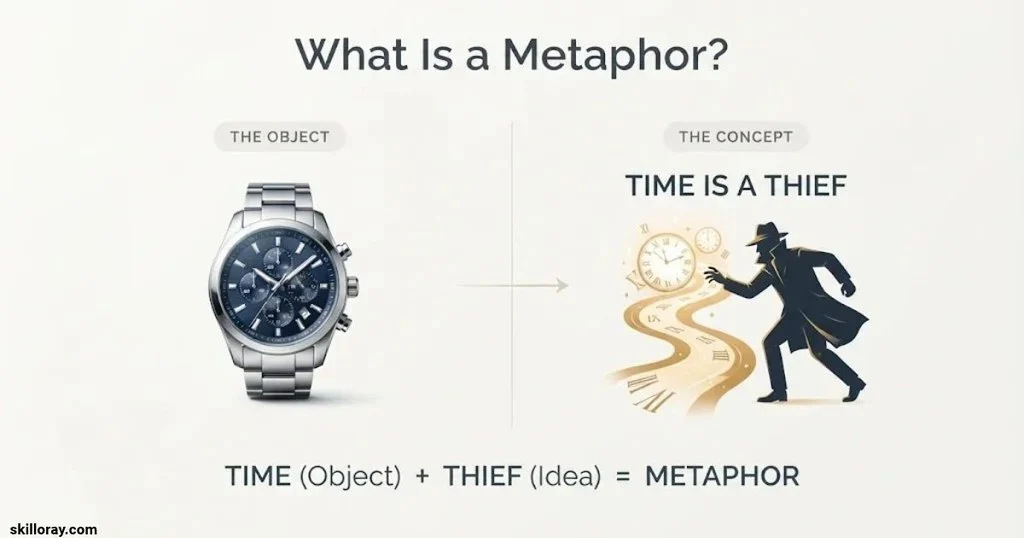
A metaphor is a figure of speech that describes one thing as another to suggest a shared quality or create a particular image. The comparison isn’t meant to be taken literally. Instead, it helps readers understand an idea through something familiar.
Consider this sentence:
The classroom was a zoo.
A classroom isn’t actually a zoo. The writer compares it to one to describe a noisy, crowded, or chaotic environment. Readers understand the intended meaning without needing a long explanation.
Metaphors can make ordinary descriptions more interesting. Instead of simply saying someone is kind, brave, or knowledgeable, a writer can use a comparison that gives the reader a stronger impression.
Examples of Metaphors
Here are some examples you’ll recognize in everyday language:
| Metaphor | What It Means |
| Time is money. | Time is valuable and shouldn’t be wasted. |
| She has a heart of gold. | She is kind and generous. |
| He is the backbone of the team. | He provides important support. |
| My brother is a walking encyclopedia. | He knows a great deal of information. |
| The office was a pressure cooker. | The workplace was stressful and tense. |
| Her words were a warm blanket. | Her words brought comfort. |
| Life is a roller coaster. | Life includes unexpected ups and downs. |
| The world is a stage. | People take on different roles throughout life. |
Notice that these expressions don’t simply describe something. They help readers picture a quality, feeling, or situation.
Common Types of Metaphors
Metaphors can appear in different forms. Three useful types are direct, implied, and extended metaphors.
1. Direct Metaphor
A direct metaphor clearly describes one thing as another.
Example:
My sister is a ray of sunshine.
The sentence compares the sister to sunshine to suggest that she brings happiness into people’s lives.
2. Implied Metaphor
An implied metaphor suggests a comparison without directly stating it.
Example:
The coach barked orders at the players.
The coach isn’t literally barking. The verb “barked” compares the coach’s way of speaking to a dog’s sharp, forceful sound.
3. Extended Metaphor
An extended metaphor develops the same comparison across several sentences or a longer passage.
Example:
Life is a journey. Some roads are easy to travel, while others are full of unexpected turns. We sometimes take the wrong path, meet helpful travelers, and discover new directions along the way.
The comparison between life and a journey continues throughout the passage. Each detail adds meaning to the original metaphor.
When Should You Use a Metaphor?
Metaphors are useful when a plain description doesn’t fully express what you want to say.
For example, imagine describing a student who feels overwhelmed before an important exam.
A simple sentence would be:
She felt very stressed about the exam.
A more expressive version would be:
A storm of worry was building inside her.
The second sentence gives readers a stronger image of her feelings.
Metaphors are especially useful in creative writing, poetry, speeches, storytelling, and everyday conversation. They help writers communicate emotions and ideas in a memorable way.
What Is Hyperbole?
Hyperbole is a figure of speech that uses deliberate exaggeration to emphasize something. It makes a statement sound more extreme than reality, and readers understand that the words aren’t meant literally.
For example:
I’ve been waiting forever!
The speaker hasn’t actually been waiting forever. They’re exaggerating to express frustration about a long wait.
You probably use hyperbole more often than you realize. People say things like “I’m starving,” “This bag weighs a ton,” and “I’ve got a million things to do” during ordinary conversations.
These statements make everyday experiences sound more dramatic, funny, or emotional.
Examples of Hyperbole
| Hyperbole | Intended Meaning |
| I’ve told you a million times. | I’ve repeated this many times. |
| This suitcase weighs a ton. | The suitcase is very heavy. |
| I’m so hungry I could eat a horse. | I’m extremely hungry. |
| She cried a river. | She cried a lot. |
| The queue was a mile long. | The queue was very long. |
| I have a mountain of homework. | I have a lot of homework. |
| It took me forever to finish this task. | The task took a long time. |
| He runs faster than the wind. | He runs extremely fast. |
The exact numbers and descriptions aren’t important. The exaggeration is what communicates the speaker’s feelings or emphasizes the situation.
Common Ways Hyperbole Is Used
Hyperbole doesn’t have a fixed set of formal grammatical categories. However, it often appears in a few recognizable ways.
1. Exaggerating Quantity
A speaker may use an unrealistic number to emphasize how much of something there is.
Example:
There were a million messages waiting in my inbox.
The speaker means there were many messages, not exactly one million.
2. Exaggerating Emotions
People often exaggerate when describing strong feelings.
Example:
I was so embarrassed I wanted the ground to swallow me.
The speaker isn’t literally expecting the ground to open. The statement emphasizes embarrassment.
3. Exaggerating Size or Weight
This type makes something sound much larger or heavier than it really is.
Example:
That shopping bag weighs a ton.
The bag might be heavy, but it doesn’t actually weigh a ton.
When Should You Use Hyperbole?
Use hyperbole when you want to make a statement more dramatic, humorous, or emotionally powerful.
Imagine a student who has several assignments due on the same day. Instead of saying:
I have a lot of homework.
The student might say:
I have enough homework to last a lifetime.
That exaggeration communicates frustration more strongly.
Hyperbole is common in casual conversations, comedy, advertising, storytelling, and poetry. In formal or factual writing, however, use it carefully. Readers may misunderstand an exaggerated statement if the context isn’t clear.
Metaphor vs Hyperbole: The Main Differences
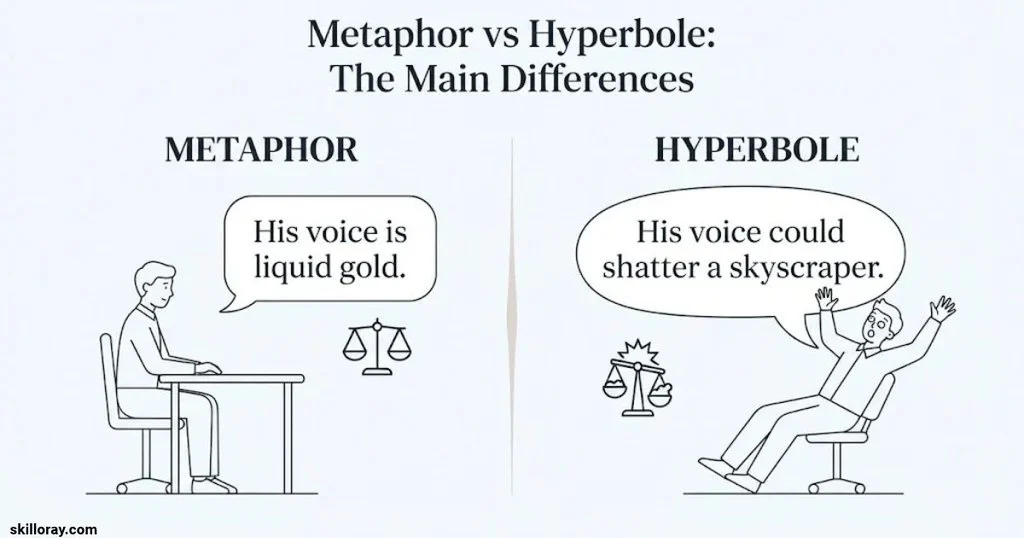
The two devices can sometimes appear in the same sentence, but their main functions remain different.
Comparison vs Exaggeration
A metaphor describes one thing through another.
My brother is a rock.
This comparison suggests that the brother is strong, reliable, or supportive.
A hyperbole makes a statement more extreme than reality.
My brother is strong enough to lift a mountain.
This exaggerates his strength to emphasize how powerful he is.
How Readers Understand Them
When readers encounter a metaphor, they look for the quality shared by the two things being compared.
For example:
Her mind is a library.
Readers understand that she has a great deal of knowledge, not that her head contains shelves of books.
With hyperbole, readers recognize that the statement has been intentionally exaggerated.
I’ve got a thousand things to do today.
The speaker probably has several tasks, but the exaggerated number makes the workload sound overwhelming.
What They Add to Writing
Metaphors create imagery and help readers understand ideas through comparisons. Hyperboles add emphasis and make experiences sound more intense.
A writer might describe a stressful workplace as “a pressure cooker.” That’s a metaphor.
The same writer might say, “The deadline was so stressful it nearly drove everyone such as wild.” That’s hyperbole if the statement deliberately exaggerates the effect of the deadline.
Can a Metaphor Also Be Hyperbole?
Yes. A sentence can use both devices at once. A metaphor creates the comparison, while hyperbole exaggerates its effect.
Consider this sentence:
His voice was thunder that shook the entire world.
There are two things happening:
- Metaphor: His voice is described as thunder to suggest that it was loud or powerful.
- Hyperbole: The claim that it shook the entire world exaggerates the effect of his voice.
Here’s another example:
My backpack is a mountain, and it weighs a thousand tons.
“My backpack is a mountain” is a metaphor because the bag is compared to a mountain. “It weighs a thousand tons” is hyperbole because the weight is deliberately exaggerated.
This overlap is important. A figure of speech doesn’t always belong to just one category. Look at the purpose of each part of the sentence rather than trying to assign one label to everything.
Metaphor vs Hyperbole vs Simile
A simile is another common figure of speech. It compares two different things using words such as like or as.
Although all three devices make language more expressive, their structures are different.
| Figure of Speech | How It Works | Example |
| Metaphor | Describes one thing as another | He is a lion in battle. |
| Hyperbole | Exaggerates something for emphasis | He is stronger than a thousand men. |
| Simile | Compares two things using like or as | He is as brave as a lion. |
Here’s another way to understand the difference:
- Metaphor: The office was a pressure cooker.
- Hyperbole: The office was so stressful it could drive a person such as wild.
- Simile: The office was like a pressure cooker.
A metaphor creates a direct figurative comparison. A hyperbole exaggerates the situation, while a simile makes an explicit comparison using like or as.
Common Mistakes When Using Metaphors and Hyperboles
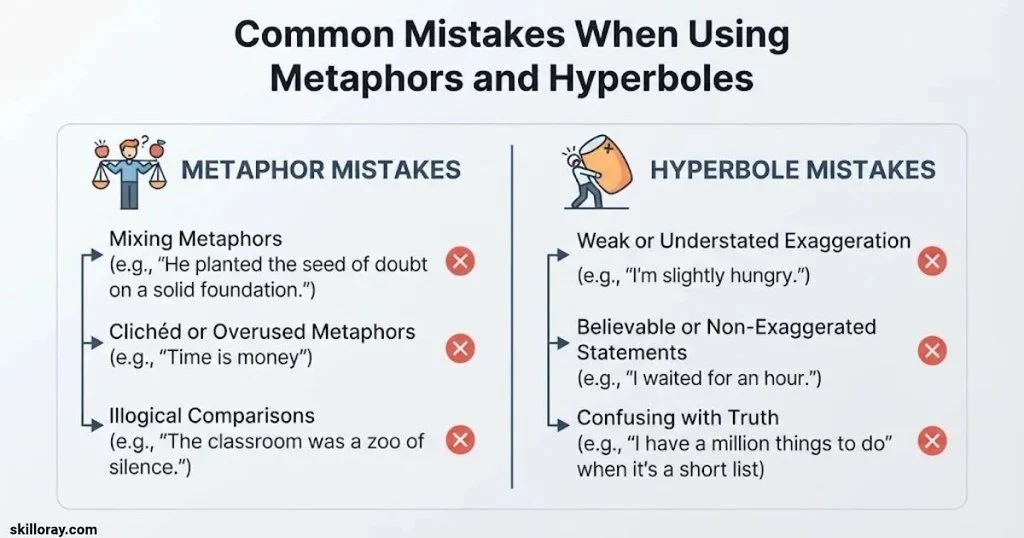
These figures of speech are easy to recognize once you understand their purpose. Still, a few common misunderstandings can cause confusion.
Assuming Every Exaggeration Is a Metaphor
A dramatic statement isn’t automatically a metaphor.
For example:
I’ve waited a thousand years for this appointment.
This is hyperbole because the speaker exaggerates the waiting time. There’s no comparison between two different things.
Assuming Every Comparison Is Hyperbole
A metaphor can make a comparison without exaggerating anything.
For example:
Her home is her safe harbor.
This compares her home to a harbor to suggest safety and comfort. The sentence doesn’t need an exaggerated claim to work as a metaphor.
Taking Hyperbole Literally
Hyperbole is not intended to communicate an exact fact.
If someone says, “I’m freezing to death,” they usually mean they’re extremely cold. Understanding the situation helps readers recognize the exaggeration.
Thinking a Sentence Can Only Have One Figure of Speech
A sentence can combine multiple devices.
For example:
Her smile was sunshine that could brighten a thousand dark days.
“Her smile was sunshine” is a metaphor. “Brighten a thousand dark days” adds hyperbole through exaggeration.
Recognizing both devices gives you a more accurate understanding of the sentence.
Overusing Figurative Language
Too many metaphors and exaggerated statements can make writing difficult to follow.
Compare these examples:
Overloaded:
The classroom was a jungle, the students were wild animals, their voices were explosions, and the teacher was fighting a thousand battles.
Clearer:
The classroom was a jungle, with students shouting and moving around in every direction.
The second version keeps the central metaphor but avoids piling on unnecessary comparisons.
Frequently Asked Questions
Is a metaphor the same as hyperbole?
No. A metaphor compares one thing to another to express a quality or idea. Hyperbole uses deliberate exaggeration to emphasize something. Both are figures of speech, but they have different purposes.
What is a simple example of metaphor vs hyperbole?
A metaphor is “My father is my rock.” It compares a father to a rock to show that he provides strength and support.
A hyperbole is “My father can move mountains.” It exaggerates his strength to make a point.
Can a metaphor be an exaggeration?
Yes. A metaphor can also exaggerate something, depending on how it’s used. For example, “Her voice was thunder that shook the entire city” compares her voice to thunder and exaggerates its effect.
Is hyperbole always a lie?
No. Hyperbole is a figure of speech, not necessarily an attempt to deceive someone. People use it to express strong feelings, create humor, or emphasize a point. The audience usually understands that the statement isn’t literal.
What is the difference between hyperbole and simile?
Hyperbole exaggerates something for emphasis, while a simile compares two things using like or as. For example, “I’ve waited forever” is hyperbole, while “She runs like the wind” is a simile.
Why do writers use metaphors and hyperboles?
Metaphors help writers create vivid images and express ideas through comparisons. Hyperboles make descriptions more dramatic, humorous, or emotionally powerful. Both can make ordinary language more memorable.
Final Thoughts
Metaphor and hyperbole both add expression to everyday language, but they do it in different ways. A metaphor helps readers understand one thing through another, while hyperbole makes a description more extreme to emphasize a point.
When you come across a figurative expression, ask yourself what it’s doing. Is it describing one thing through another, or making something sound more extreme than reality? That simple question will usually help you tell the difference.
Use metaphors to create meaningful comparisons and hyperboles when you want to make an impression. With a little practice, you’ll start noticing both in conversations, books, and everyday writing.

I am James Walker, an English language specialist with extensive experience in grammar, editing, and academic writing. I enjoy helping students, bloggers, and professionals strengthen their writing by explaining grammar concepts in a clear and engaging way. My focus is on providing accurate, practical, and easy-to-follow guidance that helps learners communicate more effectively in everyday and professional situations.
Books: Perfect English Grammar Handbook and Advanced Writing Techniques
 Daniel Carter
 Olivia Brown